Universal Quantum’s $100 Million Series A: The Sussex Spin-Out Scaling Trapped-Ion Quantum Computing
When a quantum startup raises a nine-figure Series A, the whole industry stops to look. Universal Quantum, a spin-out of the University of Sussex headquartered in Haywards Heath, England, has done exactly that: more than $100 million, co-led by DCVC and Firgun Ventures, to scale its modular trapped-ion quantum computers. According to the University of Sussex, it is the largest Series A ever raised by a UK quantum company and the largest financing round ever taken on by one of its spin-outs.
The largest UK quantum Series A on record
Universal Quantum announced the round on 8 October 2026, with press coverage and industry wires following in the days after. The round was co-led by DCVC, a deep-tech venture firm, and Firgun Ventures, with EDBI, Artal (advised by Invus), Integral GlobalTech, Main Sequence, Hostplus, NGS Super, IAG Capital, EdenBase, Eigenstate Holdings, SiteGround Capital and Dave Baszucki, the founder and chief executive of Roblox. Existing and new strategic investors including Nauta Capital and The Venture Collective also took part.
The co-founders are Professor Winfried Hensinger and Dr Sebastian Weidt, who ran the Sussex Centre for Quantum Technologies. In 2017 the pair co-authored what was described as the first practical blueprint for a large-scale trapped-ion quantum computer. The company spun out of the university the following year and has since grown into a global engineering organisation with more than 100 specialists across three continents.
Why trapped ions, and why modularity matters
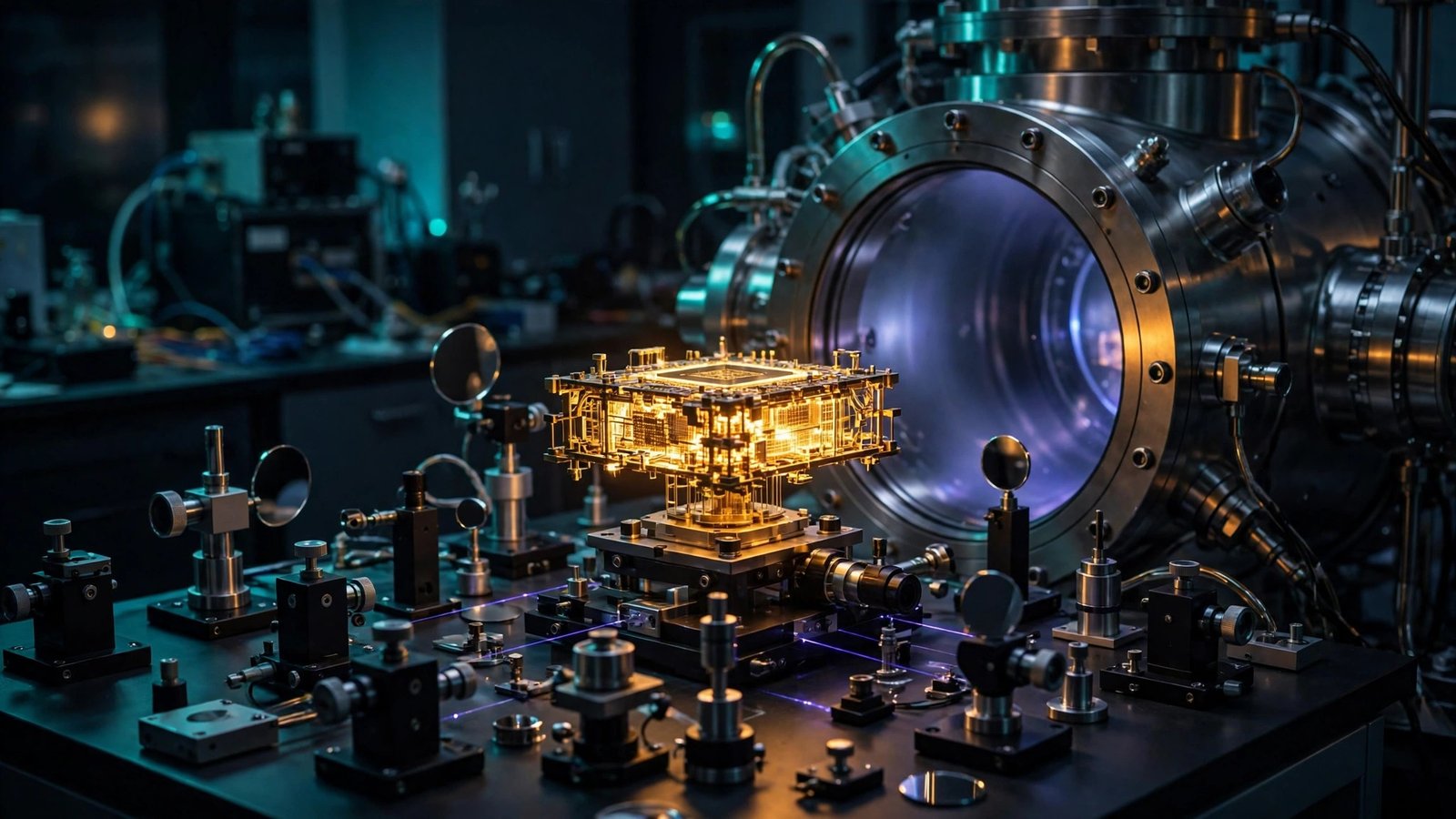
There are several competing ways to build a quantum computer, and two architectures currently dominate the race: superconducting qubits, the approach favoured by IBM and Google, and trapped ions. Universal Quantum is firmly in the second camp. Trapped-ion machines hold individual charged atoms in electromagnetic fields and manipulate them with lasers, a technique that has produced some of the most stable and accurate qubits demonstrated so far.
The challenge for every quantum hardware company is not proving that qubits work, but making thousands of them work together without errors. Small, noisy machines exist today. The industry’s goal is fault tolerance: error-corrected quantum computers able to run long calculations reliably, the kind that could outperform conventional supercomputers on commercially significant problems such as drug discovery, new materials and energy system design.
Universal Quantum’s answer is modularity. Rather than trying to cram ever more qubits onto one monolithic chip, the company builds smaller modules designed to be linked together. It points to its patented interconnect technology, described in company announcements as a world record in linking quantum modules, alongside advanced integrated chips that form the basis for chiplet arrays and control systems. The idea is to reduce engineering risk by making scale a question of connecting proven modules rather than redesigning the whole machine at every step.
Where the $100 million goes
According to the company’s announcement, the funding will do two things: accelerate development and commercialisation of the modular technology, and fund global expansion. The specifics sketch an ambitious growth plan.
A large share will go into the chip and control-system work needed to move from demonstration hardware toward systems built for real customers. Quantum companies live or die on engineering execution, and this round buys Universal Quantum years of that.
The geographic plans are equally telling. The company is establishing its first research and development centre outside Europe in Singapore, while also expanding in the United States, Japan and at its German hub in Hamburg. That is a lot of ground to cover for a 100-person company, and it signals that investors see quantum computing as a global supply-chain business, not a single-lab science project.
There is already evidence of commercial traction. According to industry reports, the company holds a contract worth around $77 million with Germany’s aerospace centre for modular trapped-ion systems, an unusually large customer commitment for a company at this stage. That figure has not been confirmed in the company’s own announcements, so it should be read as reported rather than verified.
What this round says about the UK quantum race
The Universal Quantum round lands in a busy year for British quantum hardware. Oxford Quantum Circuits closed a £260 million Series C in June, and Quantum Motion raised $160 million in May to scale silicon quantum computing. Together, the three rounds suggest institutional investors are moving from exploratory bets on UK quantum into conviction-sized cheques.
Analyst firm Gartner projects global quantum computing revenue of about $1.1 billion in 2027, up from roughly $870 million this year, and warns that more than half of today’s quantum startups could exit the market by 2030 if they fail to reach fault tolerance. Capital is concentrating on the companies investors believe can actually get there.
For Britain, the round feeds a bigger industrial-policy story. Universal Quantum’s growth is expected to support efforts to turn the Sussex and Brighton region into a major quantum technology cluster. The UK has produced world-class quantum science for decades; the open question has always been whether it can keep the companies that commercialise it.
Frequently Asked Questions
What is Universal Quantum building?
Universal Quantum is building large-scale quantum computers based on trapped-ion technology. Its approach is modular: smaller quantum processing modules are linked together into larger systems, with the goal of reaching fault-tolerant, error-corrected machines capable of solving problems beyond the reach of conventional supercomputers. The company spun out of the University of Sussex in 2018.
Why does trapped-ion quantum computing matter?
Trapped-ion systems are among the most stable and accurate quantum hardware demonstrated to date, because individual atoms can be isolated and controlled with high precision. The approach competes with superconducting qubits in the race toward fault-tolerant quantum computing. The main challenge is scaling from hundreds of qubits to the thousands or millions needed for practical applications, which is exactly what modular architectures like Universal Quantum’s aim to solve.
When will Universal Quantum’s quantum computers be useful?
There is no confirmed public timeline for a commercially useful machine from Universal Quantum. The company says the new funding will accelerate development and commercialisation of its modular technology, and it has reported customer engagements including a large contract with Germany’s aerospace centre. Analysts broadly expect practical, error-corrected quantum computers to emerge over the coming years.




Post Comment