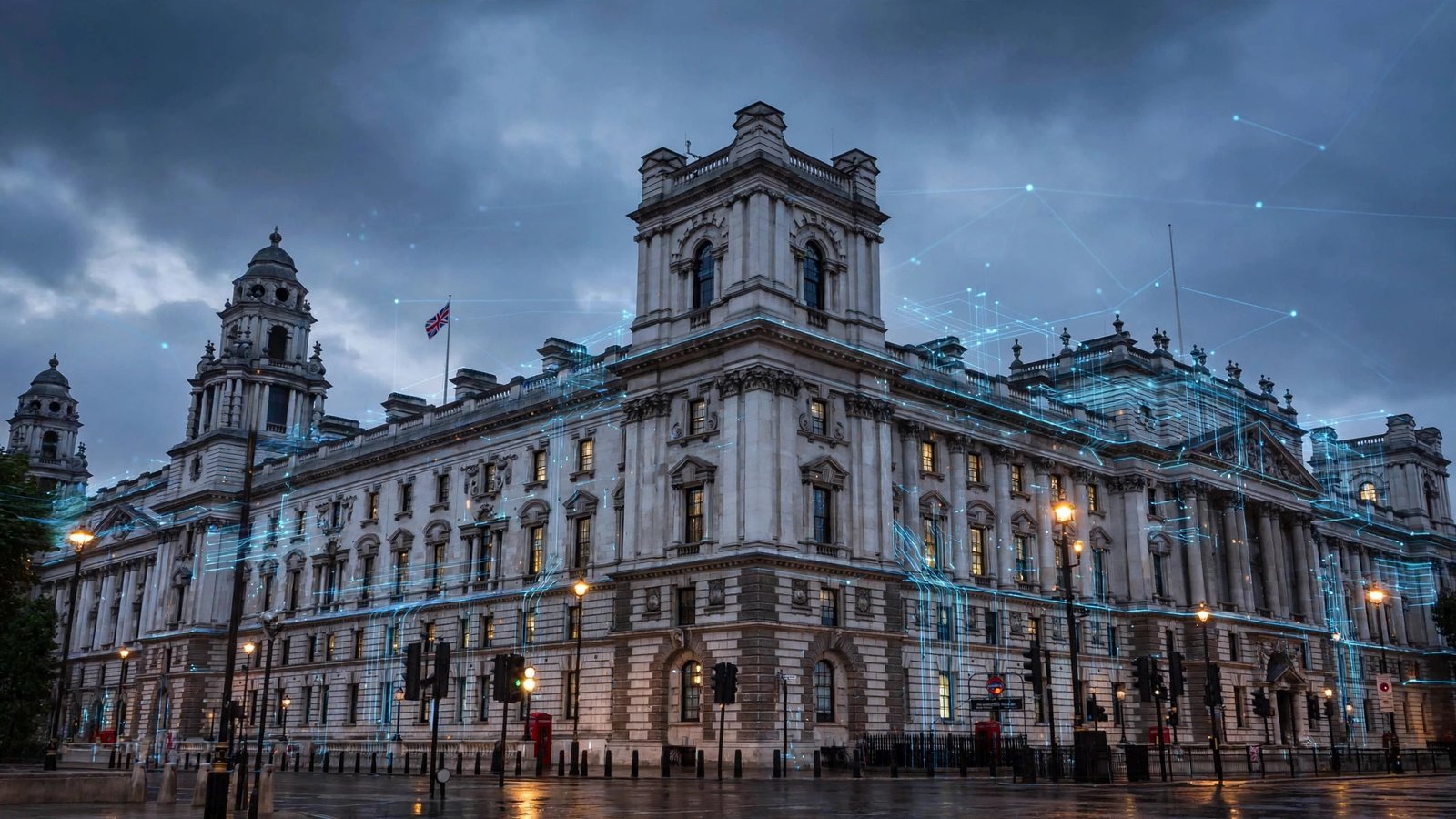
UK Government AI Tools Rely Almost Entirely on US Models, Raising Sovereignty Questions
The artificial intelligence tools used by the UK government rely almost entirely on models built by American technology companies, according to new findings from a freedom of information request. Ten of the eleven AI tools deployed or bought by the Cabinet Office use models developed by firms in the United States. The disclosure has reopened a debate about how much control Britain really has over the technology inside its own departments.
The request was made by Aventail, a UK artificial intelligence company, and the results were reported by Computer Weekly on 5 November 2026. While the models themselves are hosted in the UK, the design, the access terms and the pricing are all controlled by organisations based in the United States. For a government that has spent the past year talking about AI sovereignty, the numbers are awkward.
What the freedom of information request found
The Cabinet Office confirmed the details in its response to the request. Of the eleven AI tools it has deployed or purchased, ten run on models from Google, OpenAI, Microsoft or Anthropic. Those models are used either directly or through the cloud platforms Microsoft Azure and Amazon Web Services.
The only exception is PolyAI, a British company whose models serve the government's shared services provider, SSCL. Everything else traces back to one of four American firms.
Google Gemini is the primary authorised enterprise level generative AI tool, the Cabinet Office confirmed. Other tools in use include Hansard AI for parliamentary and legislative research, Minute for meeting notes and GCS Assist for government communications.
Joe Ward, the chief executive of Aventail, said the findings should worry anyone who cares about the resilience of public services. "Vital tools at the heart of government depend almost entirely on a handful of US companies," he said. "Hosting the data in the UK helps, but it does not change who controls the models, the pricing or the terms of access."
Ward supports the government's use of the latest American models. His concern is what happens if access to them is ever interrupted. "We risk building a house of cards if essential services depend on continued access to any one supplier," he said. "We need flexible infrastructure that lets public bodies switch providers, adopt new models and run open-weight alternatives under their own control when needed."
The continuity question
A second freedom of information request went to the Home Office, which manages the government's AI and technology supplier relationships. It asked for details of any business continuity plans, risk assessments or risk register entries that address an outage of, or loss of access to, those providers' services.
The government said the information does exist. It refused to disclose it, on the grounds that doing so would prejudice the prevention or detection of crime. The Cabinet Office said the material "contains details about the detection and prevention of crime which would assist criminals to plan and execute criminal acts and to avoid detection."
That answer tells the public two things at once: plans for coping with a loss of access do exist inside government, but the public cannot see them or judge whether they are good enough.
Why sovereignty is hard to achieve
The findings arrive as ministers talk more openly about control of AI. According to the Financial Times, ministers have agreed seven principles to guide AI adoption and infrastructure, with control and sovereignty among them. The gap between that ambition and the reality in the FOI response is the heart of the story.
Mark Lewis, a specialist IT outsourcing lawyer at Stephenson Harwood, questioned how the government could ever untangle itself from its current suppliers. "It is not just that they are all US, but there is a high concentration of the leading developers," he said. He added that the cloud infrastructure behind them is American too.
Lewis pointed out that the lock-in risk in AI mirrors what happened with cloud computing, where customers found it hard and expensive to move between providers once they were settled. "AI labs locking in customers is exactly the same as we saw with the cloud," he said.
He added that the government may have protected itself better than the figures suggest. "What we do not know, in fairness to the UK government, is whether they have managed to do smart commercial deals," Lewis said. "But, bluntly, given what we know about UK government procurement, it is hard to imagine that the UK government would be in a strong position. But we do not know, in fairness."
What happens next
The disclosure adds pressure on several fronts. The UK's AI minister, Kanishka Narayan, has already warned technology companies not to release AI systems they cannot control, and the government is preparing amendments to the long awaited Cyber Security and Resilience Bill. That bill is expected to include measures covering serious AI incidents and the reporting of near misses.
The government is also exploring stronger protections for essential services such as hospitals and utilities, and the National Cyber Security Centre and the AI Security Institute are working together on ways to respond to incidents involving agentic AI systems. None of that changes the basic fact the FOI request exposed: the tools still come from a small group of American suppliers.
For now, the practical question is whether the government can build the flexibility Ward called for: contracts that allow departments to switch providers, open-weight models that run under government control, and procurement rules that treat dependence on one supplier as a risk to manage. Until that happens, the house of cards warning will keep coming back.
Frequently Asked Questions
How many of the UK government's AI tools use American models?
Ten of the eleven AI tools deployed or bought by the Cabinet Office use models developed by US firms: Google, OpenAI, Microsoft or Anthropic, used directly or through Microsoft Azure and Amazon Web Services.
Which AI tool is the main one used across the Cabinet Office?
Google Gemini is the primary authorised enterprise level generative AI tool, the Cabinet Office confirmed. Other tools in use include Hansard AI for parliamentary and legislative research, Minute for meeting notes and GCS Assist for government communications.
Does the government have a backup plan if it loses access to these AI providers?
The government told the freedom of information requester that business continuity plans and risk assessments on this point do exist. It refused to disclose them, saying that releasing the details would prejudice the prevention or detection of crime, so the public cannot judge how robust those plans are.





Post Comment