Sydney Wants AI to Watch Its Street Cameras for Unusual Behaviour, Without Facial Recognition
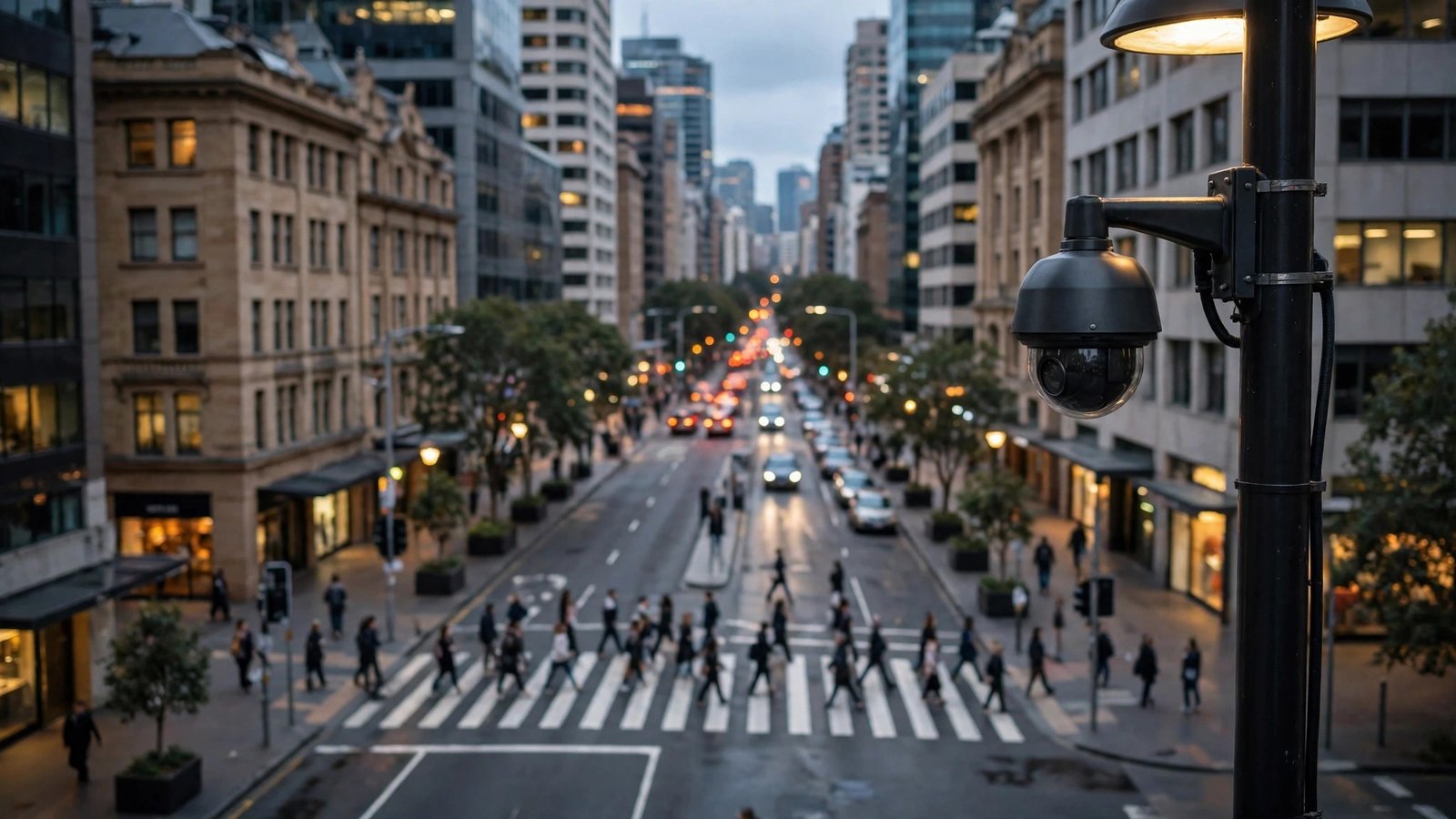
Sydney could soon let artificial intelligence help watch its street cameras. The City of Sydney has drafted an updated code of practice for its Street Safety Camera Program that would allow AI software to alert operators to unusual behaviour in CCTV footage. The program runs more than 100 cameras across the city around the clock, according to October council papers obtained by news.com.au.
The draft does not propose facial recognition. In fact, it states plainly that the technology will not involve biometric identification systems, including facial recognition. That line matters, because it draws a boundary around what the system can do: it can flag behaviour and help search footage, but it cannot identify a person by their face.
What the AI would actually flag
Under the draft, the AI would sit either inside the camera system or as add-on software on top of it. Its job would be to spot specific events and draw them to the attention of a human operator. The examples in the papers are practical rather than futuristic: a person leaving or removing an object, a vehicle travelling in the wrong direction, or a crowd that suddenly gathers or runs.
Those are the kinds of moments a control room operator might miss when dozens of feeds are running at once. A bag left on a footpath, a car heading against traffic, or a crowd that breaks into a run can all signal that something needs a closer look. The AI would act as an extra set of eyes, not as a decision maker.
A council spokeswoman said the draft would allow the city to procure AI-supported software that can help identify public safety risks in CCTV footage. She added that a staff member would still need to view and verify what is happening before taking action. That human check is the key safeguard in the proposal: the software raises the alert, and a person decides what happens next.
Search tools are part of the plan too
Alongside live alerts, the draft includes search tools that would let operators look back through footage using descriptive features. Those features include sex, age, clothing colour, hair colour, bags, and vehicle type and colour.
In practice, that means an operator searching for a missing person or a vehicle of interest could narrow footage by what someone was wearing or what kind of car was involved, rather than watching hours of video from the start. It is a capability that already exists in some modern camera systems, and it is often pitched as a way to find relevant footage faster after an incident.
This is also where the debate is likely to focus. Supporters will say descriptive search helps police and council staff respond faster and with less guesswork. Critics will ask how these categories are defined, how accurate they are, and what happens when the software gets a description wrong. Age and sex estimation from video, for example, is far from exact, and a wrong label could send an investigation down the wrong path or draw attention to the wrong person.
Why the facial recognition exclusion matters
The explicit exclusion of facial recognition sets Sydney’s draft apart from some overseas systems that scan crowds against watchlists in real time. By ruling out biometric identification, the council is signalling that it wants behaviour detection and footage search, not identity matching.
That distinction will matter in public consultation. Privacy advocates tend to treat facial recognition as a red line because it links a face to an identity without consent. Behaviour detection raises different questions: what counts as unusual, who defines it, and how often does the system cry wolf. A system that flags every fast-moving crowd could flood operators with false alarms, while a system tuned too conservatively might miss the events it was bought to catch.
The draft also raises questions that the papers alone do not answer. How long is footage kept? Who can request a search, and is each search logged? What testing has been done on accuracy across different lighting conditions, crowds, and times of day? Those details usually sit in the full code of practice and in procurement documents, and they are exactly the kind of thing residents can ask about when the draft goes on public exhibition.
What happens next
The proposal will be placed on public exhibition before any final decision is made. That is the point at which residents, businesses, privacy groups, and police can read the draft in full and lodge submissions. The council will then weigh that feedback before deciding whether to adopt the code, change it, or drop parts of it.
For now, nothing has changed on the street. The cameras already operate, and the draft is a proposal for how AI could be added to the existing program. The timeline for exhibition and a final decision has not been spelled out in the reporting so far, so the next concrete step to watch is the publication of the draft itself.
Sydney is not the first city to consider this kind of technology, and it will not be the last. What makes this draft worth watching is the balance it tries to strike: AI that watches for behaviour and speeds up footage searches, with facial recognition explicitly off the table and a human required to verify every alert. Whether that balance holds up under public scrutiny will decide if the plan goes ahead, and in what form.
Frequently Asked Questions
Would the system use facial recognition?
No. The draft states that the technology will not involve biometric identification systems, including facial recognition. It would flag behaviour and support descriptive footage searches instead.
Who decides what happens after an AI alert?
A human staff member. According to the council, a staff member would still need to view and verify what is happening before any action is taken, so the AI raises alerts but does not make decisions.
When will a final decision be made?
The draft will go on public exhibition first, and a final decision will follow that consultation. No final adoption date has been reported yet.



Post Comment