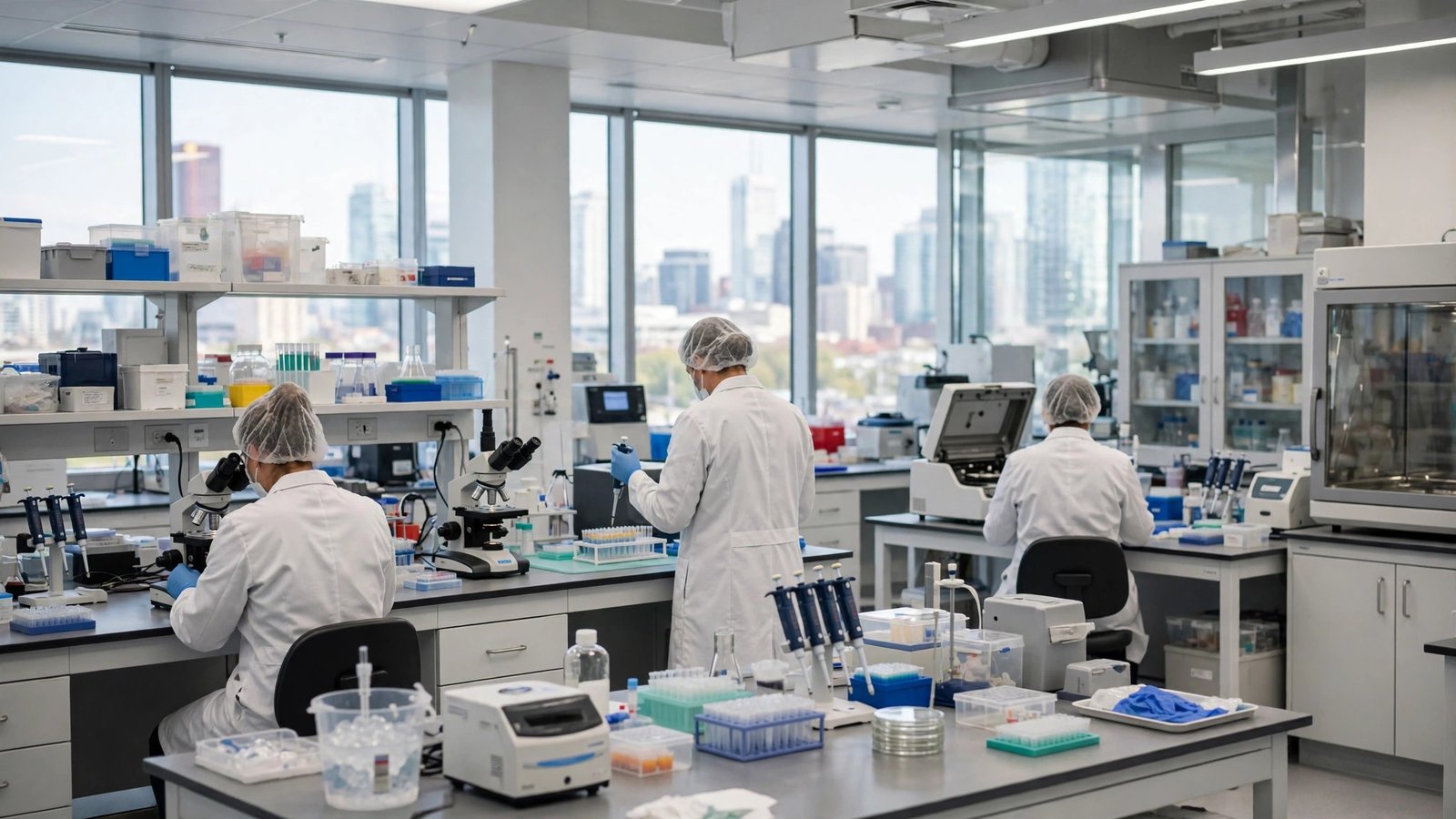
Specific Biologics Raises $35 Million to Advance Precision Gene Editing for Serious Genetic Diseases
Toronto has a new funding story in the life sciences world, and it is one worth watching. Specific Biologics, a Toronto based company working on a precision gene-editing platform for serious genetic diseases, has raised $35 million in Series A funding. The round was reported by FinSMEs on November 2, 2026, and it gives the company fresh capital to grow its team, expand its operations, and push its research and development work forward.
For readers outside the biotech world, a Series A round is an early but serious vote of confidence. It usually comes after a company has shown that its core idea works in the lab and now needs money to turn that idea into something that can be tested and scaled. The investors here focus on life sciences, which suggests they see real promise in the science.
What Specific Biologics does
Specific Biologics develops precision gene-editing therapies for serious genetic diseases. According to FinSMEs, the company is led by chief executive Brent Stead, and its work centres on a proprietary platform called Dualase.
The platform is designed to remove disease-causing DNA repeat expansions while preserving normal sequences. In plain terms, some genetic conditions are linked to stretches of DNA that repeat far more times than they should. Those extra repeats can disrupt how a gene works. Dualase aims to cut out the problem stretch in a targeted way, while leaving the healthy version of the sequence intact.
That distinction matters, because the practical challenge has always been precision: change the part that causes harm, and leave everything else alone. Specific Biologics says its approach delivers targeted DNA removal and repair, using either a single AAV delivery method or lipid nanoparticle delivered mRNA, two routes researchers use to carry gene-editing tools into cells.
The company has not, in the reporting reviewed, named specific diseases it plans to treat first, and this article does not guess at them. What is clear from the announcement is the direction of travel: a platform built around removing repeat expansions, with the goal of turning that science into therapies for people living with serious genetic conditions.
Who backed the $35 million round
The Series A round was led by Hatteras Venture Partners. Participation came from Lumira Ventures, adMare BioInnovations, Genesys Capital, the Business Development Bank of Canada Life Sciences Venture Fund, DeepWork Capital, and Seido Capital.
That investor list is notable for two reasons. First, it mixes Canadian and international life sciences investors, which is common when a company needs both local support and access to wider networks. Second, several of the participants focus specifically on early stage life sciences companies, so their involvement signals that the science has passed a level of scrutiny that goes beyond a good pitch deck.
FinSMEs reports that the company intends to use the funds to expand operations and research and development. The announcement does not disclose a valuation or a timeline for clinical work, so this article does not invent one. In practice, that expansion typically means hiring scientists and technical staff and growing lab capacity.
Why this round stands out in Toronto
Toronto has built a strong reputation in artificial intelligence and software, but its life sciences sector often gets less attention in mainstream tech coverage. A $35 million Series A for a gene-editing company is a reminder that the city research ecosystem covers far more than apps and algorithms.
Canada has deep research strengths in genetics and molecular biology, with universities and hospitals that train specialists and run long term studies. Companies like Specific Biologics sit where that academic research meets private investment, and a round like this keeps skilled researchers, and the jobs that follow, working in Canada.
The presence of the Business Development Bank of Canada Life Sciences Venture Fund also fits that picture. BDC supports growing Canadian companies, and its life sciences fund focuses on exactly this kind of early stage science.
What precision gene editing still has to prove
It is worth keeping expectations realistic. Gene editing has made enormous progress in the past decade, but turning a platform into an approved therapy is a long road. Researchers must show that an edit works reliably, that it reaches the right cells, that it does not cause unwanted changes elsewhere, and that the benefit lasts.
Repeat expansion diseases add their own complexity, since the problematic repeat can sit in different genes and tissues, and at different lengths from person to person. A platform that handles one repeat well still has to be adapted and tested for each condition it hopes to address.
For patients and families, the honest message is patience mixed with genuine interest. A $35 million round does not mean a treatment is around the corner, and no timeline should be read into this announcement. It does mean that a Toronto team working on a difficult problem now has the resources to keep going, with investors who understand how long this kind of science takes.
What comes next for Specific Biologics
The next steps to watch are practical ones: hiring announcements, research updates, and possibly new partnerships with academic or clinical groups. Any move toward formal studies in people would be a major milestone, and it would almost certainly be announced publicly.
For now, the story is a funding milestone, and it is a solid one. A Toronto gene-editing company has raised $35 million from a credible group of life sciences investors, led by Hatteras Venture Partners, to expand its operations and research. In a year when many startups have found fundraising harder, that is a result worth noting, and it puts Specific Biologics on the list of Canadian biotech names to follow.
Frequently Asked Questions
What is Specific Biologics?
Specific Biologics is a Toronto based biotechnology company developing precision gene-editing therapies for serious genetic diseases. It is led by chief executive Brent Stead, and its platform is called Dualase.
How much did Specific Biologics raise, and who led the round?
The company raised $35 million in Series A funding, according to FinSMEs on November 2, 2026. The round was led by Hatteras Venture Partners, with participation from Lumira Ventures, adMare BioInnovations, Genesys Capital, the Business Development Bank of Canada Life Sciences Venture Fund, DeepWork Capital, and Seido Capital.
What will the funding be used for?
According to the announcement, the funds will be used to expand operations and research and development efforts. No valuation or clinical timeline was disclosed in the reporting reviewed.



Post Comment