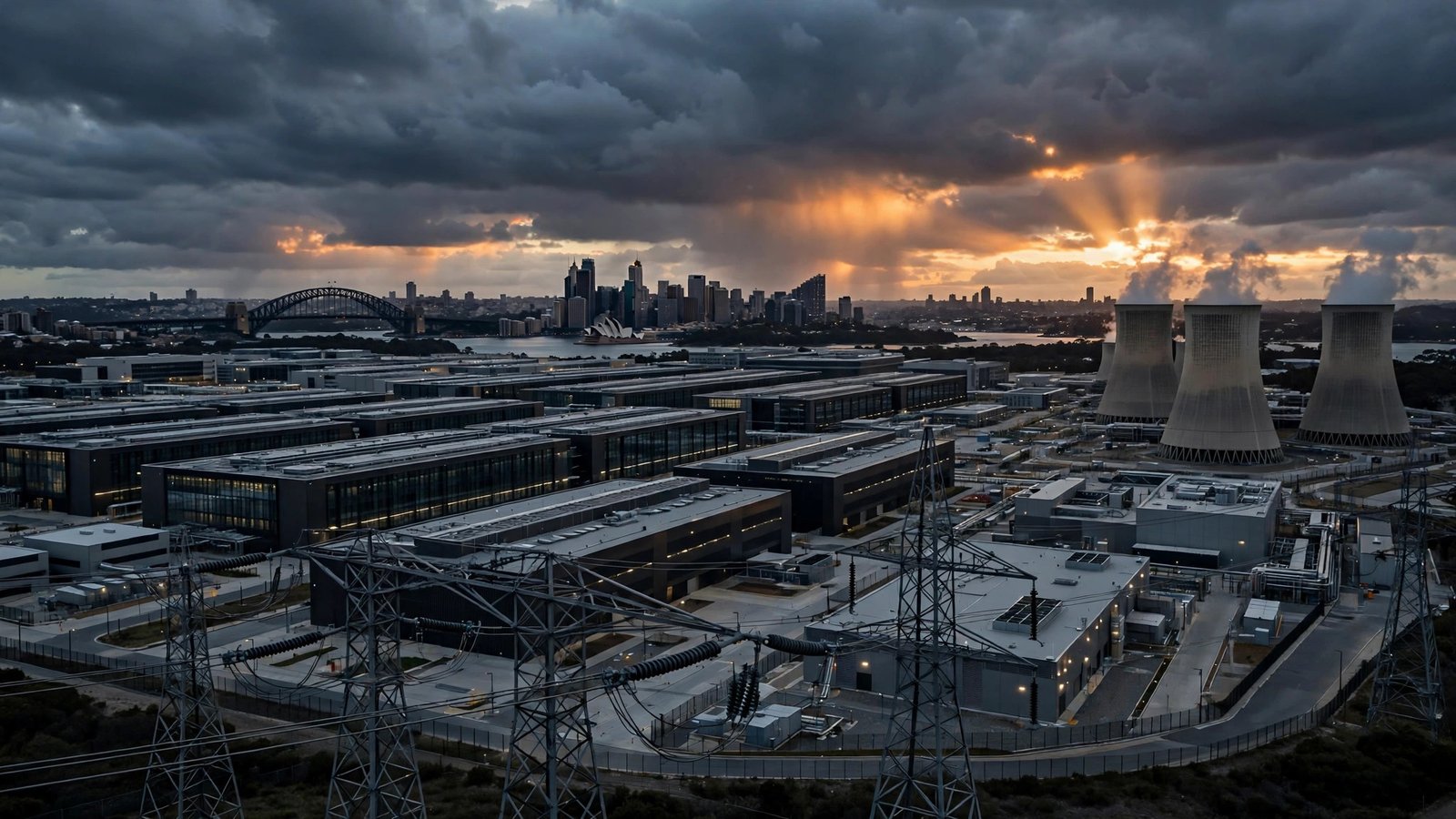
NextDC Just Shed A$3 Billion in a Day. What Australia’s Data Centre Crash Says About the AI Boom
On Wednesday, Australia's biggest data centre operator had its worst day on the stock market in 15 years. NextDC closed down 41.7 percent after cutting its revenue outlook and putting all new projects on hold. Roughly A$3 billion of market value disappeared in a single session, and the shockwave reached well past Sydney.
The day A$3 billion vanished
According to Reuters, NextDC shed nearly half of its market value on Wednesday, October 21, 2026, after cutting its revenue forecasts for the year ahead and halting future developments. The shares closed down 41.7 percent, wiping about A$3 billion from the company's market value in its worst day of trading since it listed in 2010.
NextDC was also the biggest loser on the broader ASX200 benchmark index, which itself closed up 0.16 percent on the day. That contrast matters. This was not a market-wide panic. It was a reckoning aimed squarely at one company, and at the assumptions holding up the AI infrastructure trade.
What went wrong in Melbourne
The trigger, notably, was not falling demand. It was electricity, or the lack of it arriving on time. NextDC said delays to electricity network upgrades at one of its major Melbourne projects would mean about A$140 million (roughly US$98 million) worth of contracted customer revenue would be deferred this financial year.
Read that carefully, because it is the whole story in miniature. The customers are signed. The contracts exist. The capacity is spoken for. But the power grid upgrades needed to energise the site have not arrived, so the revenue cannot be recognised yet. For a business whose entire product is ready-to-use computing capacity, a bottleneck like this cuts straight into the numbers investors actually trade on.
It also points to a structural problem the industry keeps running into. Data centres are power-hungry by design, and local grids are struggling to keep pace with the speed at which operators want to build. When a single grid delay can move A$140 million off your books, the power network stops being a background utility and becomes your biggest single risk.
The guidance cuts that rattled investors
Management responded to the Melbourne delay by cutting its forecasts hard. NextDC now expects net revenue of A$475 million to A$500 million in 2027, down from its prior outlook of A$615 million to A$640 million, excluding the affected M3 contracts. That is a cut of roughly a quarter at the midpoint.
The underlying earnings picture took a similar blow. The company cut its 2027 underlying EBITDA forecast, that is earnings before interest, taxes, depreciation and amortisation, to A$245 million to A$265 million, down from A$385 million to A$410 million. Both cuts exclude the M3 contracts tied to the delayed Melbourne project.
Investors did not wait for the fine print. The stock's 42 percent fall in a single session is the kind of move that says the market had priced in growth that no longer looks safe, and repriced it all at once.
Expansion is officially off the table
Perhaps more alarming for long-term shareholders than the guidance cut was what NextDC said about its future. The company will shelve all new development projects and land acquisitions for the foreseeable future. It will also evaluate capital recycling opportunities, including potential sales of selected development sites.
That is a company switching from expansion mode to defence mode. For the past two years, data centre operators have raced to add capacity on the bet that AI demand would keep climbing. Hitting pause on every new project is an admission that the pace of spending needs a rethink, and that investors will no longer reward building capacity at any cost.
Why this is about more than one company
Zoom out and the NextDC crash fits a pattern that has been building for weeks. Reuters reported that AI exuberance has given way to caution, dragging down data centre and technology stocks as investors reassess growth expectations and valuations. Sentiment has weakened as investors question whether massive AI spending can justify soaring computing, land and power costs.
The warning signs were already there. Just last week, a data centre IPO was withdrawn in Australia as investors pulled back from the sector. Credit investors are becoming increasingly selective toward AI-linked companies, which matters because many operators have funded their build-outs with heavy borrowing.
In Seoul, shares in South Korean AI firm Elice rebounded 30 percent on Wednesday after falling 32 percent on its trading debut the day before, reportedly the worst debut ever in Seoul for an IPO raising more than US$100 million. Across markets, the message is consistent: the easy phase of the AI infrastructure boom is over, and proof of cash flow now matters more than promises of future capacity.
What happens next
For NextDC, the immediate question is whether the Melbourne power delays stay contained to this financial year. Deferred revenue is not lost revenue, but markets have shown they will not wait patiently for it either.
For the broader sector, Wednesday's crash is another data point in a rethink that was already under way. AI demand has not disappeared, but the financial terms on which it gets built are changing. Operators that can fund themselves through operating cash flow will ride this out. Those relying on cheap credit and ever-rising share prices to finance the next campus may find the next few years much harder.
Frequently Asked Questions
Why did NextDC shares fall 42 percent?
NextDC cut its 2027 revenue and earnings forecasts after delays to electricity network upgrades at a major Melbourne project deferred about A$140 million of contracted customer revenue. It also shelved all new development projects and land acquisitions, which rattled investors and sent shares down 41.7 percent, wiping about A$3 billion off its market value.
How much revenue did NextDC guide for 2027?
The company now expects 2027 net revenue of A$475 million to A$500 million, down from its earlier outlook of A$615 million to A$640 million, excluding the affected M3 contracts. It also cut its 2027 underlying EBITDA forecast to A$245 million to A$265 million from A$385 million to A$410 million.
Is the NextDC crash a sign the AI boom is over?
Not exactly, but it signals that investors are repricing AI infrastructure stocks on cash flow rather than promises. AI demand continues, yet markets are questioning whether massive spending on data centres can be justified at current valuations. With a data centre IPO withdrawn in Australia last week and credit investors growing selective, the easy funding phase of the boom appears to be ending.


Post Comment