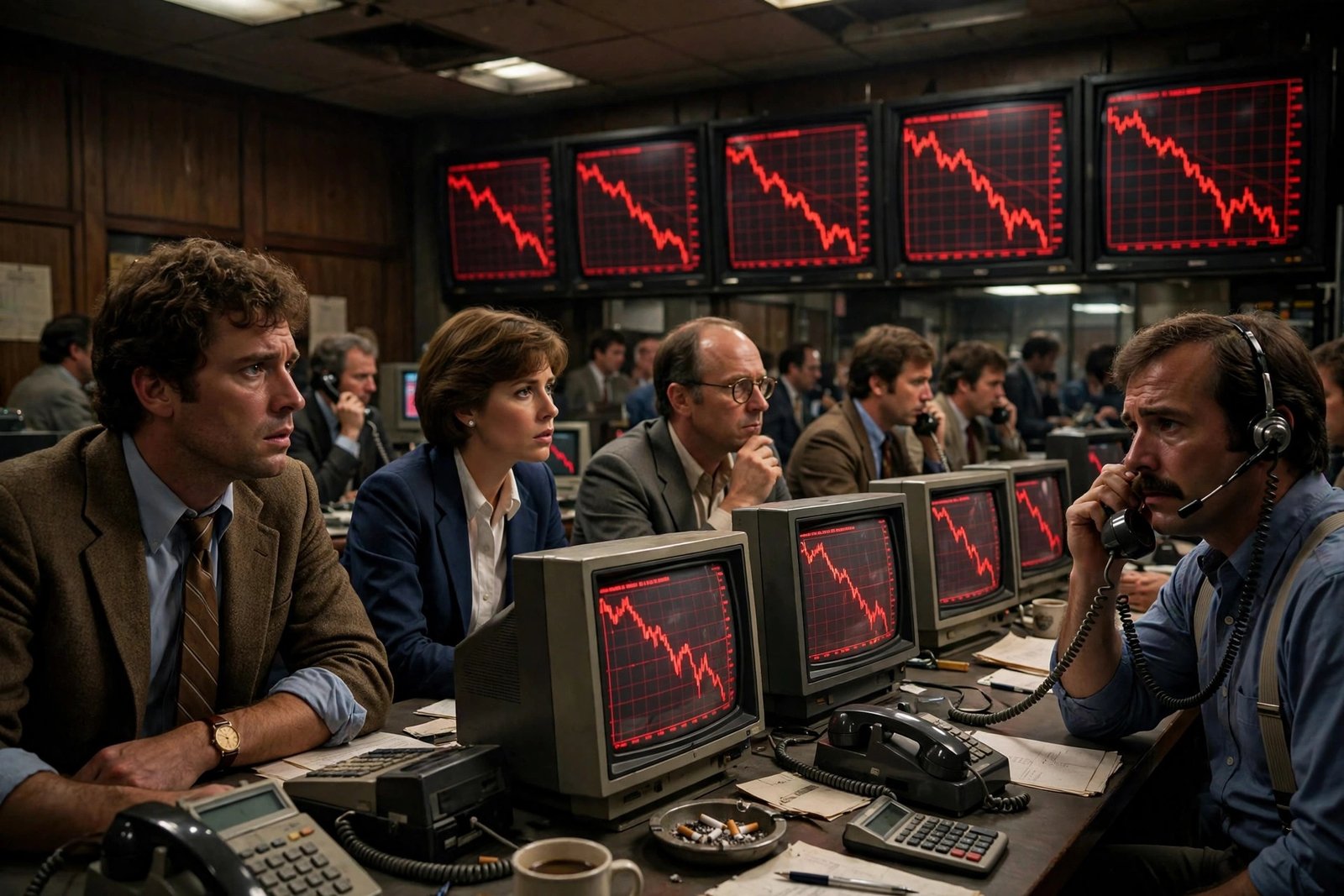
Black Monday at 39: What the 1987 Crash Teaches Us Today
Thirty-nine years ago today, the US stock market suffered its worst single day ever: on October 19, 1987, the Dow fell 22.6 percent in one session, erasing about $500 billion in value within hours. Right on schedule, "Black Monday" is trending on social media again ahead of today's open, with some voices warning history is about to repeat. Let's separate what actually happened in 1987 from what's different now, and take an honest look at the chatter. (This is a history explainer, not financial advice.)
What happened on October 19, 1987
The numbers are still startling. The Dow's 22.6 percent plunge remains the largest one-day percentage drop in its history, worse than anything in 1929, worse than the reopening after September 11, worse than any single day of the 2008 financial crisis. The S&P 500 lost 20.5 percent. The Nasdaq fell 11.4 percent.
The panic went global: Hong Kong closed its exchange for four days, then fell 33 percent in a single session when it reopened.
What made it frightening was the speed. No single piece of terrible news broke that morning; markets simply started falling and kept falling, with selling feeding on itself until the closing bell.
Why it happened is still debated
There was no single cause, which is itself the lesson. Rising tensions in the Persian Gulf had markets on edge. Fears of higher interest rates were building. The US trade deficit was a constant worry. And stocks had run hot for five years without a serious correction, leaving a lot of fragile optimism baked into prices.
The usual prime suspect is program trading, the 1980s ancestor of today's algorithmic trading. Computer-driven strategies sold automatically as prices fell; on that Monday they all sold at once, pushing prices down and triggering more selling, a feedback loop with no human able to hit pause.
What changed: the circuit breakers
Regulators drew a clear lesson: markets need a pause button. US exchanges introduced circuit breakers in 1988, and they still operate today, tied to the S&P 500.
If the S&P drops 7 percent before 3:25 pm Eastern, all US stock trading halts for 15 minutes. A 13 percent drop triggers a second 15-minute halt. A 20 percent drop stops trading for the day. These sit alongside separate halts for sharp moves in individual stocks.
The logic: forced pauses break the feedback loop, giving humans time to assess and panic a chance to cool. Tested in real crises since, including 2020, the system doesn't prevent declines, but it blocks the mechanical cascade that made 1987 so violent.
Why 2026 is structurally different
Information moves instantly now. In 1987, many investors reacted to price moves they barely understood, with news arriving in fragments. Today's traders are drowning in data rather than starved of it, which changes how panics form and spread.
The Fed's crisis playbook is also established. In 1987 its liquidity promise was improvised; since 2008, repeated interventions have shaped market expectations for better and worse.
And program trading has evolved into something more sophisticated and more supervised. Modern algorithms still correlate under stress, and flash crashes still happen, but exchanges now have far more tools to detect and interrupt disorderly automated selling than anyone had in 1987.
None of this means markets can't fall hard. They can and do. It means the specific mechanics of Black Monday, an all-day unbroken cascade with no brakes, are much harder to reproduce.
An honest look at today's chatter
According to reports, this morning's trend is driven by weekend liquidations in tokenized AI stocks, high oil prices, and rising bond yields. Those are real pressures.
But anniversary-driven predictions have a poor track record, for a simple reason: calendars don't move markets. The 1987 crash came from specific conditions, fragile positioning, and mechanical feedback loops, not from the date. This social media ritual resurfaces nearly every October 19, and almost all of them have passed without incident.
There's a selection effect at work too. Crash predictions are loud and memorable when right, quietly forgotten the many times they're wrong. The accounts warning about a crash today were, in most cases, warning about one last month as well.
None of which means complacency is wise. High oil prices squeeze consumers, rising yields pressure valuations, and forced selling in speculative corners can spill into broader sentiment. A cautious investor can respect all of that without believing the calendar is destiny.
What 1987 actually teaches
The real lesson isn't "crashes happen on anniversaries." It's quieter than that.
First, crowding turns declines into crashes. In 1987 everyone was positioned the same way and tried to exit through the same door.
Second, structure matters more than sentiment. The circuit breakers didn't make investors calmer or smarter. They just changed the mechanics, and that was enough.
Third, the market recovered. Investors who held through the terror of October 1987 and stayed invested did fine over time, while panic selling at the bottom locked losses in permanently. That's history, not advice: your situation is your own.
Frequently Asked Questions
What happened on Black Monday 1987?
On October 19, 1987, the Dow Jones Industrial Average fell 22.6 percent in a single session, the largest one-day percentage decline on record. The S&P 500 dropped 20.5 percent, about $500 billion in US market value was erased, and Hong Kong's market fell 33 percent after a four-day closure.
What are stock market circuit breakers?
Circuit breakers are automatic trading halts introduced after the 1987 crash. In the US, a 7 percent S&P 500 decline triggers a 15-minute market-wide pause, 13 percent triggers a second pause, and 20 percent stops trading for the day. They are designed to interrupt panic-driven selling cascades.
Is the market going to crash today because of the anniversary?
Anniversary dates don't cause crashes; economic conditions and positioning do. While real pressures like oil prices and bond yields are being discussed, the "Black Monday" trend resurfaces nearly every October 19. This article is educational only and not financial advice.

Post Comment