Canada Just Handed Xanadu $195 Million to Build Quantum Computers Out of Light
—
title: "Canada Just Handed Xanadu $195 Million to Build Quantum Computers Out of Light"
meta_description: "Canada backs Toronto's Xanadu with CAD $195M for a quantum manufacturing hub, alongside a GlobalFoundries deal to industrialize photonic quantum chips."
focus_keyword: "quantum computing"
category: "Business"
—
Canada has written one of the largest cheques in quantum computing history. In August, the federal government signed a definitive agreement worth CAD $195 million with Xanadu Quantum Technologies, a Toronto company building quantum computers that run on light instead of electricity. Then in October, Xanadu announced a multiyear manufacturing partnership with GlobalFoundries to bring its photonic chips into real commercial production. Together, the two moves mark Canada's clearest statement yet that it wants to own the quantum supply chain, not just research it.
The $195 million bet on light
Xanadu is a Toronto-based quantum computing company founded in 2016. Unlike most quantum efforts, which cool superconducting circuits to temperatures colder than deep space, Xanadu uses photons, particles of light, as its qubits.
The CAD $195 million comes through the federal Strategic Response Fund, administered by Innovation, Science and Economic Development Canada. It formalizes the full federal portion of support announced back in March 2026 for what Xanadu calls Project OPTIMISM, with potential total federal backing of up to CAD $390 million. The full project, including private capital, is valued at roughly CAD $893 million.
From a Toronto lab to a 158,000-square-foot factory
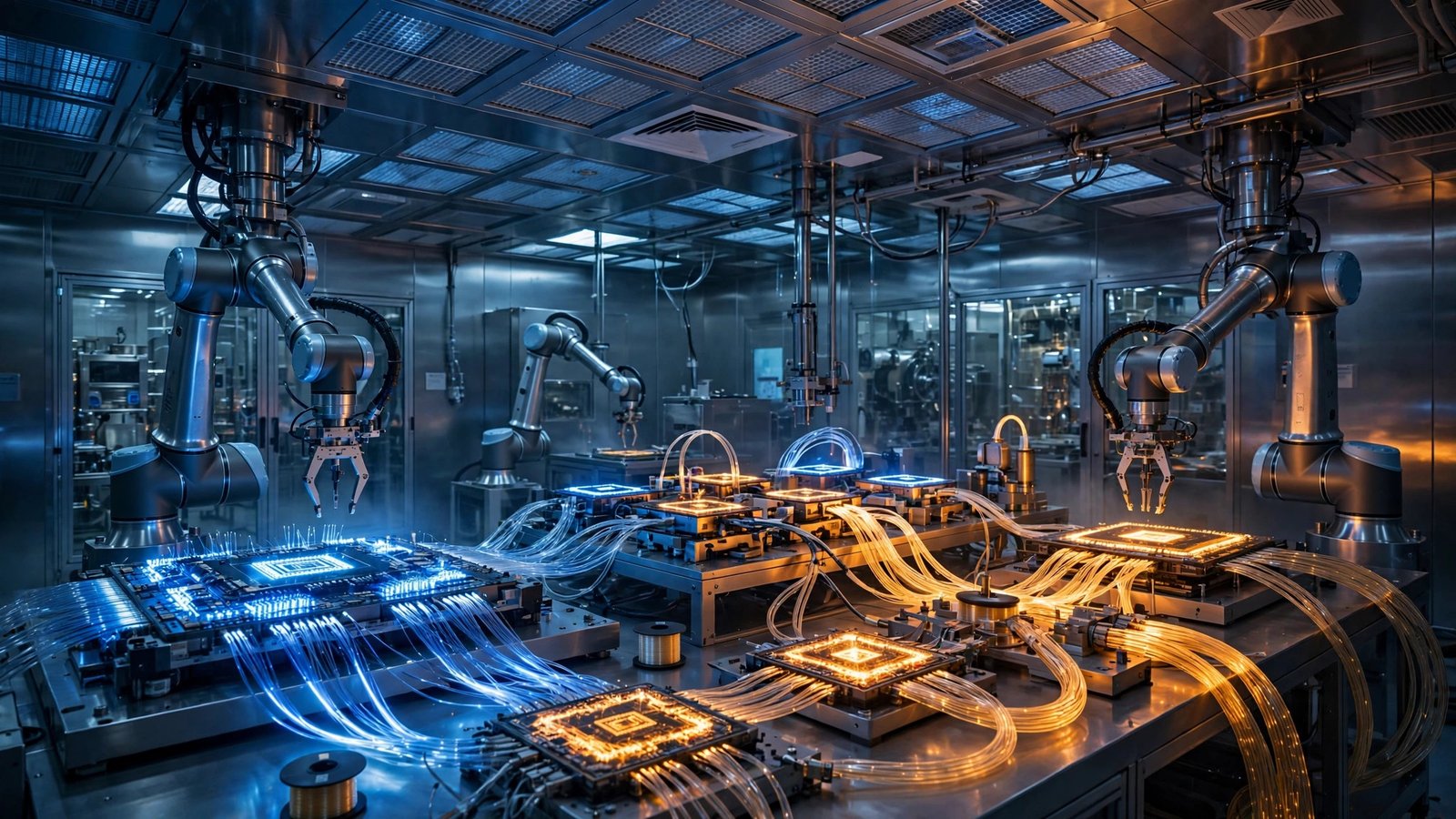
The money is not going into research papers. Xanadu plans to use it to build "Inception," a 158,000-square-foot advanced photonics research, development and manufacturing facility in Toronto, alongside a separate site for testing, chip integration and rack-level module assembly.
The idea behind Inception is vertical integration. Quantum computers capable of solving commercially valuable problems cannot be built from off-the-shelf parts, according to the company. Inception would bring chip integration, photonic packaging, wafer-level testing and quantum module assembly under one roof, giving Xanadu a path from chip to full system.
The project is expected to create 275 direct jobs, and Xanadu has already lined up tooling partners for the effort, including a multimillion-dollar collaboration with Bluefors on cryogenic cooling for its photon detectors. As of June 30, 2026, the company reported capital resources of approximately $686 million, so the federal money lands on top of a substantial private war chest.
The GlobalFoundries deal: quantum chips go industrial
If the federal funding built the factory, the October 6 announcement gave it a customer path. Xanadu signed a multiyear partnership with GlobalFoundries to industrialize its ultra-low-loss silicon nitride photonics and superconducting nanowire single-photon detectors on GlobalFoundries' 300mm line in Malta, New York.
This matters because it moves Xanadu from bespoke lab fabrication toward industrial-scale chipmaking. Producing exotic quantum chips on a commercial semiconductor line, with real yield management and volume, is the challenge every quantum company eventually has to solve.
Investors liked the signal. Xanadu's shares rose about 17 percent on the announcement day, while GlobalFoundries shares gained roughly 1.4 percent. In an interview with EE Times around the same time, Xanadu chief operating officer Rafal Janik described the company's approach as a holistic one, with hardware and software development running in parallel rather than as isolated problems. He said the company had solved the networkability and modularity side of its architecture but still needed to improve performance before large-scale deployment, a refreshingly honest admission in an industry known for big promises.
Why photons, and why it is still hard
The pitch for photonic quantum computing is simple enough to state. Photons are relatively easy to generate, they work at room temperature in the computing part of the system, and light is the natural medium for networking quantum processors together. That last point matters: the most practical path to a large quantum computer may be to wire many smaller modules together with light rather than build one giant chip.
The hard parts are just as real. Single-photon detectors still need cryogenic cooling, which is why Xanadu is working with Bluefors on compact, manufacturable cooling modules. Manufacturing photonic chips with low enough optical loss for fault-tolerant operation is a precision problem, not a solved one. Quantum roadmaps also have a long history of slipping, and big government investments do not compress physics. But the manufacturing focus is a genuine shift in the conversation: the industry is starting to be judged on supply chains and production, not just lab results.
Canada is quietly building a quantum cluster
Xanadu is not a one-company story. Canada has become one of the densest quantum ecosystems in the world. Photonic Inc., based in British Columbia, reportedly raised a $200 million US round in May 2026 at a valuation around $2 billion. Nord Quantique, spun out of Sherbrooke in 2020, reportedly raised $30 million led by Fidelity in May at about a $1.4 billion valuation. D-Wave, founded in British Columbia in 1999, remains one of the oldest names in the field.
Xanadu, Photonic and Nord Quantique have all reportedly advanced to Stage B of the US DARPA Quantum Benchmarking Initiative, a sign that American defense evaluators take their roadmaps seriously. That also raises the obvious question of whether US money eventually pulls these companies south. Ottawa's answer, at least for Xanadu, is a $195 million reason to stay.
What happens next
The near-term milestones are concrete enough to watch. Xanadu's next hardware iteration and the ramp of the Inception facility will tell us whether the manufacturing bet is working, and the GlobalFoundries production line will show whether photonic quantum chips can be made at industrial yields. Canada has decided that quantum computing is infrastructure worth owning. $195 million will not buy a working fault-tolerant quantum computer. But it might buy the factories that build one.
Frequently Asked Questions
When will Xanadu's quantum computers actually be ready?
The company has not announced a firm commercial launch date for a fault-tolerant machine. Its public focus right now is on manufacturing capability: the Inception facility in Toronto and the GlobalFoundries production partnership. Timelines for working systems measured in years, not months, remain the realistic read.
Why is Canada investing so much in a single quantum company?
Ottawa frames it as economic sovereignty and jobs, with 275 direct positions tied to the project. Canada hosts one of the world's strongest quantum research ecosystems, but critics have long said the country lacked growth-stage funding for companies trying to scale. The $195 million commitment is the government's answer to that gap.
What does the GlobalFoundries partnership mean?
It moves Xanadu's photonic chip technology onto a commercial 300mm semiconductor production line in Malta, New York. Instead of hand-building prototype chips, the company gets access to industrial manufacturing, yield management and volume production. Investors treated it as a major de-risking event, pushing Xanadu shares up about 17 percent on announcement day.



Post Comment