230 Megawatts in the Outback: NVIDIA’s DSX Pod Brings the AI Factory Race to Australia
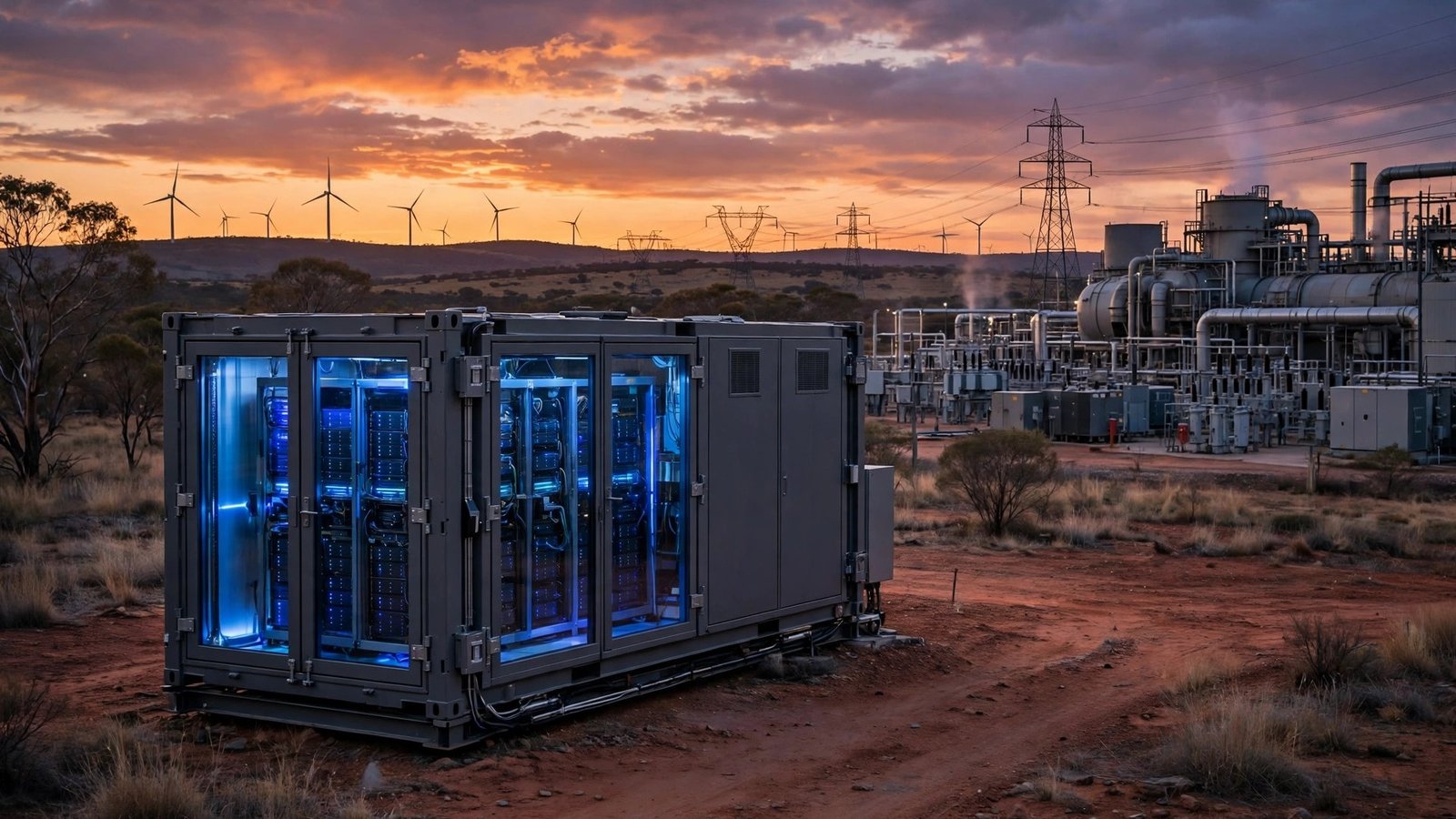
The next Australian AI data centre might not look like a data centre at all. It might look like a shipping container, factory tested and dropped beside a power station in regional Australia, generating tokens within a fortnight. That is the vision Australian infrastructure company WinDC is backing, after NVIDIA selected its US partner Armada to help deliver a new generation of AI factories worldwide.
WinDC says it is preparing to deploy 230 megawatts of AI computing capacity across regional Australia during 2027, built around NVIDIA’s DSX Pod, unveiled at GTC Berlin for complete, containerized AI factories running on NVIDIA’s next generation Vera Rubin architecture.
What NVIDIA actually announced
At GTC Berlin on October 21, 2026, NVIDIA chief executive Jensen Huang introduced the DSX Pod as a blueprint for AI factories that are built, tested and shipped ready to operate. Each pod packages NVIDIA Vera Rubin systems with networking, rack power distribution and liquid cooling inside a modular container. Partners assemble and validate everything in a factory, so months of on site cabling, piping and testing move into the supply chain.
According to NVIDIA, that shift could cut deployment at a prepared site from roughly six months to as little as 14 days. Reporting on the announcement, including coverage by The Register, described a reference configuration with seven liquid cooled Vera Rubin NVL72 racks, adding up to 504 GPUs, with 17 kilometers of Spectrum-X cabling preinstalled. The timing claim comes from NVIDIA and has not been independently verified, and it covers only the installation phase, not planning, permitting or power infrastructure.
Where WinDC and Armada fit in
Armada, the US company NVIDIA named among the select group delivering the DSX Pod ecosystem, builds its standardized factories inside what it calls Galleon Forge facilities. Armada co founder and chief executive Dan Wright said the pod lets the company skip the wait that normally comes after chips arrive. “Companies and nations can have the chips, the land, the power, and the ambition, and still be told to wait years for a building,” he said. “We build the SI factory in one of our Galleon Forge factories, ship it, connect it, and our customers are generating tokens in months, on infrastructure they own and control.”
WinDC acts as Armada’s Australian partner, supplying the sites, power and local operations. Under the model, customers provide their own NVIDIA hardware, Armada supplies the modular factories, and WinDC handles the land, power infrastructure and operations around them.
Founded in 2019, WinDC commissioned its first Armada unit in January and announced an initial 11 megawatt program in March. The 230 megawatt target for 2027 would be a substantial expansion from that starting point, if delivered at scale.
Why regional Australia is the point
The most interesting part of WinDC’s strategy is where it wants to put the containers. Rather than concentrating capacity around traditional metropolitan data centre hubs, the company is advancing a national portfolio of regional sites close to existing power generation.
The reasoning is practical. WinDC’s model connects behind the meter at the point of power generation, using electricity available directly from generation sites rather than relying on new grid connections. That could reduce dependence on lengthy grid connection queues while putting electricity that might otherwise go unused to work.
WinDC founder and chief executive Andrew Sjoquist framed it plainly: “The race is won on time to power. WinDC and Armada skip the grid queue and build compute at the energy source, delivering capacity across Australia in months, not years.”
Sovereign compute is becoming a national talking point
The announcement lands in a broader moment for AI infrastructure politics. Governments around the world are waking up to the idea that whoever controls computing capacity controls a layer of economic power. Armada styles itself as a leader in what it calls sovereign SI infrastructure, and Johnson Controls announced separately at GTC Berlin that it plans to build 500 megawatts of distributed sovereign SI capacity with Armada in 2027.
Australia has abundant land and energy and research institutions hungry for compute. What it has historically lacked is large scale domestic infrastructure for training and running frontier AI models, which has meant Australian businesses renting capacity from overseas clouds.
A 230 megawatt program would not, on its own, put Australia alongside the largest AI infrastructure markets. But 230 megawatts of locally available, modern infrastructure would be a meaningful step, particularly if it arrives in 2027 rather than the back half of the decade.
What could go wrong
Plans and deliveries are different things. The 230 megawatt figure is a target, and WinDC said further details on its regional sites and the 2027 rollout will be released as the program advances. Site preparation, power availability and customer demand will decide how much of that number materializes.
There is also a competitive question. Prefabricated modular data centres are not new, and rivals are pursuing similar ideas. NVIDIA’s advantage is standardization: seventeen partners plan to start delivering DSX Pod units worldwide in early 2027, which could make this the reference approach for modular AI builds.
Still, the direction of travel is clear. The industry is moving from selling chips to selling complete factories, and Australia is positioning itself as a place where those factories can be built fast, close to power, and owned locally.
Frequently Asked Questions
What is the NVIDIA DSX Pod?
The DSX Pod is a reference design NVIDIA unveiled at GTC Berlin in October 2026 for complete, factory built AI factories. It packages NVIDIA Vera Rubin computing systems with networking, power distribution and liquid cooling inside modular containers. Partners assemble and validate the units in a factory, then ship them to a prepared site, where NVIDIA says deployment can take as little as 14 days.
Who is WinDC and what is it planning in Australia?
WinDC is an Australian infrastructure company founded in 2019 and Armada’s Australian partner for the DSX Pod program. It plans to deploy 230 megawatts of modular AI computing capacity across regional Australia during 2027, using sites close to power generation and connecting behind the meter to skip grid connection queues.
How is this different from a normal data centre build?
In a traditional build, racks arrive separately and months of on site work follow: cabling, piping, power and cooling integration, then functional testing. With the DSX Pod model, that integration and testing happens at the factory before shipment, and site work runs in parallel, which NVIDIA says can shrink a six month deployment to about two weeks.




Post Comment