Kevin Weil’s Warp Sciences Raises $215M to Bring Drug Chemistry Home With Robot Labs
Kevin Weil spent the last two years running AI for science at OpenAI. This week he stepped out of the browser and into the beaker. His new company, Warp Sciences, came out of stealth on October 22 with $215 million in funding to build robotic chemistry labs in the United States, according to reports from Bloomberg and TechCrunch.
The round was led by Lightspeed Venture Partners and values the company at $865 million including the new money. The pitch is straightforward: drugmakers currently send the most labor-intensive part of drug research overseas, and Warp wants robots to do that work on American soil, around the clock.
What Warp Sciences actually wants to automate
Warp is not trying to discover drugs. It is going after the slog that comes after a promising molecule is found, when chemists need to make hundreds or thousands of variations of it to improve how it works and cut down on side effects.
That step, known as lead optimization, is slow, repetitive, and expensive. For years, biotech firms have outsourced it to contract firms in China, most notably WuXi AppTec, because of lower costs and faster turnaround. Warp’s first offering will center on exactly this process: analog synthesis of lead optimization compounds, made for pharmaceutical customers on a fee basis.
The company’s plan is to have experienced chemists do the work at first while robots and AI take over progressively. According to citybiz and Pulse2, payments will be tied to delivered compounds, and the long-term goal is labs where automated systems keep experiments running without breaks.
The data play hiding inside the lab
The most interesting part of Warp’s pitch is not the robotic arms. It is the gloves.
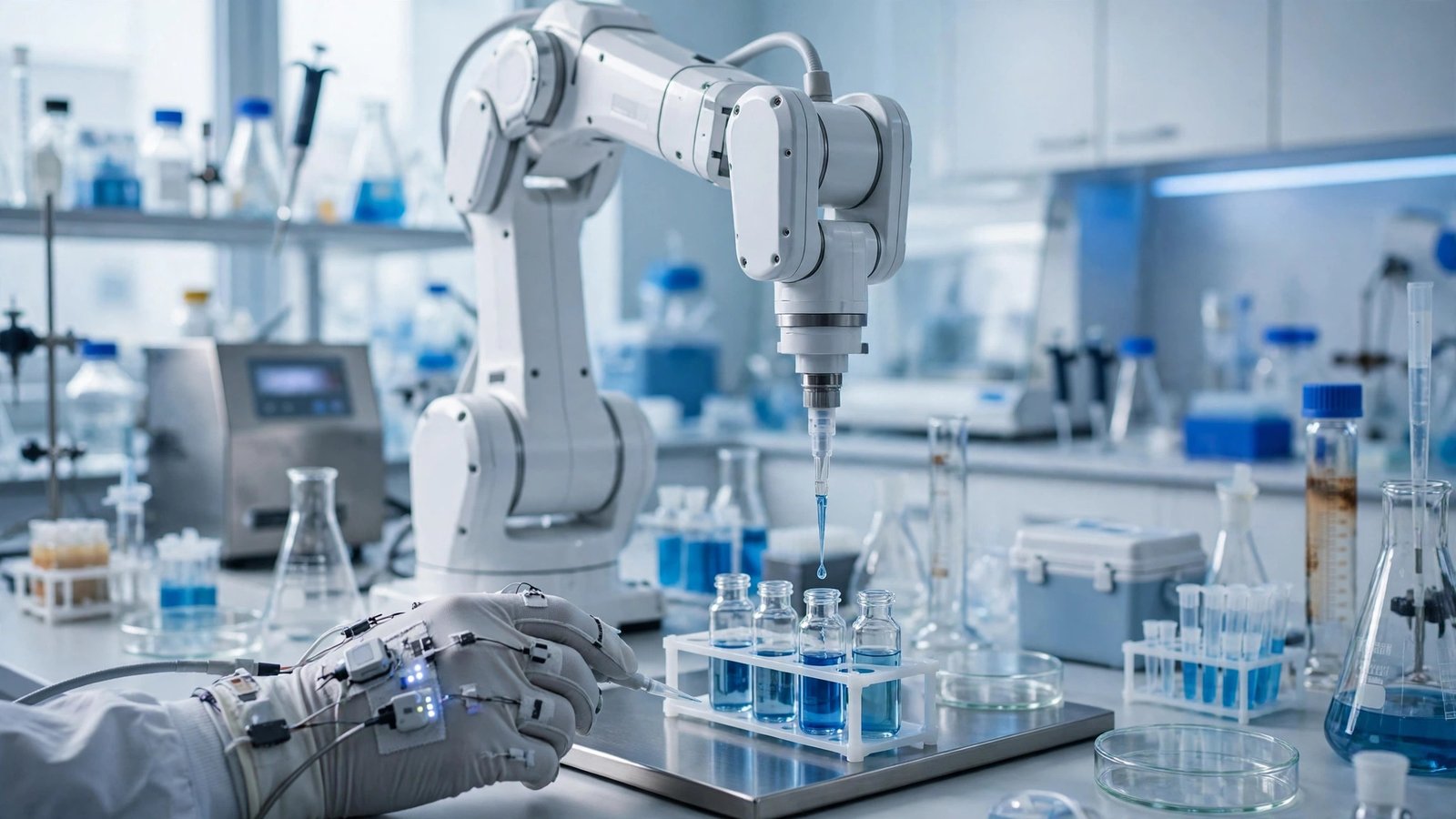
Human chemists at the company will wear cameras and pressure-sensing gloves while they work, so every experiment generates data. That data will be used to train Warp’s own AI models to figure out which molecules to make and how to make them.
This is a version of the lesson the whole AI industry keeps learning: models get better when they are fed real-world results, not just simulations. “Chemistry and biology move forward when you make something, test it, and learn from the result,” Weil said in a statement carried by citybiz. “If we want to build more capable AI for science, we need to generate real-world data at scale.”
The company has reportedly already bought robotic arms and AI chips, and it has a team of about 20 people. It has not said where the labs will be located or when it expects its first customers.
Why reshoring matters right now
Warp’s timing rides on more than AI hype. Depending on Chinese contractors for sensitive drug research has become politically uncomfortable in Washington.
In June, the Pentagon added WuXi AppTec to a list of companies it says are linked to China’s military. A federal judge blocked enforcement of that designation in August after WuXi sued, but the episode reminded pharmaceutical executives that supply chains can become geopolitical flashpoints overnight.
Weil told Bloomberg that some pharmaceutical companies are already worried about handing sensitive research data to contractors in China. Warp is betting that a domestic option will let customers protect their intellectual property while still getting molecules made fast. The company says it aims to compete on speed, cost, and IP protection all at once.
The people behind the pitch
Warp’s founding team reads like a networking event for people who run things. Weil served as chief product officer and science lead at OpenAI from 2024 to 2026, where he led the company’s AI-for-science initiatives, and earlier ran product and business at the satellite-imaging company Planet Labs.
His co-founders are Manohar Paluri, previously a vice president at Meta’s Superintelligence Labs; DJ Patil, who served as the first U.S. Chief Data Scientist in the White House; and Solomon Reisberg, formerly with Terremoto Biosciences, who takes the chief scientific officer role.
The cap table is just as decorated. Alongside institutional backers like IVP, Mayfield, Lux Capital, and Premji Invest, the round reportedly includes angel investments from Coinbase CEO Brian Armstrong, LinkedIn co-founder Reid Hoffman, Anthropic executive Mike Krieger, Figma CEO Dylan Field, Databricks co-founder Ion Stoica, OpenAI CFO Sarah Friar, and OpenAI Chief Research Officer Mark Chen.
What to watch next
Warp has not shipped a product, and automated chemistry is littered with demos that look great and scale badly. The company now has to prove it can run a contract lab that is actually faster and cheaper than the Chinese firms it wants to displace, while its AI genuinely gets smarter from the experiments.
If it pulls that off, the stakes go beyond one startup. Warp is a bet that the next chapter of AI is physical: not chatbots answering questions, but machines that make things, test them, and learn. Investors just paid $215 million for a seat at that table.
Frequently Asked Questions
What is Warp Sciences?
Warp Sciences is a San Francisco-based startup founded by former OpenAI science lead Kevin Weil. It is building AI-powered robotic chemistry labs in the United States to handle the labor-intensive synthesis work in drug discovery, currently worth $215 million in announced funding at an $865 million valuation.
Who invested in Warp Sciences?
The $215 million round was led by Lightspeed Venture Partners, with participation from IVP, Mayfield, Lux Capital, Premji Invest, Menlo Ventures, and others. Individual backers reportedly include Brian Armstrong, Reid Hoffman, Mike Krieger, Dylan Field, Ion Stoica, Sarah Friar, and Mark Chen.
Why does Warp Sciences want to reshore drug chemistry?
Biotech companies have long outsourced molecular synthesis to Chinese contractors like WuXi AppTec for cost and speed. Warp argues that geopolitical tensions, IP concerns, and supply-chain risks make a domestic, automated alternative attractive, and that AI can make U.S.-based labs competitive on cost.




Post Comment