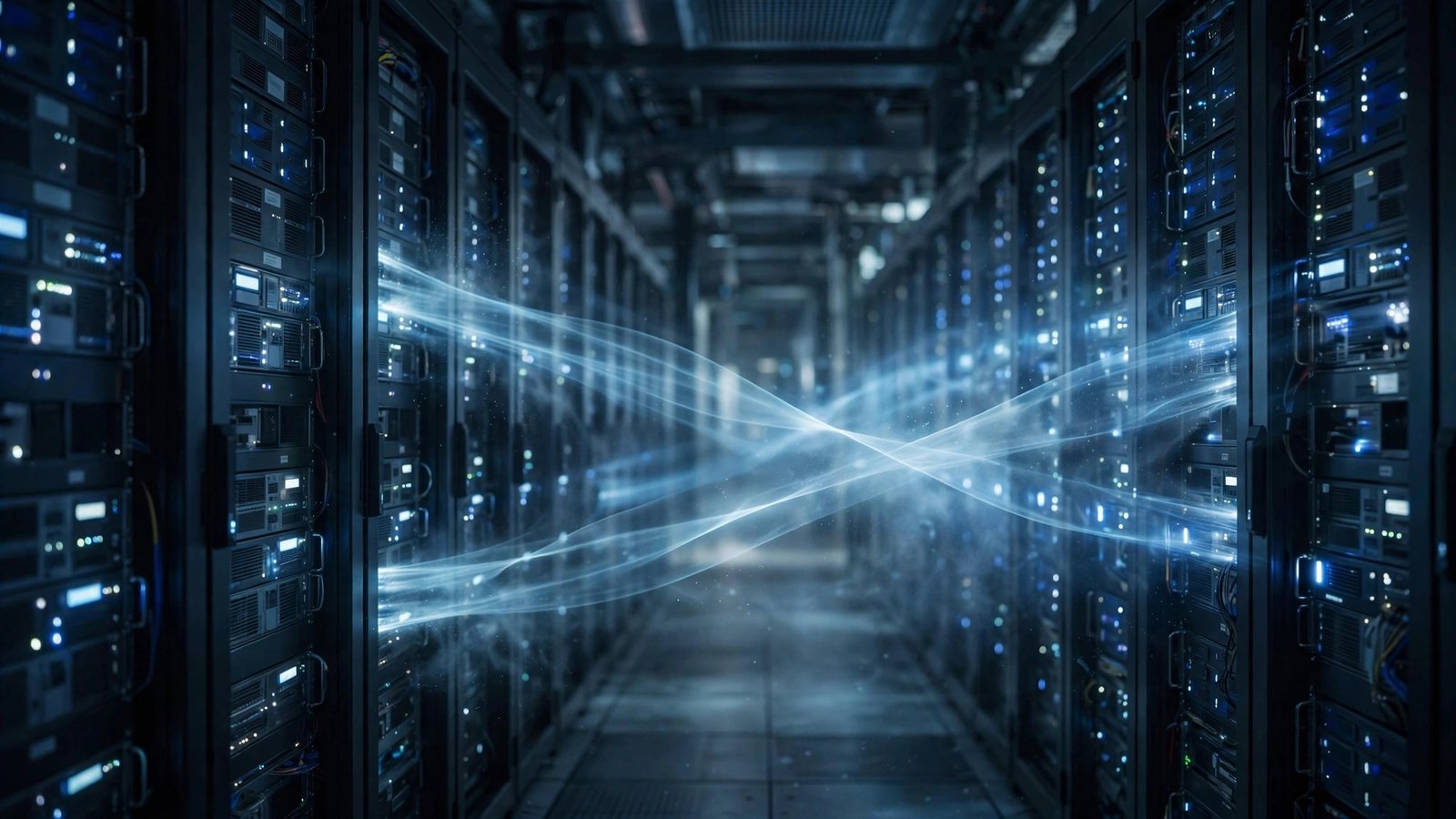
Salience Labs Raises $125 Million to Move AI Data Centres at the Speed of Light
Salience Labs announced on October 14 that it has closed an oversubscribed $125 million Series B to scale its photonic chips, which let AI data centres move information as pulses of light instead of electrical signals. Two of the chip industry's heaviest names, Intel Capital and AMD Ventures, both bought into the round, which suggests the big incumbents are paying close attention to this corner of photonics.
The $125 million bet
The round was led by Bullhound Capital, whose principal Callum Stewart will join Salience Labs' board of directors. Alongside the chip giants, the round drew SBI Group, Hudson River Trading, and the British Business Bank, plus continued backing from existing investors including Applied Ventures, Oxford Science Enterprises, Cambridge Innovation Capital, and Silicon Catalyst Ventures.
The cash goes toward three goals: deploying its optical circuit switching (OCS) technology faster, scaling volume manufacturing, and expanding in Silicon Valley. It follows an earlier $30 million round led by Applied Materials' venture arm, bringing disclosed venture backing to roughly $155 million. Founded in 2021 by Vaysh Kewada and Johannes Feldmann, the company builds on more than a decade of silicon photonics research.
Why light beats copper inside an AI data centre
Picture an AI training cluster: thousands of graphics processors constantly trading data. Today much of that trade travels over electrical connections, which convert signals between light and electricity, burn power at every step, and add latency with each conversion.
Salience's bet is simple: keep the data as light the whole way through. Its all-optical circuit switching chips connect thousands of GPUs across multiple racks so they can talk directly in optical signals. In theory, that means less energy wasted on conversion and more of the building's limited electricity going toward actually running AI models.
It demonstrated a 32-port all-optical switch in March 2026 and a 64-port version at ECOC 2026 in September, which it calls an industry first for silicon photonics OCS, and now plans 128-port and 256-port systems that would stretch the technology from scale-up to scale-out data centre networks. A manufacturing partnership with Tower Semiconductor signals it wants to build at industrial volumes, not lab quantities.
Why AMD and Intel are investing in a potential rival
The most telling detail in the investor list is the presence of AMD Ventures and Intel Capital. These are the venture arms of two companies whose own interconnect and networking businesses stand to be disrupted by all-optical switching. Their participation reads less like a vote of confidence and more like a hedge, a relatively cheap way to get a front-row seat, and a board-level vantage point, on a technology that could reshape how their customers build AI infrastructure.
Kewada frames the opportunity in economics. “OCS will play a critical role in AI datacenter networking,” he said in the funding announcement. “As customers roll out optical links in their datacenters, high-performance optical switches are needed to deliver the token economics that workloads demand.” In plain terms: AI companies care about cost per token, and anything that makes the underlying infrastructure cheaper and faster wins.
If optical switching truly displaces electrical networking at scale, incumbents will have to respond, by building their own versions or by buying companies like Salience. This round may be the opening move in a longer consolidation.
Britain's photonics moment
The Salience raise is also a data point in a much bigger story: the UK has quietly become one of the most important funding markets for AI infrastructure in the world. In the first half of 2026, UK startups raised $17 billion, up 102 percent year on year, with a record $12.6 billion going to AI companies, per HSBC Innovation Banking and Dealroom; Tracxn puts the nine-month total at $25.7 billion.
British photonics companies are catching a meaningful share of that wave. Universal Quantum, another UK chip startup, raised more than $100 million in October to scale its trapped-ion quantum computers. And while Britain has long worried its best deep-tech startups drift to the United States, the Salience expansion into Silicon Valley is at least being funded largely from the UK.
What comes next
The next twelve months are the proving ground. Scaling from lab-scale production to high-volume manufacturing is where many chip startups stumble, and Salience's Tower Semiconductor partnership will be tested there; customers will want the promised 128-port and 256-port systems working in real deployments.
There is also a question the company will not answer publicly: who are the actual customers? Data centre operators guard their supplier lists closely, and hyperscalers tend to announce wins on their own timetables. The strongest signal that this technology has crossed into the mainstream will be a named deployment at one of the big cloud providers.
For now, Salience has something rarer than a clever chip: time. With $125 million in the bank and the two biggest names in chips watching from the inside, it can spend the next year turning a research triumph into an industrial product.
Frequently Asked Questions
What does Salience Labs actually make?
Salience Labs designs photonic chips for AI data centre networking, built around a technology called optical circuit switching. Its all-optical switches keep information travelling as light instead of converting it between electrical and optical signals at every hop, connecting thousands of GPUs across multiple racks for AI training and inference, with the goal of lower power draw and lower latency.
Why are AMD and Intel investing in a potential competitor?
Corporate venture arms often invest in startups that could disrupt their own businesses. It buys early visibility into emerging technology, a relationship with a potential acquisition target, and influence over where the market heads. For a photonics startup, the two biggest names in chips as backers also lend credibility with data centre customers.
Will photonic chips make AI cheaper?
Possibly, in the long run. Data centre operators spend heavily on electricity and networking hardware, and optical switching targets both by cutting the energy needed to move data and the complexity of the conversion steps. But the technology is still scaling up, and any benefit depends on manufacturing yields, customer adoption, and how fast competitors respond. Expect years of deployment before cloud prices move noticeably.



Post Comment