Microsoft Walks Away From Nscale’s Essex AI Datacentre as the Grid Says No
Britain's biggest sovereign AI datacentre project just lost its anchor tenant, and the culprit is not demand, politics, or the price of GPUs. It is the electricity grid. Microsoft has ended its agreement to anchor Nscale's planned AI datacentre in Loughton, Essex, after the local grid operator warned that the site might not receive enough power until the early to mid-2030s, according to reporting by The Guardian and Reuters. Ministers had hailed the project in 2025 as the country's largest sovereign AI datacentre. Instead it has become the clearest example yet of the constraint the whole industry now faces: announced capacity means nothing without the megawatts to run it.
A flagship project hits the grid wall
Nscale, the British neocloud backed by Nvidia, announced the Loughton site in 2025 as a flagship for the UK's AI ambitions. The plan called for a 50-megawatt campus that could scale to 90 megawatts, built with liquid cooling for high-density GPU deployments. In September 2025, the company announced an agreement with Microsoft to deploy 23,040 Nvidia GB300 GPUs at the facility, with delivery scheduled for the first quarter of 2027 to power Azure cloud services across the UK. A separate initiative, Stargate UK, was announced involving Nscale, OpenAI and Nvidia.
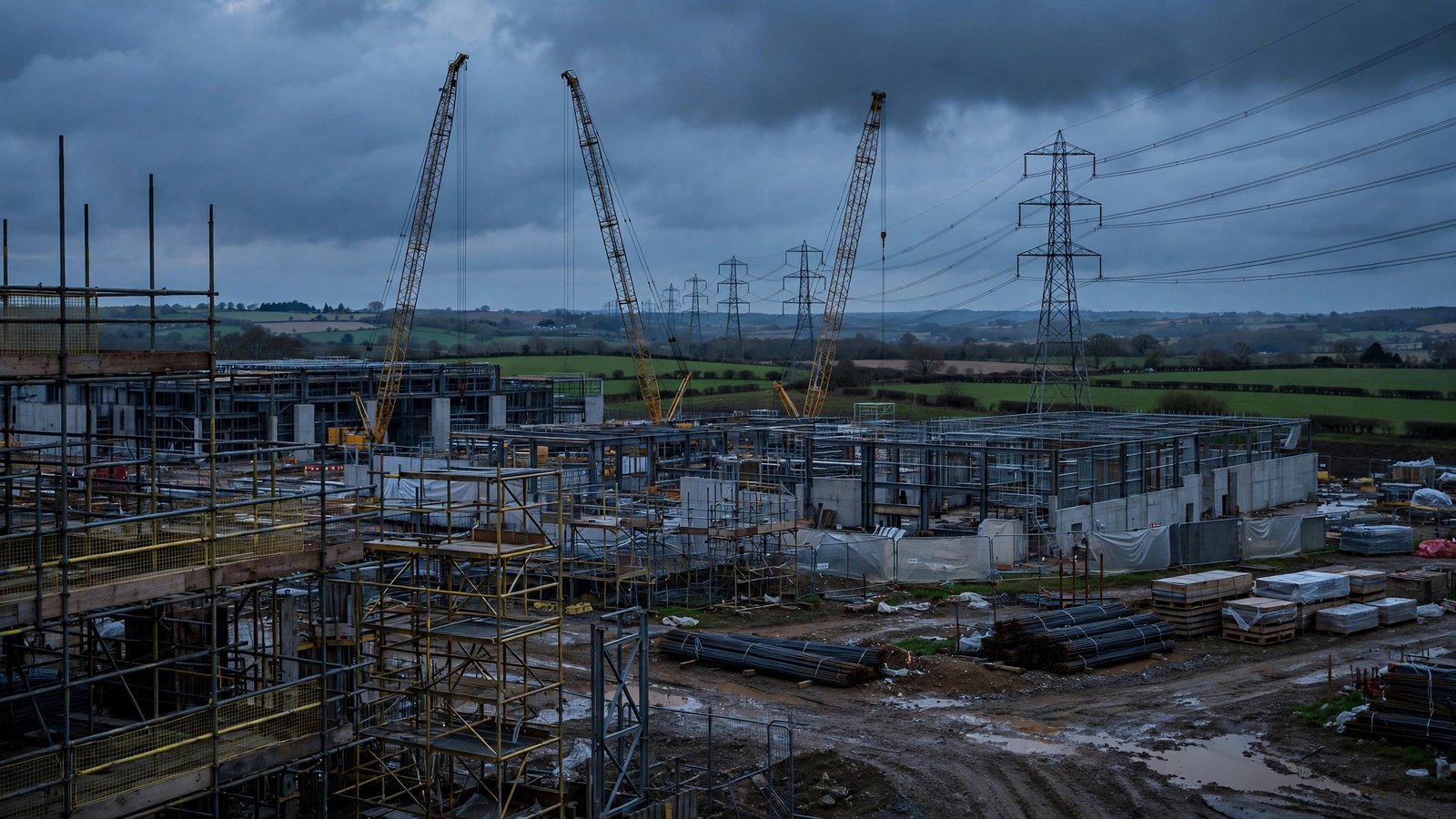
The trouble started with the grid. Earlier this year, UK Power Networks, which runs the electricity network across London and south-east England, told Nscale that sufficient power would not be available for the Loughton site until the early to mid-2030s, several years after the planned opening. According to the BBC, the datacentre had been due to receive its power connection at the end of this year. The Guardian's reporting, which followed earlier reporting by the Financial Times, described a site that was still a working scaffolding yard when visited in February. On October 18, The Guardian reported that Microsoft had terminated the agreement, and Reuters confirmed the news the following day. Microsoft declined to comment on the decision.
The numbers behind the deal
The scale of what has been cancelled matters. Microsoft was expected to be the main customer, and its withdrawal leaves Nscale without a publicly announced replacement anchor for the site, according to reports.
For Nscale, the timing is awkward. For Microsoft, the loss is absorbed differently. A hyperscaler of its size can spread one late site across a huge fleet of datacentres. Nscale, like other neoclouds, finances GPU deployments against specific contracts with a small number of large customers, which makes every site critical.
Why power beats chips now
The Loughton cancellation is not an isolated embarrassment. It reflects a structural shift in how AI infrastructure gets built. Analysts quoted in industry coverage point to the same diagnosis: a project needs a creditworthy customer, financing backed by that customer, and available electricity at the same time, and developers can influence the first two far more than the third. Grid operators can push connection dates back by months or years with little notice. As one industry observer put it, capacity without power earns nothing while the bills keep arriving.
This is why the story keeps repeating in different forms. The AI boom has been framed as a race for chips and capital, but the binding constraint is increasingly the electricity to run the chips and the substations to deliver it. Building a datacentre shell is now the fast part. Getting a grid connection on schedule is the hard part. When the Guardian visited the Loughton site in February, the fact that it was still a scaffolding yard told the story before any of the announcements did: hardware on order does not equal power in the ground.
Britain's AI Growth Zones policy is meant to accelerate exactly this kind of buildout, but the Loughton experience suggests that designating a zone is not the same as delivering electrons to it.
What Nscale says, and what happens next
Nscale has not walked away from the site. The company said it remains committed to Loughton and the UK, and that it is exploring alternative power sources for the site alongside other expansion locations in the country. An Nscale spokesperson told Reuters that the relationship with Microsoft remains strong and long-term, and that the grid issue would have no impact on the company's other contracts with Microsoft. The two companies continue to work together on projects in Norway, Portugal and the United States. A company spokesperson also confirmed that Microsoft ended the contract for Loughton, according to Data Center Knowledge.
Whether alternative power can be found fast enough is an open question. Options like private wire connections to generators or battery-backed arrangements can take years of their own to permit and build, and the economics that made the original deal work were built around a grid connection arriving at the end of 2026. Nscale has since cleared the site, according to reports, but has not provided a revised timetable or confirmed when sufficient power will become available.
The lesson for the industry is plain. Every AI datacentre announcement should now come with a second date: not just when the building opens, but when the grid can actually power it. Microsoft can afford to wait for the electrons. The question is whether Britain's sovereign AI buildout can.
Frequently Asked Questions
Why did Microsoft leave the Nscale datacentre project in Loughton?
According to reporting by The Guardian and Reuters, Microsoft terminated its agreement to anchor Nscale's planned AI datacentre in Loughton, Essex, because the site could not get enough electricity on time. UK Power Networks reportedly told Nscale that sufficient power would not be available until the early to mid-2030s, years after the facility's planned 2027 opening.
How big was the planned datacentre?
The announced design called for a 50-megawatt AI campus that could scale to 90 megawatts, with 23,040 Nvidia GB300 GPUs scheduled for delivery in the first quarter of 2027 to support Microsoft Azure services in the UK. These figures describe the announced plan, not an operating facility.
What happens to Nscale now?
Nscale says it remains committed to the Loughton site and the UK, is exploring alternative power sources and other expansion sites, and that its other contracts with Microsoft are unaffected. The company has not given a revised timetable for Loughton or confirmed when power will be available.



Post Comment