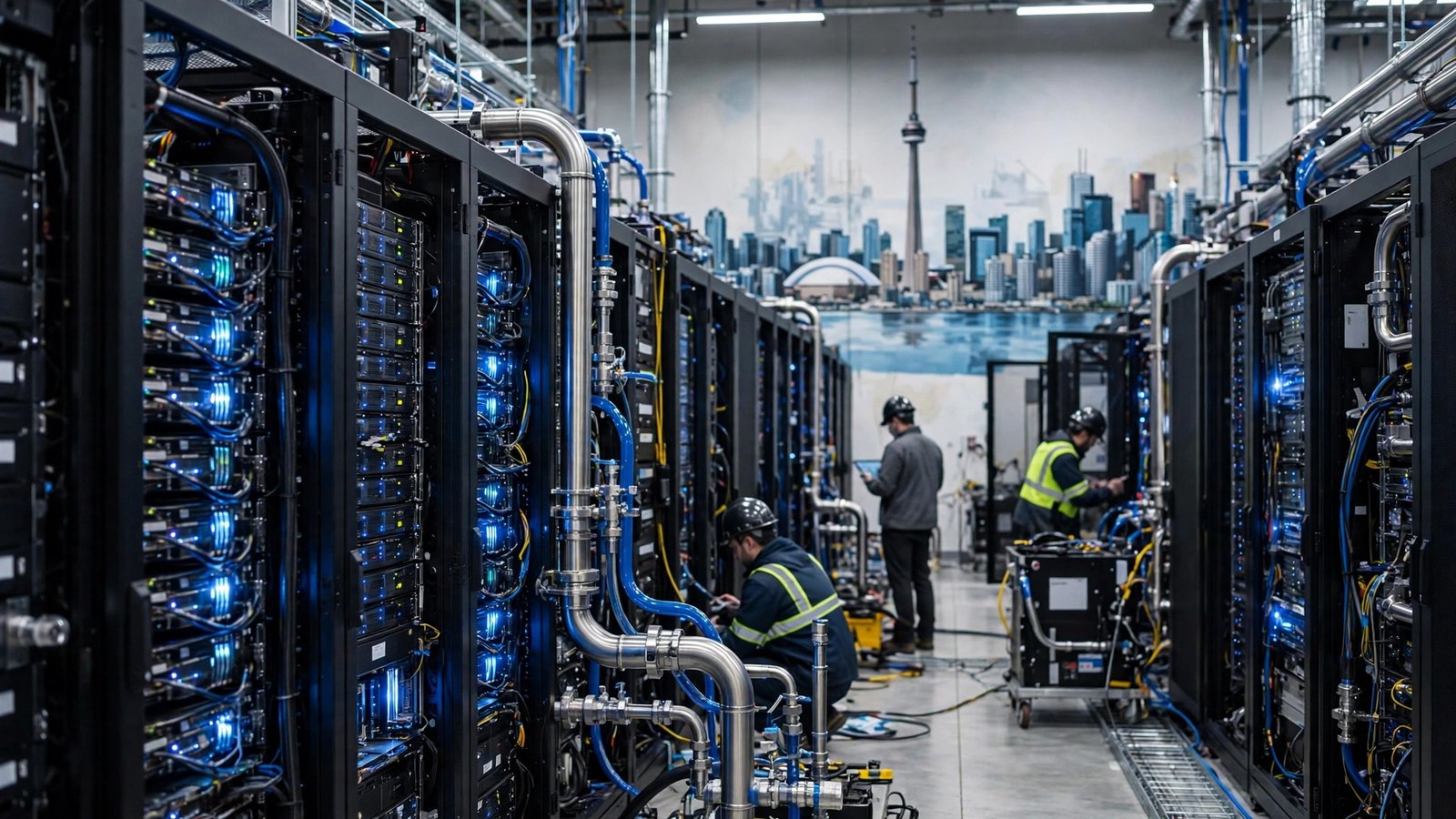
From Bitcoin Rigs to AI Racks: Hive Digital Buys a Toronto Data Center for 5,000 GPUs
A Canadian crypto miner just bought prime digital real estate in Toronto, and it has nothing to do with Bitcoin. Hive Digital Technologies announced in mid-October that it has signed an agreement to acquire a 7.2MW data center in Toronto for AI training and inference. Once upgraded, the site is expected to host up to 5,000 GPUs.
The deal marks another step in one of the biggest career changes in Canadian tech: Bitcoin miners transforming into AI infrastructure landlords. And Hive is pitching this one with a word that opens doors in Ottawa right now: sovereign.
The Deal: A 7.2MW Toronto Site, No Price Tag Attached
Hive signed a purchase and sale agreement for a Toronto facility with 7.2 megawatts of installed capacity. The company did not disclose the seller, the price, or the exact terms, which is normal at this stage but leaves the final numbers unconfirmed.
The plan is clear. Hive’s wholly owned subsidiary, Buzz High Performance Computing Inc., will run the site as its first owned and operated Tier III-quality facility. Buzz says it will deploy liquid-cooled compute infrastructure aimed at large-scale AI training, inference, and cloud services, specifically tailored for Canadian enterprises, government initiatives, and AI innovators.
Tier III is a recognized reliability standard, meaning the facility keeps running through planned maintenance without shutting down the computers it hosts. For AI workloads that train for days or weeks at a time, that uptime guarantee is a real selling point.
“This acquisition positions Buzz HPC at the forefront of Canada’s digital infrastructure evolution,” said Craig Tavares, president and COO of Buzz HPC, in the announcement, calling the site a footprint for a sovereign AI data center “owned and operated in Canada by a Canadian public company.”
From Mining Coins to Renting GPUs
The move makes sense once you understand the Bitcoin mining business. Miners are operators of massive computing facilities with power contracts, industrial cooling, and round-the-clock hardware experience. When the AI boom created a global shortage of GPU compute, those assets suddenly had a second, more valuable use.
Hive was founded and went public in 2017 as a crypto miner and still operates mining sites in Canada, Sweden, and Paraguay. Its Buzz HPC subsidiary now sells cloud access to Nvidia H100s, A6000s, A5000s, and H200s, the chips behind modern AI. Buzz’s current cloud capacity is just 2.2 megawatts across Stockholm and Montreal.
The economics explain the enthusiasm. AI compute rents by the GPU-hour at far higher prices than Bitcoin mining generates per megawatt. When Hive previously announced a 320-megawatt AI campus near Toronto said to support more than 100,000 GPUs at a reported cost of about CAD 3.5 billion, its shares jumped more than 27 percent in a single day, according to reports. The new Toronto acquisition is a separate, smaller site, but it follows the same playbook.
Why “Sovereign AI” Is the Phrase That Matters in Canada
The most interesting part of the announcement is not the megawatts. It is the framing. Hive says the acquisition will support a “sovereign Canadian AI ecosystem,” a phrase that carries real weight in Canadian policy circles.
Canada helped pioneer modern AI, yet much of its cloud computing still runs through American companies. Banks, hospitals, and federal agencies handle data that often must stay inside the country. A Canadian-owned, Canadian-operated AI cloud in Toronto directly targets that demand.
This fits a bigger pattern. Earlier this year, Canada launched voluntary principles for responsible data center development, and around two dozen companies signed on, including the big American hyperscalers alongside Hive. Ontario, meanwhile, is courting tens of billions in data center investment with the pitch that its grid runs mostly on non-emitting power from nuclear and hydro. An AI data center in Toronto inherits all of that positioning for free.
The bet is that Canadian enterprises will pay a premium for compute that keeps their data at home. If that demand is real, a 7.2MW facility fills fast.
What 5,000 GPUs Means for Canadian Builders
Context matters. A single flagship AI training run can consume tens of thousands of GPUs, so this site will not be training the next frontier model from scratch. It does not have to. Most of the market is fine-tuning, inference, and cloud services for companies that need reliable, local capacity.
For Canadian AI startups, the value is simple: a domestic option for GPU capacity, priced in Canadian dollars, with data staying on Canadian soil. Right now, many Canadian firms buy American cloud compute by default, accepting currency risk and cross-border data questions as the cost of doing business. A Toronto facility run by a Canadian public company gives them somewhere else to go, and that competition alone can push prices and terms in their favor.
The risks are real too. The acquisition price was not disclosed, the upgrade timeline is vague, and converting a facility to liquid cooling is a serious project. According to reports, Hive currently operates roughly 5,500 GPUs for AI computing, so the Toronto site would roughly double that capacity.
The company that once used waste heat from its Quebec mining site to warm a swimming-pool factory now pitches itself as a pillar of Canadian AI independence. In a market where every country is racing to keep its AI workloads on its own soil, Toronto just got another bet placed on its future.
Frequently Asked Questions
Is Hive Digital leaving Bitcoin mining behind?
No. Hive still operates Bitcoin mining sites in Canada, Sweden, and Paraguay, including a 30MW site in Lachute, Quebec and a 70MW site in New Brunswick. The Toronto acquisition expands its AI arm, Buzz HPC, rather than replacing the mining business. Think of it as the company running two businesses under one roof: crypto mining and AI cloud.
How much compute is 5,000 GPUs, really?
It is a mid-sized facility by global standards: far more than most startups will ever use, and enough for many customers running AI inference and fine-tuning at once. It is not enough for training a frontier-scale model from scratch, which can require tens of thousands of GPUs. For the Canadian market’s most common workloads, it is a solid, useful amount of capacity.
When will the Toronto AI data center actually open?
That part is still unclear. The purchase and sale agreement was signed in mid-October 2026, but Hive has not announced a closing date, an upgrade timeline, or when customers can start renting GPU capacity. Converting a facility to liquid cooling takes months, so the site is unlikely to be fully operational before well into 2027.

Post Comment