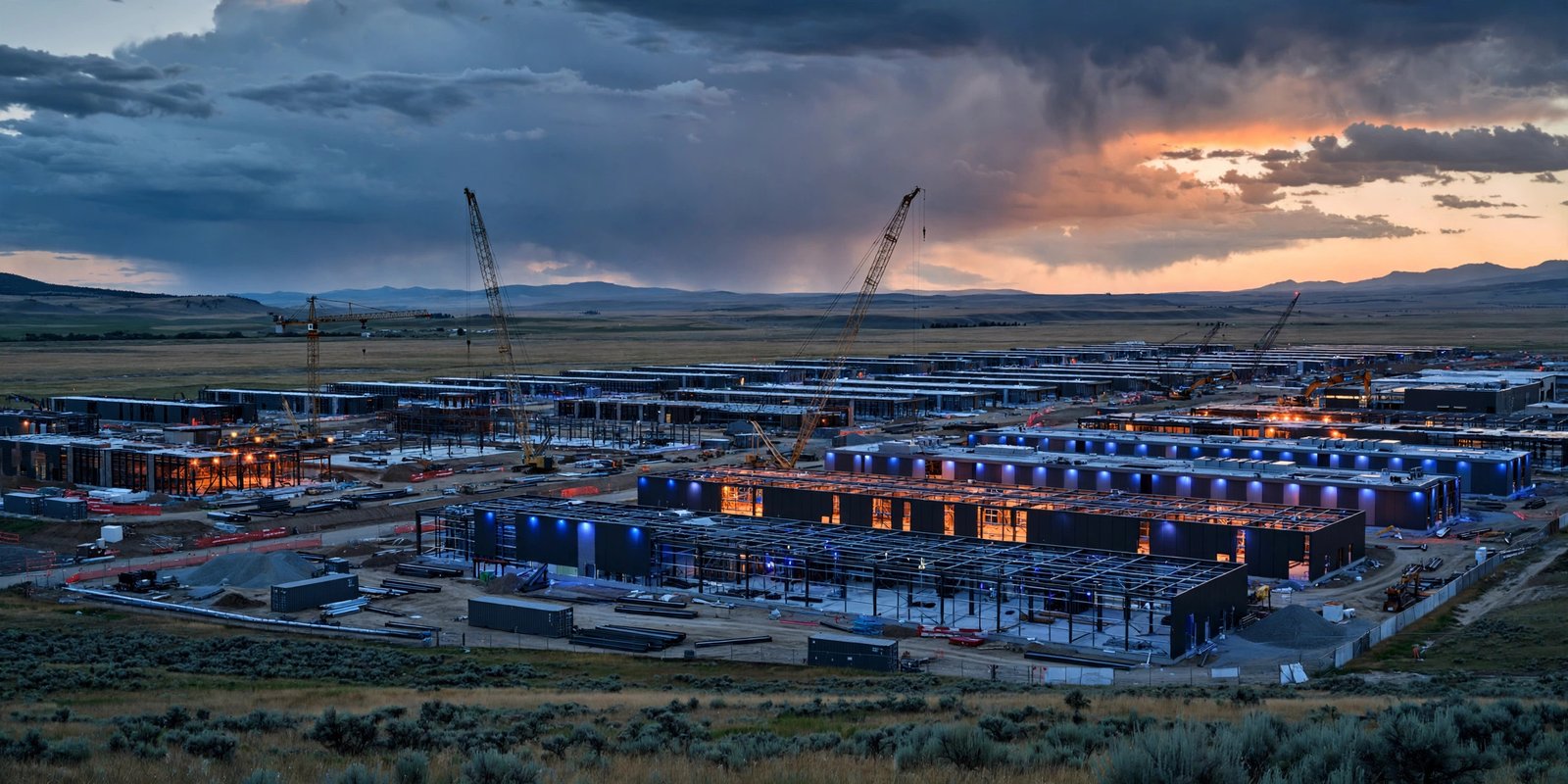
Google Takes Over Crusoe’s Unfinished Wyoming Data Center in a $17 Billion AI Bet
Google is about to become the owner of one of the largest artificial intelligence data center projects in the United States, and it did not get there by buying a finished building. On November 6, 2026, Denver-based developer Crusoe confirmed it has sold an unfinished data center campus in southeastern Wyoming to Google, handing over a project it once hoped to run itself. Google did not say what it paid for the site, but it announced plans to invest $17 billion to develop the campus.
The deal is unusual because of how it came about. Crusoe first announced the Wyoming project last year together with Tallgrass Energy, an infrastructure company backed by Blackstone, with a plan to eventually scale the campus to 10 gigawatts of power capacity. Crusoe tried to sign Google as a customer for the site and failed. According to TechCrunch, Google then raised concerns about the project's cost and construction timeline under Crusoe's management, and instead of signing a lease, it decided to take over the development itself.
Bloomberg first reported in June 2026 that the site would be sold to Google. The confirmation came on November 6, one day after Google announced its $17 billion investment in Wyoming, its first data center in the state, alongside Tallgrass Energy, Black Hills Energy, American Electric Power and Related Digital. No public timeline for construction or opening has been disclosed so far.
What Google is buying
The Wyoming campus is not a working data center. It is a site in the pre-development phase, and Crusoe says it completed the early work of origination, entitlement and de-risking. In plain terms, Crusoe found the land, secured the permits and lined up the power arrangements, and Google is buying that groundwork.
The original plan called for a campus that could eventually reach 10 gigawatts of capacity. A gigawatt is one billion watts, so 10 gigawatts is roughly the output of several large power plants. That scale explains the hybrid power strategy: Crusoe said the campus would combine fuel cells, grid power and natural gas turbines, with a longer-term plan for carbon capture through Tallgrass Energy's regional carbon dioxide sequestration hub.
For Google, the Wyoming site fits a pattern. Training and running large AI models needs enormous amounts of electricity, and the best places to build are often far from big cities, where land is cheaper and power projects can be built at scale. Wyoming offers that combination.
Why Crusoe let the project go
Crusoe is not a small company, and the Wyoming sale does not look like a company in trouble. The eight-year-old developer was recently valued at $30.9 billion, and in September 2026 it raised $3.9 billion in a Series F funding round, adding three board members including JB Straubel, the founder of Redwood Materials and a Tesla board member who had invested in Crusoe in 2021. Bloomberg has also reported that trading firm Jane Street signed a $13 billion, five-year cloud deal with Crusoe.
The Wyoming outcome still says something important about the business. Crusoe started out as a cryptocurrency mining company that ran on natural gas that would otherwise have been flared, founded by Chase Lochmiller and Cully Cavness. It has since remade itself as an AI infrastructure company, leasing data center space to customers who bring their own graphics processors, renting out its own graphics processors, and selling computing power for AI inference work. That model works when customers sign up. In Wyoming, the customer Google wanted to be a tenant ended up becoming the owner instead.
The relationship is not over
Losing the Wyoming project did not end Crusoe's work with Google. Crusoe recently announced it is the developer of a separate Google data center campus under construction in Armstrong County, outside Amarillo, Texas. That project keeps the two companies working together, with Crusoe as a builder rather than an owner.
That shift is the real story here. Hyperscalers like Google, Microsoft, Amazon and Meta are spending hundreds of billions of dollars on AI infrastructure, and they increasingly want direct control over the biggest builds rather than relying on independent developers. Microsoft, for its part, was reported this week to be reviewing its own cloud commitments and cutting back on some outside providers. The pattern is the same: when the stakes are this high, the biggest buyers want to own the project. For Crusoe, the question is whether it can stay profitable as a developer and contractor for hyperscalers rather than as a project owner. The Texas project for Google will be an early test.
What to watch next
The first thing to watch is whether Google publishes a construction timeline for Wyoming. So far there is none, and the pace of the $17 billion spend is unknown. The second is whether the 10-gigawatt target and the Tallgrass partnership survive the handover, since Google has not confirmed either in its own words.
The deal also arrives in a week when the AI spending boom itself is under scrutiny. On November 5, the Nasdaq fell about 5.5 percent as investors reassessed AI infrastructure stocks. A $17 billion commitment from Google cuts the other way, a sign that at least one hyperscaler sees no reason to slow down.
Frequently Asked Questions
Why did Google buy Crusoe's Wyoming data center project?
Crusoe confirmed on November 6, 2026 that it sold the unfinished campus in southeastern Wyoming to Google. According to TechCrunch, Google had raised concerns about the project's cost and construction timeline under Crusoe's management, after Crusoe failed to sign Google as a customer for the site. Google is now taking over development and plans to invest $17 billion in the campus.
How much did Google pay Crusoe for the Wyoming site?
Neither company has disclosed the purchase price. The only public figure is Google's plan to invest $17 billion to develop the campus, which was announced on November 5, 2026. The price of the unfinished site itself remains undisclosed.
How big is the Wyoming data center campus?
The project was originally planned to eventually scale to 10 gigawatts of power capacity, a plan set out when Crusoe announced it with Tallgrass Energy. Google has not yet confirmed whether that target will stand under its ownership, and no public timeline for construction or opening has been disclosed.




Post Comment