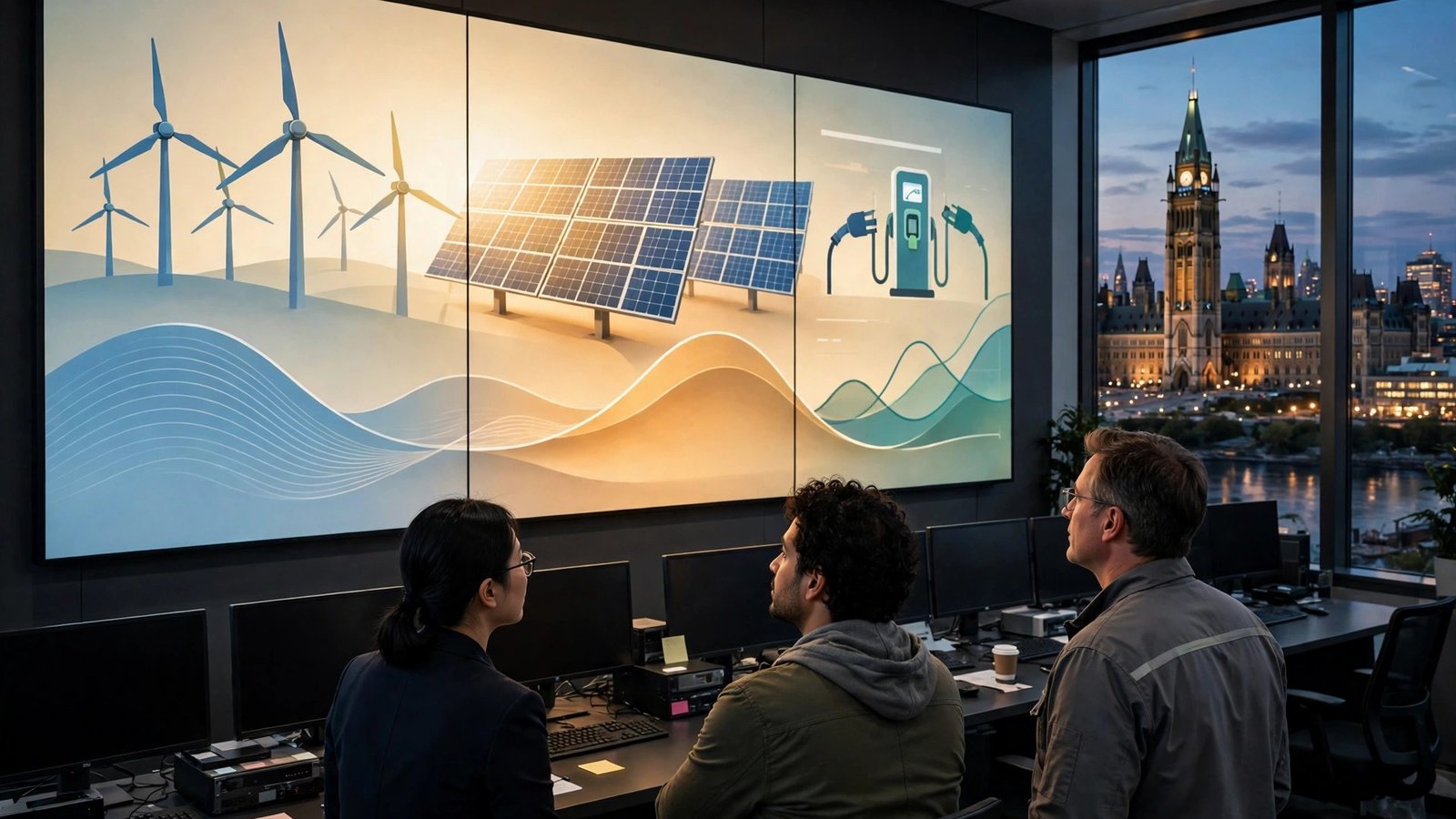
Ottawa AI Startup BluWave-ai Raises $8.1 Million to Help Power Grids Handle EVs and Data Centres
Ottawa startup BluWave-ai has closed $8.1 million in financing to grow its AI software for electricity grids, electric vehicle charging and data centres. The company announced the Series A-2 round on November 12, 2026, in its tenth year in business.
The round mixes three kinds of money: a Series A-2 equity close, non-dilutive federal project financing and operating capital from Royal Bank of Canada and Bank of Montreal. New and returning international angel and family office investors took part, including several from the Capital Angels Network. The company has now raised more than $24 million in total, including this round.
What the money will pay for
The company said the proceeds will strengthen its Canadian operations and engineering team, its patent portfolio, international business development and global expansion. It will work with Global Affairs Canada to expand in areas the federal government has marked as priorities.
BluWave-ai also plans to use the federal non-dilutive financing to improve its Energy Storage Autopilot product, which is already in multi-year deployments in Canada. The company added two industry veterans to its board of directors as part of the round: Mario Montana, who brings decades of experience in semiconductors and energy, and Suzanne Grant, a Canadian Armed Forces veteran who also leads the Capital Angels Network.
Why grids need this kind of software
Electricity grids were built for a simpler world, where power flowed one way from big plants to homes and businesses. That world is changing fast. Rooftop solar and wind farms feed power back into the grid at unpredictable times. Millions of electric vehicles plug in at the end of the workday. Data centres draw huge amounts of power around the clock.
When demand spikes in one neighbourhood, local transformers can overload. Utilities have traditionally answered these problems by building thicker wires and bigger substations, which is slow and expensive. Software that shifts flexible demand by minutes or hours can often do the same job faster and cheaper.
That is the gap BluWave-ai is trying to fill. Its software watches grid conditions in real time and moves flexible loads, such as EV charging and battery storage, to times when the grid has room. The company says this prevents local overloads, cuts the use of expensive natural gas power at peak times and reduces the need for costly grid upgrades.
The Ontario test case
In Ontario, BluWave-ai has partnered with electricity utilities including Oakville Hydro, Oshawa Power and Essex Powerlines to build province-wide EV-based energy storage. By shifting EV charging demand in real time relative to grid conditions, the AI software keeps local grids within their limits while drivers still get charged.
The company sells three products built on one shared AI engine: EV Everywhere for managed charging, Energy Storage Autopilot for stationary batteries and Data Center Autopilot for flexible AI compute loads. The intellectual property behind the products is a big part of the story. BluWave-ai says it has filed more than 84 patents internationally, with 17 granted or allowed so far. The company was founded in Ottawa in 2017.
What the CEO and backers said
Devashish Paul, the company’s CEO and founder, said the team has spent nine years patenting, building and deploying products for wind and solar power, storage and electrified transport before those technologies reached wide acceptance. He pointed to the scale of the shift now under way, with renewable energy adding more than one gigawatt of capacity per day globally and electric car sales reaching about 30 percent of new car sales, according to figures cited by the company.
Paul said the company has received strong interest from private equity firms, institutional investors and electricity utilities for product deployments and future growth capital. The board and past investors decided the time was right to close another private round before what the company expects to be a larger institutional round.
Montana said the global energy sector is going through a fundamental change driven by renewable energy, electric transport and increasingly power-hungry data centres. He said those trends create serious challenges for electricity grids and a large market for AI-driven optimization, and that BluWave-ai is well placed to benefit from it.
Grant said she has watched many Ottawa entrepreneurs use local private investor capital to chase global ambitions in her role at the Capital Angels Network. She said the network’s previous and new investors are excited to help the BluWave-ai team have a transformational impact on Canadian and international electricity grids.
A Canadian success story, with a bigger round ahead
Invest Ottawa president and CEO Sonya Shorey said BluWave-ai shows what Canadian innovation can do when companies have the capital to scale. She noted the company started in Invest Ottawa’s incubator and said the organization is proud to support its journey as countries speed up the transformation of their energy systems.
Patrick Searle, CEO of the Council of Canadian Innovators, said Canada needs more companies like BluWave-ai: businesses that develop valuable intellectual property at home, turn it into technology customers actually use and compete in global markets.
The company is already looking ahead. BluWave-ai said it is open to aligned corporate and institutional investors for its next commercialization round, aimed at strategic energy investors, corporate venture capital and large family offices.
For Canada, the deal is a small but telling sign. The country has spent years trying to turn its AI research strength into commercial companies that stay and scale at home. An $8.1 million round will not transform the sector on its own, but a decade-old Ottawa startup with real utility customers and a growing patent wall is exactly the kind of company the strategy is meant to produce.
Frequently Asked Questions
How much did BluWave-ai raise in its Series A-2 round?
BluWave-ai closed $8.1 million in financing, announced on November 12, 2026. The round combines Series A-2 equity, non-dilutive federal project financing and operating capital from Royal Bank of Canada and Bank of Montreal. The company has raised more than $24 million in total.
What does BluWave-ai’s AI software actually do?
Its software optimizes electricity use in real time across renewable energy, battery storage, EV charging and data centres. By shifting flexible demand, such as when EVs charge, it helps prevent local grid overloads and lowers the need for costly grid upgrades.
Who invested in BluWave-ai’s latest round?
The round included new and returning international angel and family office investors, including several from the Capital Angels Network, plus federal financing and operating capital from RBC and BMO. Mario Montana and Suzanne Grant also joined the company’s board of directors.




Post Comment