Foxconn Working on a New Tie-Up With OpenAI, Says There Is No AI Bubble
Foxconn, the largest contract electronics maker in the world, said on Friday that a new collaboration with OpenAI is in the works. Chairman Young Liu told reporters at the company's annual technology showcase that he had met OpenAI chief executive Sam Altman earlier that day, and that an announcement would follow once details are confirmed. The news landed on the same day Foxconn revealed that humanoid robots are already at work inside its Texas facilities, giving the story a factory floor angle that goes beyond boardroom talk.
The timing matters. Investors have spent much of October asking whether the huge sums pouring into artificial intelligence infrastructure can pay off fast enough. Foxconn, formally known as Hon Hai Precision Industry, sits right in the middle of that spending wave as Nvidia's biggest maker of AI servers. Liu's message was direct: in his view, the industry is not in a bubble, and Foxconn expects to keep growing at a double digit pace next year.
What Foxconn actually announced
Liu kept the details thin, and that is worth stating plainly. He did not describe the shape of the new deal, its value, or its timeline. What he did say is that it would build on an agreement from last year, under which Foxconn and OpenAI agreed to work together on designing and engineering data center racks, components, and other AI hardware. In other words, this looks like a deepening of an existing hardware relationship rather than a brand new partnership starting from zero.
Reuters reported Liu's remarks from Taipei on October 30, 2026. Until Foxconn or OpenAI publishes confirmed terms, the prudent reading is that a deal is being prepared, not that one has been signed and priced.
The Houston connection: six plants and robots on the floor
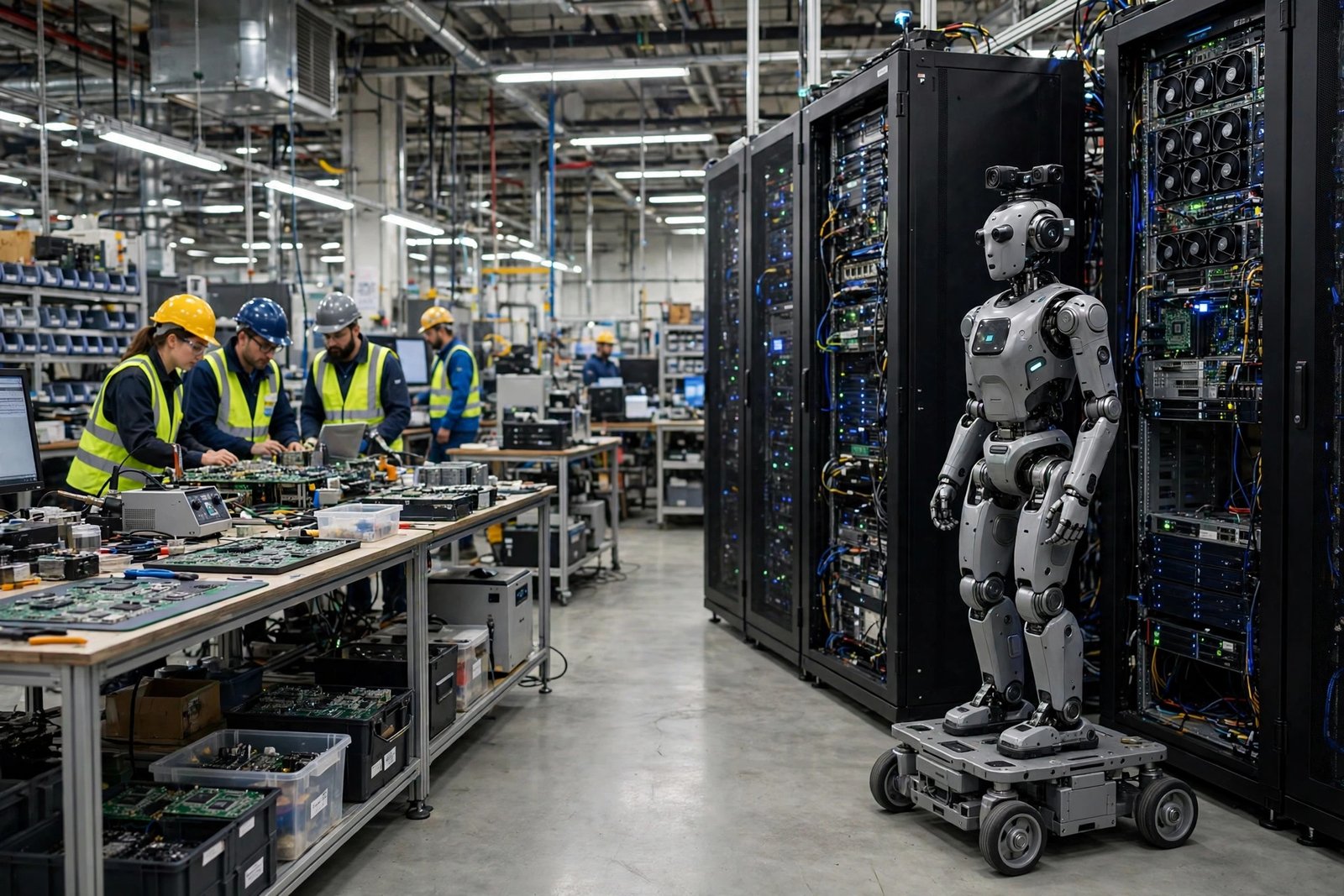
The most concrete part of the story is happening in Texas. Foxconn has six factory buildings in Houston, where it manufactures AI servers for Nvidia, and Liu said the company sees a need for further expansion there. That puts a US manufacturing footprint at the center of a deal between a Taiwanese manufacturer and a US AI lab, at a time when where AI hardware gets built is a political as well as a commercial question.
Separately, Foxconn's industrial internet unit, Foxconn Industrial Internet, said more than 10 humanoid robots have been deployed at its Texas facilities for internal use. Brand Cheng, chairman of that unit, told Reuters that Foxconn plans to extend the deployment beyond Texas. According to presentation materials seen by Reuters, the unit introduced two wheeled models in October: one that lifts things vertically, and one that can bend at the waist for assembly as well as loading and unloading tasks.
The robots are being developed with AI models based on Nvidia's GR00T foundation model, according to the report. That links three big names in one factory story: Foxconn building the machines, Nvidia supplying the robot AI foundation, and OpenAI as a potential partner on the wider AI hardware effort. It also shows where humanoid robots are first finding real work: in controlled industrial settings where tasks repeat and floors are flat, not in homes.
Readers should keep the scale in perspective. More than 10 robots across Texas facilities is a pilot, not a workforce replacement. The interesting question is whether these machines can handle varied assembly and materials tasks reliably over long shifts, and whether the economics work once maintenance and supervision are counted. Foxconn's plan to expand beyond Texas suggests early results have been encouraging enough to continue, but the company has not published performance figures.
Why Foxconn is betting so hard on AI infrastructure
Foxconn's own numbers explain the shift. The company said in August that its cloud and networking products segment, which includes AI servers, accounted for 51 percent of second quarter revenue, passing 50 percent for the first time. For a company long associated with assembling phones and consumer electronics, that is a notable crossing point: AI infrastructure is now its largest revenue engine.
Still, Foxconn is not immune to the risks in that debate. If customers slow their data center buildouts, server orders would follow, and rising borrowing costs make debt funded AI investment harder to justify. Liu's "no bubble" comment reads partly as reassurance to that audience: from the factory floor, demand still looks real.
What to watch next
The first thing to watch is a confirmed announcement from Foxconn or OpenAI with actual terms, showing whether the deal covers new product lines, new factories, or simply an extension of the rack and component work. The second is any detail on Houston expansion: new buildings, new hiring, or new production lines would show whether the Texas footprint is growing in step with the partnership talk.
The third is the robot program. Watch for numbers: how many robots, which tasks, and whether deployment spreads outside Texas. Humanoid robots in factories have been promised for years, and the gap between a demo and a dependable shift worker is large.
For now, the story is best read as two linked signals: Foxconn and OpenAI moving closer on AI hardware, and robots built on Nvidia's robot AI work already moving material in Houston. Together, they sketch a picture of AI moving from software demos into the physical work of building the machines that run it.
Frequently Asked Questions
What did Foxconn say about OpenAI?
Foxconn chairman Young Liu said on October 30, 2026 that a collaboration with OpenAI was in the works, after meeting OpenAI chief executive Sam Altman that day. He said an announcement would come once details are confirmed, and that the work would build on last year's agreement on data center racks, components, and AI hardware.
Where does Foxconn build AI servers in the US?
Foxconn has six factory buildings in Houston, Texas, where it manufactures AI servers for Nvidia. Liu said the company sees a need for further expansion there, and its industrial internet unit has deployed more than 10 humanoid robots at its Texas facilities for internal use.
Does Foxconn think AI is in a bubble?
No. Liu said the industry was not in a bubble and that Foxconn expects to maintain double digit growth next year. He made the comment while AI stocks faced pressure in October over whether heavy infrastructure spending would pay off quickly, and Foxconn's cloud and networking segment passed 50 percent of revenue for the first time in the second quarter.



Post Comment