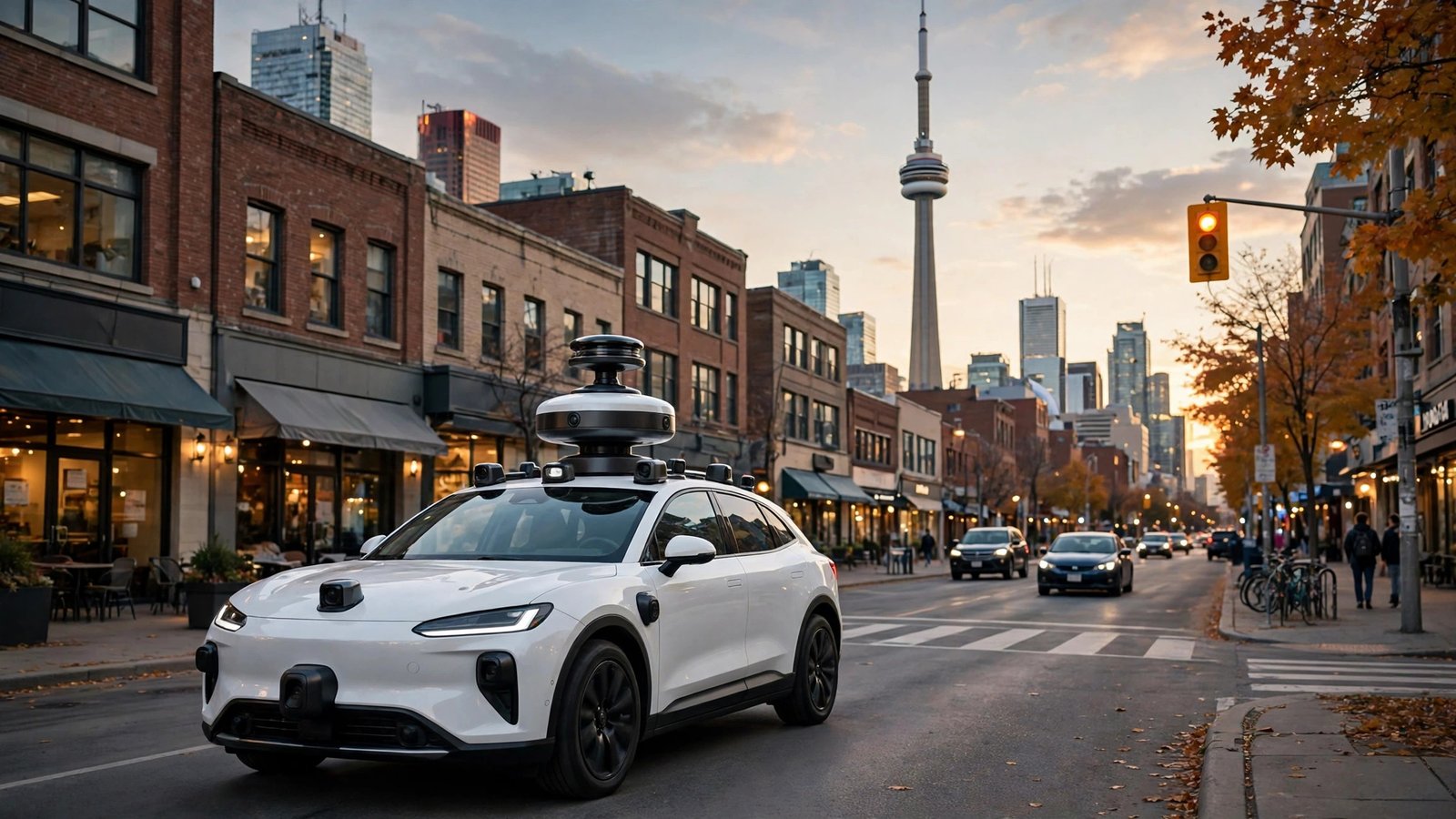
Waymo Is Coming to Toronto: Canada’s First Robotaxi City, With Driverless Rides Targeted for 2028
For years, the driverless car was a rumor that stopped at the border. You could ride one in Phoenix, San Francisco, or Los Angeles, but north of the 49th parallel the technology did not exist. On October 16, 2026, that finally changed. Waymo, the self-driving company owned by Alphabet, announced that Toronto will become its first Canadian city, with fully driverless ride hailing targeted for 2028.
It is a big statement about where autonomy goes next, but it is not a fast one. No driverless cars are on Toronto streets yet, and none will be for a while. What starts now is the slow, unglamorous groundwork: cars with human specialists behind the wheel, mapping the city block by block. Understanding what Waymo actually announced, and what happens between now and 2028, tells you a lot about how this technology really reaches a city.
What Waymo Actually Announced
Waymo confirmed on October 16 that it is laying the groundwork for a fully autonomous ride hailing service in Toronto. This makes Toronto the company’s first Canadian city and its fourth market outside the United States, after London, Tokyo, and Singapore.
The company said it will invest in local facilities in Toronto and begin hiring, and that its first vehicles will start driving the city’s streets manually in the coming days. Their job is to build high definition maps and validate the software, not to carry passengers.
Waymo co CEO Tekedra Mawakana framed the expansion as a milestone: “Expanding into Canada marks an important milestone in Waymo’s global journey.” The company has not promised an exact launch date, only that it is targeting its first public riders in 2028, more than two years after the announcement.
The Slow Playbook: Map First, Riders Later
If you have followed Waymo’s expansion in other cities, the Toronto plan will look familiar, because it is the same method repeated with discipline. The company does not drop driverless cars into a new city on day one. It starts with vehicles driven entirely by human operators, whose sensors record every lane line, curb, sign, and intersection to create a detailed map of the road network.
Only after the maps are built does the company move to testing with trained autonomous specialists behind the wheel. These specialists can take over if something unexpected happens, and their drives generate the real world data the software needs to handle local traffic patterns. Fully driverless operation comes last, once the company is confident enough to remove the human entirely.
This phased, safety first approach is deliberate. Each stage gives regulators, local officials, and residents time to see the vehicles, ask questions, and get used to the idea before a paying passenger climbs into a car with no driver. The long gap between announcement and launch is not hesitation. It is the method.
Why Toronto Is Not an Easy City
Every city has its quirks, but Toronto is an especially demanding test for a self driving system. Waymo itself has talked about adapting its software to the city’s “distinct driving conditions,” which is a polite way of describing some genuinely hard problems.
Winter is the obvious one. Heavy snow, slush, ice, and freezing rain change everything about how roads look and feel. Lane markings disappear under snow. Lidar and camera sensors can be obscured by spray from other vehicles. And a driving policy that works beautifully on dry pavement in Phoenix needs different assumptions about stopping distances and traction in a Toronto February.
Then there is the street life of the city itself. Toronto’s downtown has streetcar tracks that demand careful handling, dense one way grids, constant construction, and aggressive delivery traffic. Its suburbs sprawl with wide arterials, complex signal phases, and school zones that slow everything down at predictable hours. An autonomous system has to handle all of it, not just the photogenic waterfront routes.
That is exactly why the company spends two years on mapping and validation before taking riders. The hard cases cannot be solved in a lab. They have to be driven, recorded, and studied on the streets where the service will run.
What This Means for Canada, and for Your Next Ride
The bigger story here is not one city. It is what Toronto represents: the moment robotaxi service starts expanding across a national border, which brings it closer to everyone else in the country. When autonomous vehicles learn to handle a Toronto winter, they become far more useful for Montreal, Ottawa, Calgary, and every other Canadian city with similar roads and weather.
For Toronto residents, the practical takeaway is simple. Do not expect to hail a driverless Waymo before 2028. Do expect to see strange cars with sensor equipment quietly driving around, especially downtown. Those vehicles are the service being built in real time.
There is also a competitive angle worth watching. Zoox, Amazon’s self driving unit, and other companies are running their own expansion plans, and several have tested or considered Canadian operations. Once one major player commits to a market, the others tend to follow, which could accelerate timelines across the country. Cities also matter in this equation. Toronto’s government will have to decide how it regulates testing permits, curb space, data sharing, and passenger safety standards, and the framework it builds now will shape how every other Canadian city approaches the same questions.
For now, the milestone is clear enough. The robotaxi stopped being an American rumor on October 16. It is now, officially, a Canadian project too, just one that moves at the speed of mapping.
Frequently Asked Questions
When can I actually ride in a Waymo in Toronto?
Not soon. Waymo is targeting its first public riders in 2028, and the company says its initial work in Toronto involves manually driven vehicles building high definition maps. Fully driverless service begins only after mapping and testing with safety specialists are complete.
Why did Waymo choose Toronto as its first Canadian city?
Toronto is Canada’s largest city and its biggest technology hub, which makes it the natural starting point. Waymo has also pointed to the city’s distinct driving conditions as a reason the phased, safety first approach matters: the software needs to learn local streets, traffic, and winter weather before it can carry passengers.
Is this really the first robotaxi expansion into Canada?
Toronto is Waymo’s first Canadian city and its fourth market outside the United States, after London, Tokyo, and Singapore. Other companies have tested autonomous vehicles in Canada, but this is the first commitment of this size from the industry’s most established robotaxi operator.



Post Comment