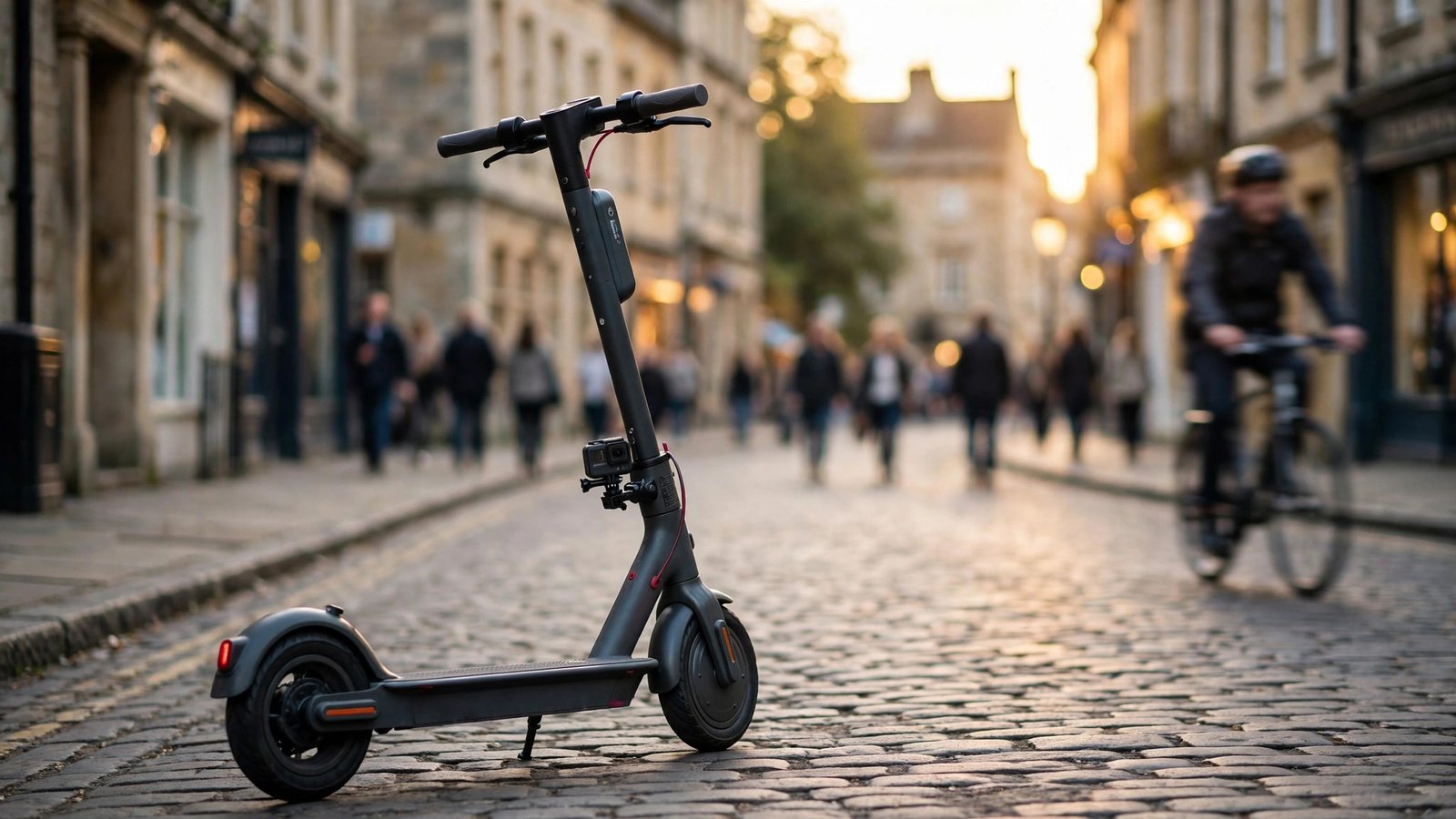
The Teen Who Built a Flamethrower Now Wants AI Cameras to Make E-Scooters Safer
At 14, Faizan Mir built a drone and a working flamethrower. His father was not impressed. "How does a flamethrower help people?" he asked his son. "Build something that makes the world a better place." That question stuck. More than a decade later, Mir runs Nearhuman, a Bristol-based startup that has just raised £350,000 in pre-seed funding to put AI cameras on shared e-scooters and e-bikes. The flamethrower story is now the company's origin story, and the new chapter is about making city streets safer instead of setting things on fire.
A camera module that bolts onto scooters already on the street
Nearhuman, based at Bristol Robotics Laboratory, is developing a retrofit camera module that fits onto vehicles already in service. The funding round, led by SFC Capital and announced on 6 October 2026, will support the development of the company's on-device safety technology for shared e-scooter and e-bike fleets. A live pilot is already running in Bristol.
The idea is straightforward. The AI runs on the vehicle itself and is designed to detect pavement riding, close calls with pedestrians, and road hazards as they happen. Operators get safety insights about their fleets without having to replace a single scooter. And because the module bolts onto existing hardware, the technology can reach the streets quickly rather than waiting for a new generation of vehicles.
Why the industry suddenly cares about scooter data
Shared e-scooters have become part of everyday travel in many cities, and the number of people getting hurt has grown alongside them. E-scooter casualties in Great Britain have more than tripled since official records began, climbing from 454 in 2020 to 1,477 in 2025, according to Department for Transport figures cited in Nearhuman's announcement. Europe is seeing a similar trend: German police recorded 16,496 e-scooter accidents with injuries in 2025, up 38 percent in a year, while e-scooter deaths in France nearly doubled, from 45 to 80.
Operators, councils, and road safety groups have been working on the problem through better infrastructure, rider education, enforcement, and vehicle design. But one gap keeps showing up: data. There is often very little direct evidence of how and where vehicles are actually ridden. A scooter might be parked neatly in a bay at the end of a trip, but nobody knows whether it spent the previous ten minutes weaving across a crowded pavement. That missing information is exactly what Nearhuman wants to supply.
How the on-device AI actually works
The clever part of Nearhuman's approach is that the video never leaves the vehicle. Footage is processed and redacted on board, so sensitive video does not need to be uploaded to a server. The AI detects the events that matter, such as a scooter mounting a pavement or a near miss with a pedestrian, and sends only the insight upstream.
That design choice solves two problems at once. First, it keeps costs and bandwidth down, since fleets of thousands of vehicles would otherwise generate an unmanageable flood of video. Second, it answers the privacy question before anyone has to ask it. A city full of camera-equipped scooters streaming raw footage to the cloud would be a hard sell to the public and to regulators. A scooter that watches, understands, and then deletes the footage is a much easier conversation.
The company describes its work as "physical AI", the branch of artificial intelligence that lives in the real world rather than in a chat window. But the scooter use case has a certain elegance: the sensors already travel the exact streets where the data is needed, every day, for free.
From safety reports to a map of the city's broken roads
Nearhuman's ambitions go beyond telling operators which riders misbehave. Over time, the company wants to give councils street-level information on the condition of roads, cycle lanes, and pavements, gathered by vehicles already travelling across the city. Every bump, pothole, and blocked lane that a scooter's camera sees could become a data point on a living map of the streets.
That pitch is aimed squarely at local authorities, which are responsible for road maintenance but often rely on patchy inspection schedules and resident complaints. A fleet of sensor-carrying scooters could spot a crumbling cycle lane weeks before anyone files a report.
What this round of funding buys
The £350,000 pre-seed round is modest by the standards of AI fundraising in 2026, where rounds in the tens of millions barely register. But pre-seed money is meant to buy proof, not scale. For Nearhuman, that means finishing the camera module, running the Bristol pilot, and coming back with evidence that the technology works on real streets with real riders.
The next test is commercial: convincing a fleet operator to put the modules on hundreds of vehicles and pay for the insights. If the Bristol pilot produces the kind of data Nearhuman promises, that conversation gets a lot easier.
A small bet on a very large problem
There is something appealing about the scale of Nearhuman's ambition relative to its funding. The company is not trying to build a new scooter or a new AI model. It is trying to add a pair of eyes to vehicles that already exist, and turn the chaos of city traffic into information that someone can act on.
Mir's father's question still hangs over the whole thing: a flamethrower is a gadget, but an AI camera that keeps a teenager from getting clipped on a pavement is something else. The Bristol pilot will show whether the technology delivers. For now, Nearhuman has the money, the team, and a genuinely interesting answer to a problem that keeps getting worse.
Frequently Asked Questions
What does Nearhuman's AI camera actually detect?
The camera module is designed to detect pavement riding, close calls with pedestrians, and road hazards as they happen. The AI runs on the vehicle itself, so detection happens in real time rather than after footage is uploaded somewhere for analysis.
How does the system handle privacy?
Footage is processed and redacted on board the scooter, according to the company. Sensitive video does not need to leave the vehicle, which means operators and councils receive safety insights without a constant stream of identifiable footage going to the cloud.
When will Nearhuman's cameras be available beyond Bristol?
The company has not announced a commercial launch date. The £350,000 pre-seed funding is aimed at developing the camera module and running the live pilot in Bristol, with wider deployment to follow if the pilot proves the technology works on real streets.



Post Comment