Bristol Startup Wins £8.4 Million to Shrink a Hospital Eye Scanner Onto a Chip
A Bristol startup has just landed one of the bigger bets the UK government has made this year on keeping people out of hospitals. Siloton, a medical technology company built around a chip smaller than a £1 coin, has won an £8.4 million contract from Innovate UK to finish development of a handheld eye scanner that can spot treatable retinal diseases at a clinic desk or in someone’s living room.
The funding comes through the Contracts for Innovation: Quantum Missions Primer programme, and Siloton says it could cut up to two years off the device’s road to patients. Clinical trials will run with Sunderland Specialist Eye Hospital, and the team plans to grow to 16 people by August 2028.
A tabletop machine, shrunk to fit your hand
To understand why this matters, it helps to know what an OCT scan actually is. Optical coherence tomography is the gold standard for diagnosing retinal disease. It works a bit like radar for the eye: light bounces off the retina and the returning echoes are timed to build a three dimensional map of tissue, down to the micron.
The catch is that hospital OCT systems are large, expensive, fragile pieces of equipment. They live in specialist clinics, which is part of why ophthalmology waiting lists keep growing. NHS ophthalmology waits currently account for 8.7 percent of all waits across the health service, according to reporting on the funding announcement.
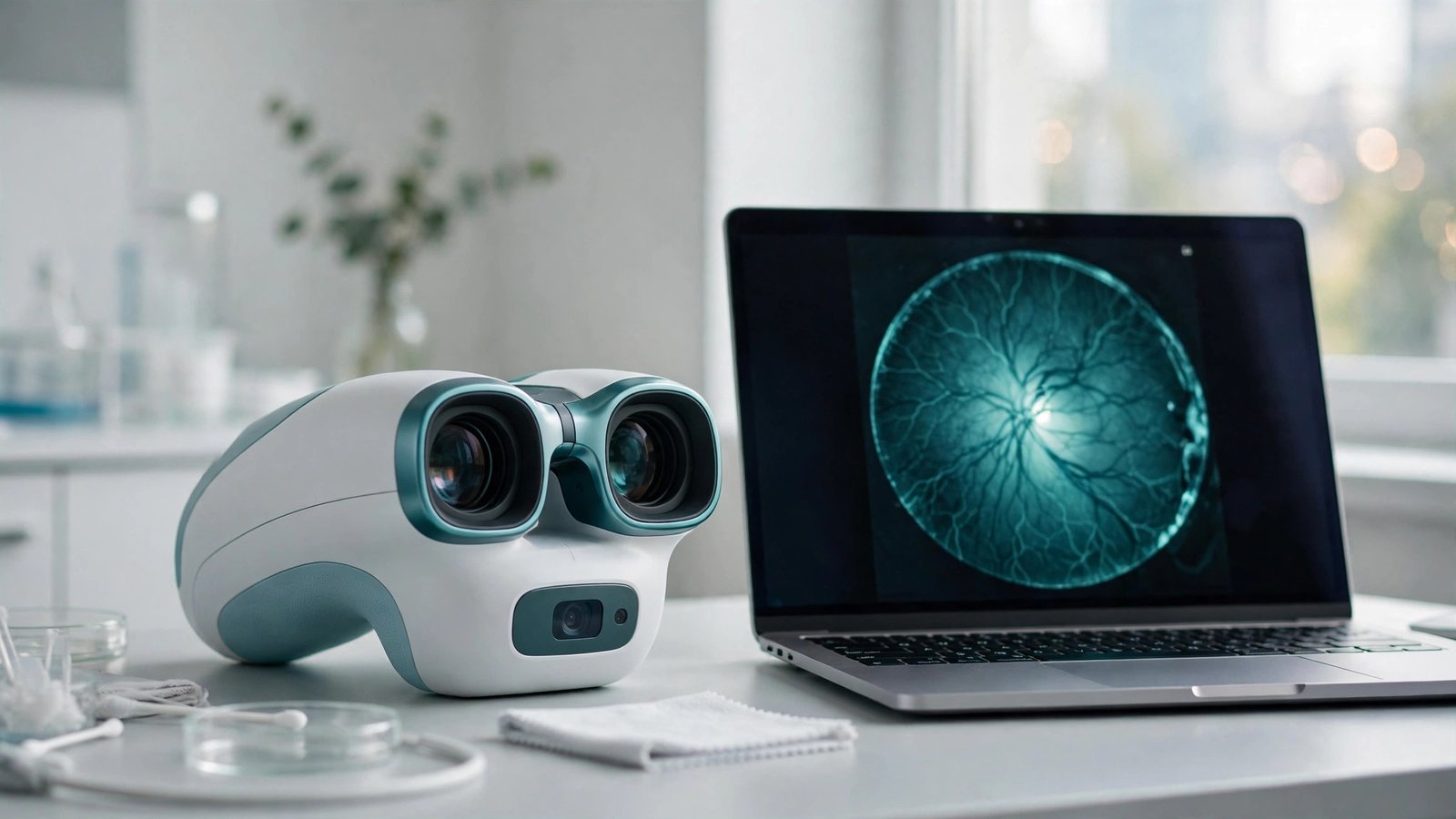
Siloton’s device, called GiraffeOCT, compresses all of that bulky optics onto a single photonic chip smaller than a £1 coin. The result is a binocular style headset that is easy to use, affordable, and robust enough to leave the hospital entirely. Two versions are planned: one for in clinic use, and an at home version with built in automation and guidance so users can reliably scan themselves.
For patients with conditions like age related macular degeneration or diabetic retinopathy, that changes the rhythm of care. Monitoring could happen at home or in a community clinic, with only genuinely concerning changes triggering a hospital visit. Earlier detection of worsening disease means treatment starts sooner, and in eye disease, weeks can be the difference between keeping sight and losing it.
Why the government is paying for this
Innovate UK, the innovation agency inside UK Research and Innovation, does not hand out £8.4 million contracts on a whim. The contract is deliberately aimed at the awkward middle phase of deep tech, the stretch between a working prototype and a certified product that many startups never survive.
“The NHS needs new technologies and new ways of working, and it needs them quickly,” said Alasdair Price, CEO of Siloton, in comments released with the announcement. He described the contract as a first step toward getting UK patients access to innovations at the same time as other countries, rather than years later.
It is also a strategic signal about British manufacturing. Price said the contract allows the company to explore manufacturing and assembly in the UK, keeping the supply chain for a genuinely advanced product on home soil rather than shipping the hard parts of the work abroad.
What £8.4 million actually buys
The two year contract funds a fairly specific shopping list. Finish the design of both the in clinic and at home versions of GiraffeOCT. Complete clinical trials on both systems, with Sunderland Specialist Eye Hospital as the trial partner for the in clinic device. Expand the technology to cover a wider range of diseases, and integrate a second generation chip called BlueJay, which the company notes uses the same architecture as a system it developed for astronauts. Then build the cloud platform underneath it all, because a scanner that lives outside the hospital still needs somewhere safe for its images to go.
The headcount tells its own story about where the hard problems are. The new roles will span photonics, electronics, and software, focused on miniaturising the electronics, product development, and manufacturing planning. Regulation is another big one: getting a medical device certified is a slow, evidence heavy process, and the contract explicitly funds bringing those skills in house.
Alongside the contract, Siloton says it plans to raise further investment to strengthen its cash position for the next few years and support development of another device called CheetahOCT. The company, founded in April 2020 as a spinout incubated in the Quantum Technologies Enterprise Centre, is clearly trying to build a platform rather than a single product.
The competition for the future of the eye exam
Siloton is not the only company chasing portable eye diagnostics, but the combination of a coin sized chip, a handheld binocular form factor, and a genuine government contract puts it in a strong position. The at home version is the genuinely radical part: self scanning with built in guidance removes the trained operator from the loop entirely, which is the step that makes the economics work at population scale.
None of this is guaranteed, of course. Clinical trials have to show the handheld images are genuinely comparable to the hospital machines for the diseases it claims to monitor. Regulators have to be satisfied. And the NHS has to actually buy and deploy the thing, which is its own obstacle course. But £8.4 million of public money, a defined trial partner, and a two year runway is about as good a start as a British medtech startup can ask for.
Frequently Asked Questions
What is Siloton’s GiraffeOCT device?
GiraffeOCT is a handheld binocular style retinal scanner based on optical coherence tomography (OCT), the clinical gold standard for diagnosing retinal disease. Siloton has shrunk the optical components of a hospital OCT machine onto a single photonic chip smaller than a £1 coin, making the device portable and affordable enough for clinics and homes.
What will the £8.4 million Innovate UK contract fund?
The two year contract funds the design of in clinic and at home versions of GiraffeOCT, clinical trials (with Sunderland Specialist Eye Hospital for the in clinic device), expansion to cover more diseases, integration of a second generation BlueJay chip, a supporting cloud platform, and growth of the team to 16 people by August 2028.
When will patients be able to use it?
Siloton has not announced a commercial launch date. The company says the contract could shorten development by up to two years, but the device still needs to complete clinical trials and gain medical device certification before it can be sold to the NHS or the public.




Post Comment