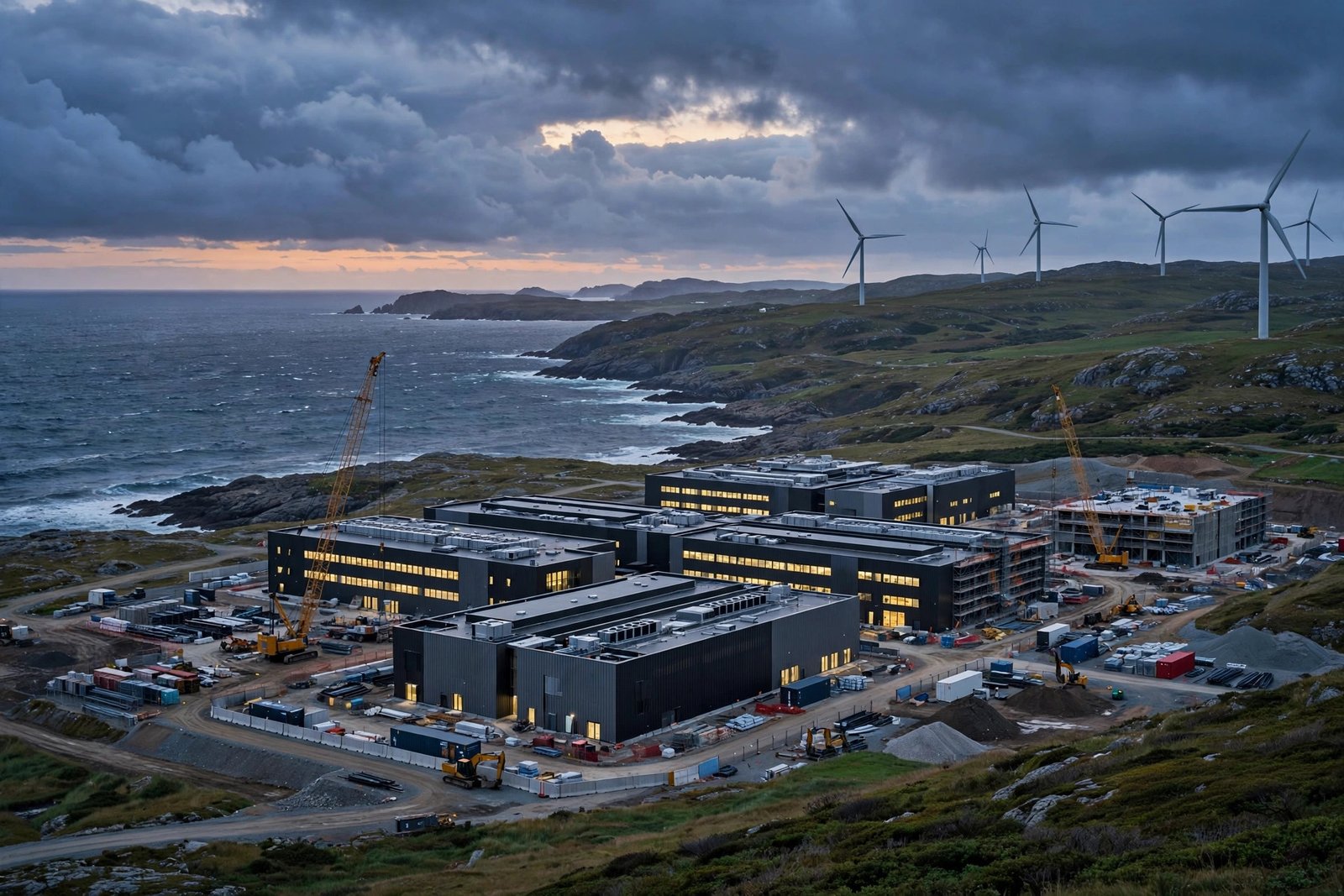
Anthropic Is Building Claude’s First Canadian Home in Nova Scotia: Inside the C$10 Billion Point Tupper Bet
Nova Scotia is not the first place most people picture when they think about artificial intelligence. But on October 16, 2026, the province landed one of the biggest tech bets in Canadian history: Anthropic, the American company behind the Claude AI assistant, signed a 20-year lease for the first phase of a new AI data centre at Point Tupper, on Cape Breton Island. It is Anthropic’s first confirmed data centre deal in Canada, and developer EverWind Fuels says the full project would be the largest private investment Nova Scotia has ever seen.
The deal, in plain numbers
EverWind Fuels will build, own and finance a data centre campus on its 1,400-acre industrial property at Point Tupper, near Port Hawkesbury. Anthropic will lease the first phase for at least 20 years: roughly 18,600 square metres drawing 95 megawatts of electricity, targeted to come online in late 2027. A 325-megawatt second phase is expected around mid-2028, taking the whole campus to 420 megawatts.
The total price tag, according to EverWind, exceeds C$10 billion: about C$8 billion for the campus itself and C$2 billion for four onshore wind farms to supply it with clean electricity. The project is projected to create around 2,000 construction jobs and 215 permanent positions, with the permanent roles reportedly paying between $135,000 and $185,000 a year. Anthropic told CBC News the site “will power Claude models and serve growing demand from Canadian and global customers,” noting Canada is the sixth-largest user of Claude worldwide.
The deal also fits Ottawa’s AI sovereignty push. Just days earlier, on October 13, the federal government added $500 million over five years to the Regional Artificial Intelligence Initiative, bringing total federal funding to $700 million under its “AI for All” strategy, released in June 2026. At the Point Tupper news conference, EverWind founder and CEO Trent Vichie said, according to The Canadian Press: “Speed matters, and capable partners matter and this is something that we can do. We can set an example for the rest of the country on how we can bring this industry to Canada and to protect Canadian sovereignty.”
Why Nova Scotia of all places
There is a cold, hard logic behind the location. First, power. AI data centres consume electricity at a scale ordinary industry cannot match, and the binding constraint on new AI capacity has quietly shifted from capital or construction timelines to electricity: who has stable, cheap, scalable power, and who can connect it quickly. Nova Scotia is pitching abundant onshore wind plus a cool North Atlantic climate that keeps server cooling costs down. The province also sits on subsea cable routes linking North America to Europe, which matters for serving global customers.
Second, stability. As AI labs spread infrastructure beyond the United States, Canada’s relative regulatory steadiness and clean-energy surplus have made it an attractive place to reduce single-jurisdiction risk. The same calculation is driving the broader wave of data centre investment reshaping the North American grid.
And third, land. Point Tupper is a former petroleum terminal EverWind bought for US$60 million back in 2022, with deepwater port access, rail infrastructure and existing electricity connections. Originally acquired for green hydrogen and ammonia production, it will now host the data centre alongside those continuing plans. Reusing an existing industrial site is far simpler than breaking ground somewhere pristine.
The parts that still need answers
The honest version of this story includes the open questions. The campus, for all its named tenant, remains a proposal. It still needs to survive construction timelines, financing, regulatory approvals and the realities of grid integration. For scale: Nova Scotia’s entire generating capacity is reportedly close to 3,000 megawatts, so a 420-megawatt campus would rank among the province’s largest single power users.
EverWind has tried to get ahead of that concern, saying it will fully fund all electrical interconnection and network upgrade costs so they are not passed on to provincial ratepayers, and that the campus will include several hundred megawatt-hours of battery storage so the data centre can ease off the grid during peak demand. On water, the facility will reportedly use an air-driven, closed-loop cooling system, with full operations expected to draw roughly 500,000 litres a day, described as less than 1.5 per cent of the safe yield from the local Landrie Lake supply. Those safeguards will need enforceable terms, not just announcements.
There is also a meaningful local dimension. According to reports, a First Nations consortium led by Membertou Development Corporation is negotiating an equity stake in the facility, supported by a multi-million-dollar community benefit fund. If that closes, the project becomes more than a foreign tech giant renting power: a genuine Atlantic Canadian economic story with local ownership in the mix.
For the rest of Canada, Point Tupper is a live experiment. If a wind-powered, locally co-owned AI campus comes online in 2027 on budget and on schedule, Ottawa gets a template it can sell to every other province. Either way, it is worth watching, because the age of AI sovereignty is no longer being debated in white papers. It is being built, one megawatt at a time, on a former oil terminal at the edge of the Atlantic.
Frequently Asked Questions
What exactly did Anthropic agree to in Nova Scotia?
According to reports from the October 16, 2026 announcement, Anthropic signed a 20-year lease for the first phase of an AI data centre campus at Point Tupper in Cape Breton, developed and owned by EverWind Fuels. The first phase covers about 18,600 square metres at 95 megawatts and is targeted to come online in late 2027. It is Anthropic’s first confirmed data centre agreement in Canada.
How big is the whole Point Tupper project?
Developer EverWind Fuels says the total private investment exceeds C$10 billion: roughly C$8 billion for the data centre campus and C$2 billion for four onshore wind farms to power it. A 325-megawatt second phase targeted for 2028 would bring the campus to 420 megawatts in total. The project is reportedly expected to create 2,000 construction jobs and 215 permanent positions.
Why does Canada’s government see this as an AI sovereignty win?
The deal arrives alongside Ottawa’s “AI for All” national strategy, launched in June 2026, which aims to keep AI talent and intellectual property in Canada and build domestic AI infrastructure. EverWind’s CEO explicitly framed the project as a model for bringing the AI industry to Canada and protecting sovereignty. The campus would give Claude, reportedly the sixth most-used AI assistant in Canada, its first physical footprint on Canadian soil.



Post Comment