WireBadger: The $1,249 Handheld That Sniffs Out Malicious USB Cables
That innocent-looking charging cable on your conference room table could be a hacker. It looks like any other cable. It charges your phone like any other cable. But inside its connectors, according to security researchers, there can be a tiny computer waiting to run commands, record your keystrokes, or open a secret wireless doorway into your network. This month, a New Jersey security hardware company launched a gadget designed to call out that exact threat, and TIME just gave it a special mention on its Best Inventions of 2026 list.
What WireBadger actually does
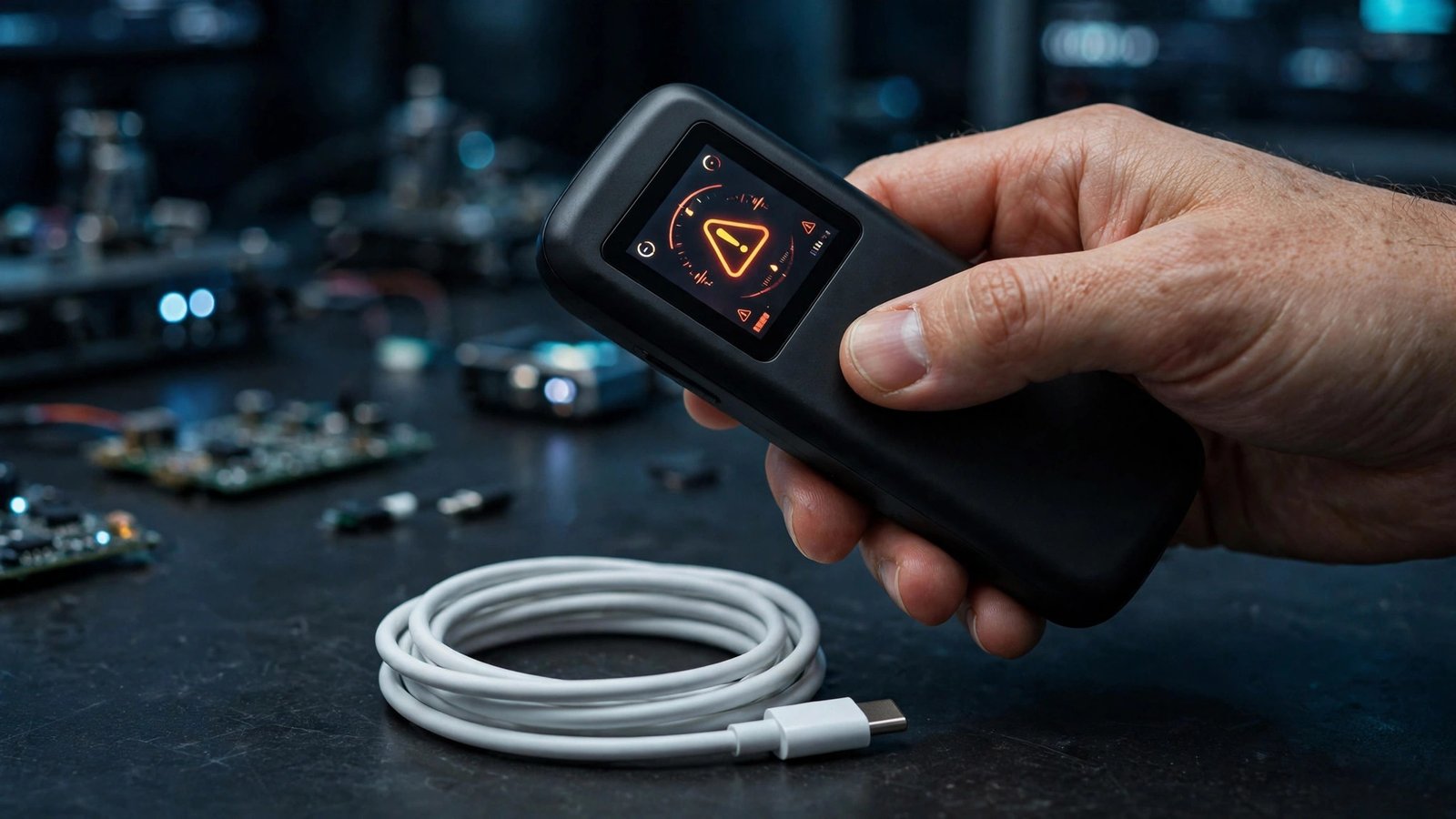
WireBadger is a portable handheld tester from Berkeley Varitronics Systems, a Metuchen, New Jersey-based manufacturer of wireless security and threat-detection gear. Plug both ends of a suspect cable into the device, and it runs a multi-stage check. First it watches the cable’s electrical current draw, looking for the small, unusual power patterns that betray hidden electronics inside. Then it scans for suspicious Wi-Fi and Bluetooth Low Energy activity, because many weaponized cables broadcast wireless signals to talk to an attacker’s phone or laptop nearby.
Unlike a basic continuity tester, which just checks whether wires carry a signal, WireBadger is specifically hunting for electronic and wireless fingerprints that a plain cable should never have. It reports through a simple touchscreen with bright visual alerts and audible warnings, so a security person can test a pile of cables quickly. It also carries a built-in USB-C data-disable switch, which cuts data lines during inspection so nothing can slip through while you are testing.
According to the company’s product pages, it accepts cables with USB-A, USB-B, USB-C, USB-Micro, USB-Mini, and Lightning connectors on the input side, and offers USB-C and USB-A on the output side, which covers the combinations most people actually use.
The threat it hunts: cables that are secretly computers
The best-known example of this attack is the O.MG cable, a commercially available penetration-testing tool that looks exactly like a standard charging cable. It can be configured to deliver malicious payloads, log keystrokes, and set up an embedded Wi-Fi access point that lets someone trigger attacks remotely. It was built for authorized security testing, but it shows what can be packed into something nobody bothers to inspect.
That is the core problem WireBadger’s makers point to. There are billions of USB and Lightning cables in circulation worldwide, and nobody x-rays a charging cable. A planted cable in a boardroom, a server room, a trading desk, or a police station is nearly invisible. “Our goal is to make detecting these hidden hardware threats a routine part of every security assessment,” said Scott Schober, President and CEO of Berkeley Varitronics Systems, in the company’s announcement.
The company is aiming the device squarely at professionals: government agencies, military installations, corporate cybersecurity teams, financial institutions, law enforcement, penetration testers, and technical surveillance countermeasures specialists. Its portable design is meant for rapid inspections in offices, conference rooms, and secure facilities where an unauthorized piece of hardware could compromise sensitive information.
How the training kit works
To demonstrate what the device catches, BVS sells an optional Test Cable Kit separately, containing clearly labeled known-good cables alongside known malicious ones, including O.MG cables. Security teams can run hands-on demonstrations and training with it, comparing safe and compromised cables side by side while learning WireBadger’s detection process. It is the kind of tool that makes the abstract idea of a “hardware supply-chain attack” concrete for a team in about five minutes.
The Test Cable Kit is listed at $849 on the company’s own site, where it was recently shown as available on backorder, which suggests demand has been picking up since the launch.
Price, availability, and the TIME nod
WireBadger is available now for $1,249 through BVS directly, as well as through Amazon and Walmart, with quantity discounts for organizations buying in bulk. That price puts it firmly in the professional-tools bracket, not the consumer-gadget shelf, which matches its intended audience. Nobody is expected to buy one of these for a home office, but a bank’s security team sweeping branches could justify it quickly.
The broader recognition came when TIME gave WireBadger a Special Mention in its Best Inventions of 2026 list. TIME’s annual list highlights technologies addressing significant challenges across industries, and the selection signals that hardware-layer attacks have moved from a niche hacker curiosity into a mainstream security concern.
Why hardware attacks are having a moment
Software gets patched constantly, and modern operating systems have hardened considerably, so attackers keep sliding down the stack toward things that are harder to inspect and update. A malicious cable is a perfect example: it needs no software exploit, no phishing email, and no user mistake beyond plugging it in. Physical access plus a two-dollar-looking accessory can defeat millions spent on network defenses.
This is the same reason security teams now worry about rogue USB drives, tampered peripherals, and compromised charging stations. The WireBadger approach, test the physical layer the way you would scan software, is part of a wider shift toward treating every component as untrusted until verified.
For ordinary consumers, the takeaway is simpler and cheaper than a $1,249 device. Use your own cables and chargers, treat found or gifted cables with suspicion, and remember that the free cable in a conference swag bag is not always just a cable.
Frequently Asked Questions
How does WireBadger detect a malicious USB cable?
It runs a multi-stage process: it analyzes the cable’s electrical current consumption for unusual draws that indicate hidden electronics, then scans for suspicious Wi-Fi and Bluetooth Low Energy signals that may come from concealed hardware. A built-in USB-C data-disable switch adds protection during inspection, and a touchscreen gives bright and audible alerts.
Which cables and devices can WireBadger test?
According to Berkeley Varitronics Systems, it accepts USB-A, USB-B, USB-C, USB-Micro, USB-Mini, and Lightning cables as inputs, with USB-C and USB-A outputs, covering nearly every common charging cable in use today.
How much does WireBadger cost and where can I buy it?
WireBadger sells for $1,249 and is available through BVS directly, Amazon, and Walmart, with quantity discounts available. The optional Test Cable Kit with known-good and known-malicious cables is sold separately and is listed at $849 on the company’s site.


Post Comment