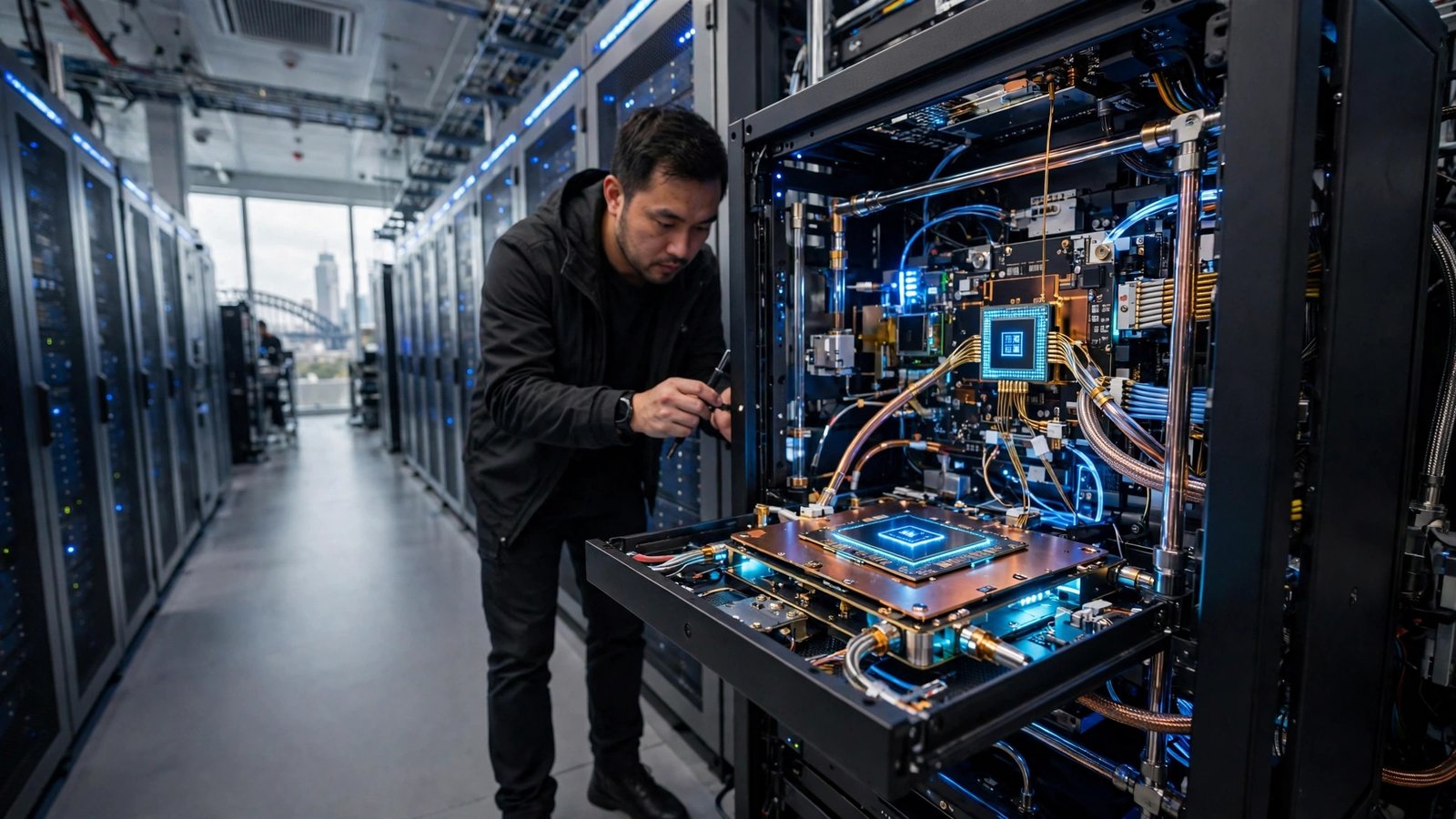
Diraq Switches On Australia’s First Quantum Computer in a Sydney Data Centre
An Australian-built quantum computer is now running inside a commercial data centre in Sydney. Diraq, the Sydney quantum computing company spun out of the University of New South Wales, announced on 9 November 2026 that its eight-qubit silicon spin system is live at an Equinix facility, in what the company describes as the first deployment of its kind in a shared commercial data centre anywhere in the world.
The machine is small by the standards of the building around it. According to Diraq's announcement, the system draws less than 20 kilowatts of power and occupies about 170 square feet. Quantum computers have traditionally lived in research laboratories, surrounded by specialist equipment. Putting one inside a facility that also hosts banking, healthcare and retail workloads is a step toward treating quantum computing as ordinary infrastructure rather than a laboratory curiosity.
Diraq builds its processors from silicon spin qubits, using manufacturing processes similar to those used for conventional computer chips. That is the bet at the heart of the company. Most quantum machines rely on exotic materials and extreme cooling, and they are difficult to manufacture at scale.
What the Sydney deployment actually is
The system now running at Equinix has eight qubits. A qubit is the basic unit of quantum information, and eight is a modest number by the standards of the field. Diraq is open about that. The point of the Sydney deployment, as the company presents it, is not raw qubit count but proof that a silicon spin system can operate reliably in a commercial environment, alongside conventional servers, artificial intelligence systems and cloud infrastructure.
The company says it plans to upgrade the same deployed system to as many as 256 qubits within the next year. That is a target, not a reported capability, and the history of quantum computing is full of roadmaps that slipped. Still, if the same rack can grow from eight qubits to 256 without being rebuilt, the Sydney site becomes a working testbed rather than a one-off demonstration.
Diraq and Equinix announced their partnership in August 2026, with installation originally expected later in the year. The system went live on 9 November, a little ahead of that loose schedule. Equinix is one of the world's largest data centre operators, and its Sydney facility hosts mainstream computing workloads across banking, healthcare, utilities, manufacturing and retail.
Why this one is different from the lab machines
Quantum computing has a long-running credibility problem. Announcements tend to focus on qubit counts and theoretical performance, while practical use remains years away for most applications. Diraq's deployment sidesteps that argument in an interesting way. Instead of claiming a breakthrough in computing power, the company is claiming a breakthrough in placement: a quantum machine operating where real workloads live.
That distinction matters for the economics. A quantum computer that only works in a university basement needs a team of specialists to keep it running. A quantum computer that works in a commercial data centre can, in principle, be operated, maintained and billed like any other piece of infrastructure.
The funding and the American connection
The Sydney deployment does not stand alone. In October 2026, Diraq announced it had advanced to Stage C of DARPA's Quantum Benchmarking Initiative, the final stage of the US Defense Advanced Research Projects Agency's program to assess whether any quantum computing approach can reach utility-scale operation by 2033. Diraq says it is one of six companies to reach that stage. The initiative carries potential funding of up to US$300 million for qualifying companies, though that should not be read as money already received.
The company has also signed a US$38 million letter of intent with the US Department of Commerce under the CHIPS and Science Act, to support US production of its fault-tolerant silicon quantum computers. A letter of intent is not the same as a confirmed award, and the department has said its agreements with quantum companies are not final. Diraq has established a US headquarters in Palo Alto, laboratories in Chicago and Albuquerque, and a technology hub in Los Angeles, and employs more than 130 people globally. In February 2026, Diraq also received $20 million from the National Reconstruction Fund Corporation for its Australian manufacturing plans.
What it might be used for
Diraq has released a report, Quantum at Work, setting out possible uses for its technology: drug discovery, materials science, energy and logistics. The report's analysis models a 10-percentage-point improvement in clinical-trial success rates as potentially saving about US$600 million per medicine, by identifying failed candidates earlier. That figure is a projection based on a 2010 industry cost study and FDA approval data, not a measured result.
For now, the honest assessment is narrower. An eight-qubit machine will not discover a new drug or redesign a power grid tomorrow. What it can do is give engineers, researchers and eventually customers a real system to test, in a real data centre, with real operating constraints.
Australia has been trying to build a quantum industry for years, with UNSW at the centre of much of it. Diraq is one of the most visible products of that effort. The Sydney deployment is a milestone, but it is best understood as the start of a longer test: whether a silicon quantum computer can grow up inside ordinary infrastructure, and whether the customers who share that building will ever want to use it.
Frequently Asked Questions
What has Diraq deployed in Sydney?
Diraq has deployed an eight-qubit silicon spin quantum computer inside a commercial Equinix data centre in Sydney. The company announced on 9 November 2026 that the system is live, and describes it as the first silicon spin quantum computer operating inside a shared commercial data centre.
How is Diraq's quantum computer different from others?
Diraq builds its processors from silicon spin qubits, using semiconductor manufacturing processes similar to those used for conventional computer chips. Most quantum machines use exotic materials and are harder to manufacture at scale. Diraq's bet is that silicon-based quantum processors can eventually be produced in existing chip factories.
What happens next for the Sydney system?
Diraq says it plans to scale the deployed system to as many as 256 qubits within the next year. The company has also advanced to Stage C of DARPA's Quantum Benchmarking Initiative and signed a US$38 million letter of intent with the US Department of Commerce under the CHIPS and Science Act. The 256-qubit target is a company goal, not a reported capability.




Post Comment