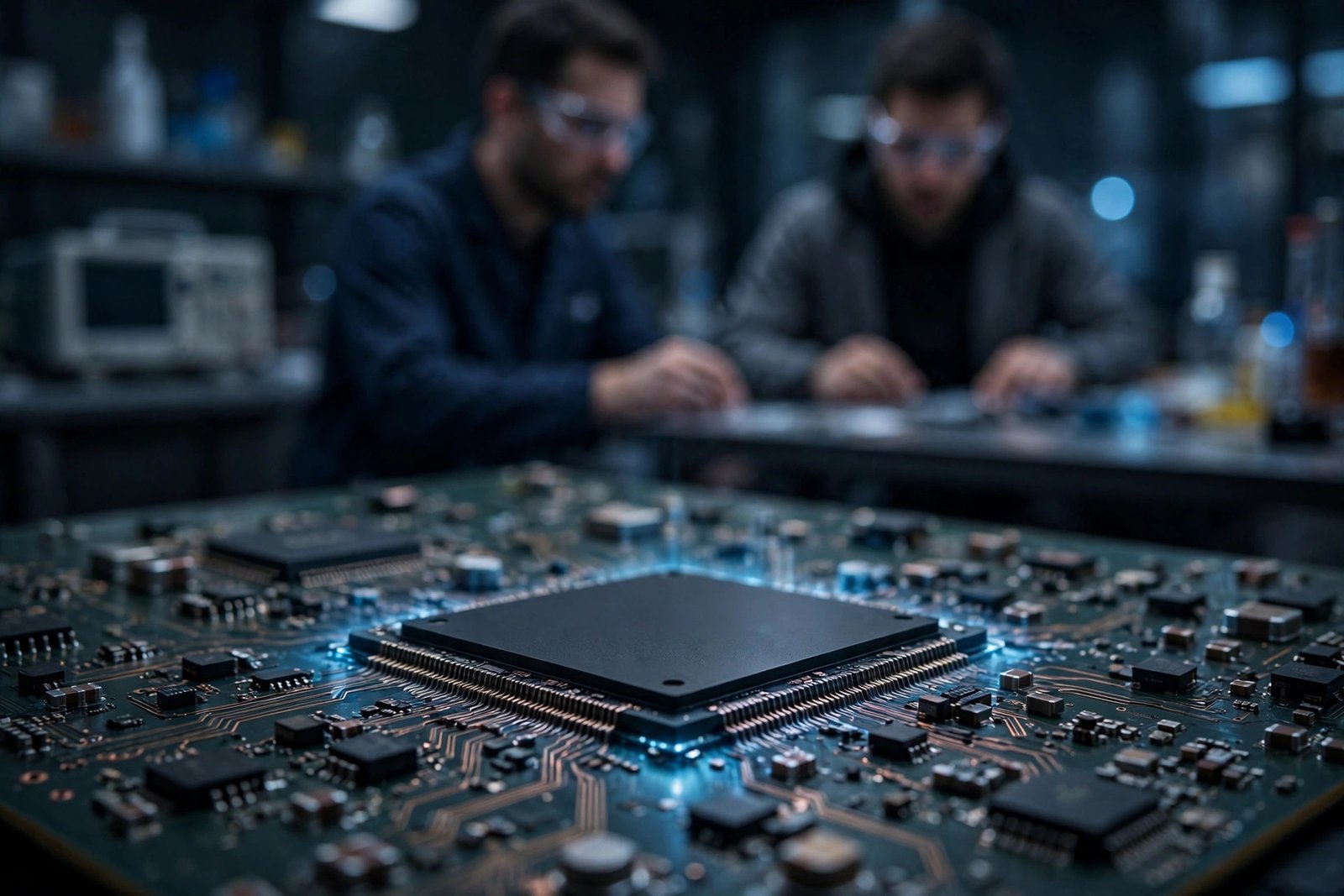
Fractile’s £100 Million Bet: The British Chip Startup Trying to Run AI Inside Its Memory
Most AI startups burn cash renting GPUs. Fractile, a small British chip company, is attacking the problem from the other end: instead of feeding more hardware to hungry AI models, it is redesigning the hardware so the hunger goes down. Earlier this year the company announced it would invest £100 million in the UK over three years, with a brand new hardware engineering facility in Bristol now taking shape.
For a country that has spent decades watching its chip champions slip away, this is the announcement Westminster wants to hear.
A £100 million commitment to Britain
The figure is £100 million, about $137 million, over three years. According to the UK's Department for Science, Innovation and Technology, the money will grow Fractile's existing sites in London and Bristol, and create a new hardware engineering facility in the latter city. That is a serious pledge for a company that only emerged from stealth in July 2024.
Engineers at the new facility will turn Fractile's chips into next generation AI systems, and the site will host a lab where other companies can test software designed for future computing infrastructure. Hardware labs are expensive to build: you do not build them unless you believe first silicon is close.
What in-memory computing actually means
Fractile's pitch rests on an intimidating name: in-memory compute. Picture how today's AI chips work. A graphics processor keeps the model's weights in memory and does the maths on separate compute cores. Every time the chip generates a word, it shuttles billions of parameters between the two, and that journey, not the maths, is where most of the time and energy goes.
Fractile's design removes the journey. The company says its chips execute 99.99 percent of the operations needed to run AI model inference directly in on-chip SRAM, the fast memory sitting right next to the compute. To get there, Fractile has licensed a RISC-V vector processor from Andes Technology and is fusing it with its own memory-compute circuitry for a first generation data centre AI inference accelerator.
The company claims the approach could run large language models up to 100 times faster than existing hardware while cutting operating costs by about 90 percent. Targets, not verified benchmarks: the first chips are expected in 2027, and nobody outside the company has tested one. As AI shifts from training models to serving them for millions of users, the cost of inference is becoming the industry's central anxiety, and Fractile is attacking it at its root.
Why Bristol suddenly matters
Bristol has quietly become one of Britain's serious hardware hubs, and the new facility deepens Fractile's presence there. The software testing lab is the clever part: chips succeed when developers can write code for them, and an early access lab builds that software ecosystem before the chips ship. By opening the doors in Bristol, Fractile invites the AI world to imagine what its hardware could do, years before anyone can buy one. It is also a political signal: Britain lost Arm's London listing to New York in 2023, so a home grown AI chip company doubling down on British soil is exactly the narrative ministers have been waiting for.
The money and the people behind it
Fractile was founded in 2022 by Dr. Walter Goodwin, then a PhD student at the University of Oxford's Robotics Institute. It raised $15 million in seed funding in July 2024, co-led by Kindred Capital, the Nato Innovation Fund and Oxford Science Enterprises.
Then, in May 2026, came the round that made Fractile a unicorn: $220 million in Series B funding co-led by Accel, Factorial Funds and Peter Thiel's Founders Fund, valuing the company at roughly $1 billion. Stan Boland, the former Arm and Acorn Computers executive, is an investor and sits on the board. Former Intel chief executive Pat Gelsinger put money in back in January 2025. Reports this summer suggested Anthropic has discussed buying Fractile's chips once they are available.
The hard part starts now
Chips are unforgiving. A software startup can pivot in a weekend; a silicon mistake can cost a year and tens of millions. Fractile's timeline, first chips in 2027, means the £100 million will be spent largely before the company has proved its architecture works outside a lab.
The risks are genuine. In-memory computing is a hard problem, and well funded startups have stumbled at it before. The Bristol lab will be where the company's claims get tested in public. Even if the chips work, Fractile faces the classic squeeze: convincing cloud providers to bet production workloads on an unproven supplier while incumbents keep improving. The $220 million war chest buys time, not customers.
None of that shrinks the ambition. Britain has not produced a globally significant AI chip company since Arm, and Arm does not make AI accelerators. If Fractile's chips work, the £100 million bet will look cheap. If they do not, it will be an expensive reminder that in chips, the distance between a clever idea and a working product is measured in years and hundreds of millions. The silicon will have its say in 2027.



Post Comment