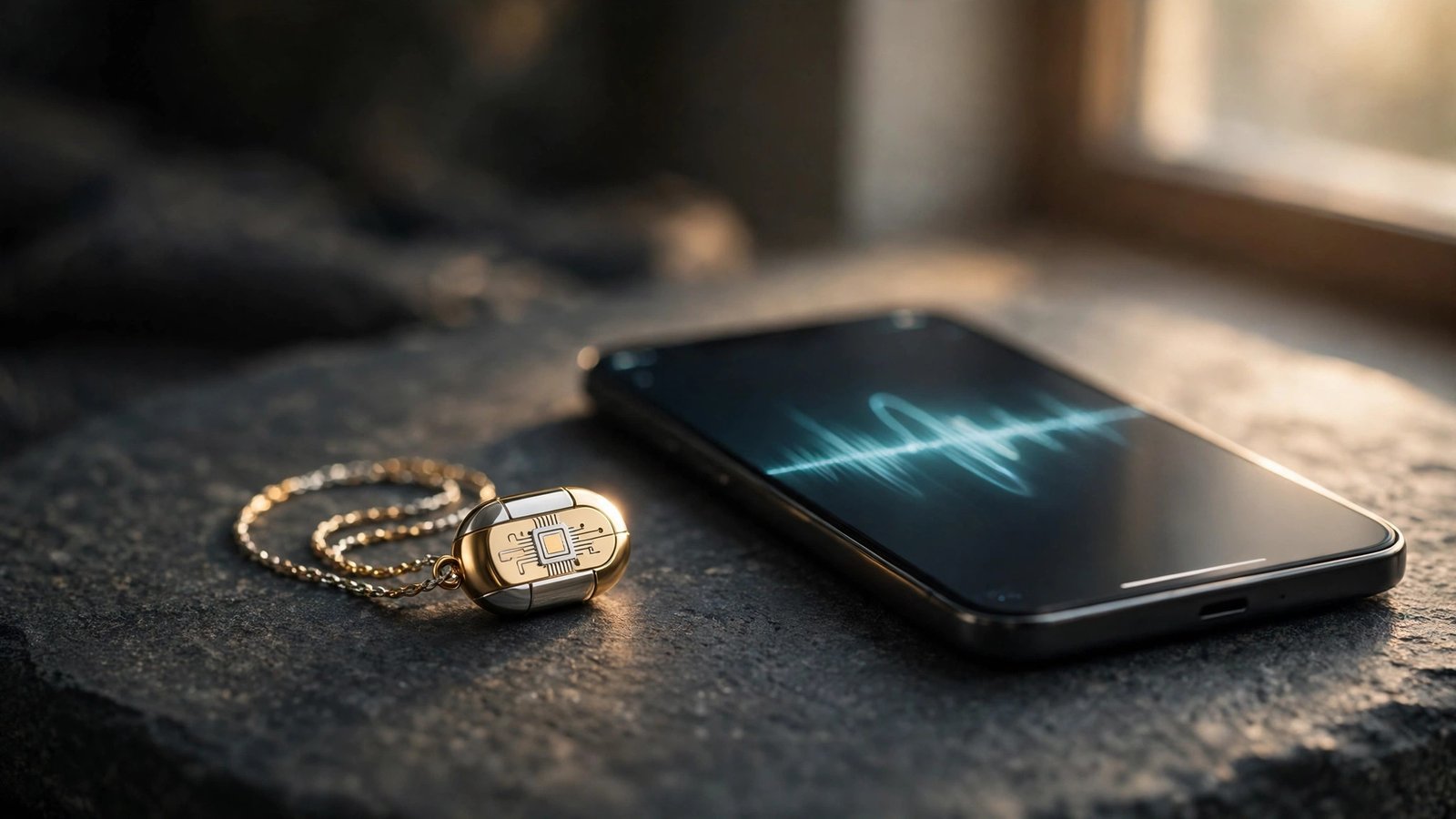
Nirva’s $25 Million Bet: A $249 AI Pendant That Listens Only to You
There is a strange paradox in wearable tech right now. The most interesting devices are the ones that listen to you all day, and that is also what makes people uneasy about them. A new San Francisco startup is trying to thread that needle: Nirva, which just announced a $25 million pre-Series A round, is building a piece of AI jewelry that eavesdrops on exactly one person. You.
What Nirva actually is
The device is a pendant, though you can also wear it as a bracelet. It weighs about eight grams, runs up to three days on a charge, and sits in the jewelry drawer looking like jewelry rather than a gadget. That last point is deliberate. The company was founded in 2025 by Wei Lyu and Jason Chen, both former Meta Reality Labs employees, together with Hanying Hu, who previously started a fashion and jewelry brand. The founding mix tells you the pitch: something you would wear even if it did nothing at all.
Orders open in November, with an expected price of $249 and four finishes: silver, brushed silver, black and gold. The company says early pieces should reach customers before the end of the year.
The listen-to-you twist
Here is where Nirva splits from the rest of the ambient-AI crowd. Most always-on wearables record everything around you, much like a meeting note taker. Nirva says its pendant filters out the people nearby and keeps only the wearer’s voice. During setup you record short snippets of your voice, and the device builds a model of how you sound. Everything that does not match gets dropped.
That design choice is a direct answer to the creepiest question hanging over this category. Ray-Ban Meta glasses put strangers on edge because nobody nearby knows whether they are being recorded. A pendant that ignores everyone except its owner sidesteps that worry in a way a camera never could.
It is not an assistant, it is a mirror
Nirva is not trying to be another voice assistant that books meetings and reads your calendar. Instead, the pitch is closer to a therapeutic journaling tool. The pendant listens through the day, and a companion app reflects back on your life to give you an idea of what shaped your day. With your permission it can also pull in your calendar, location and Apple Health data to round out the picture.
Lyu described the effect to reporters with an anecdote: while dog-sitting for a friend he accidentally closed a door on the puppy’s paw, kept asking if the dog was okay, and quickly spiraled into guilt. He never told Nirva any of this. The app noticed the pattern anyway and pointed out how fast he had slid into self-blame. That is the product in one sentence. It keeps modeling you and modeling your mind, in the CEO’s words.
Audio and transcripts are deleted by default after processing, according to the company’s description of its privacy approach. That matters, because the whole concept collapses if users do not trust what happens to their words.
The money behind it
The new $25 million pre-Series A adds to an $8 million raise from earlier this year, bringing Nirva’s total funding to $33 million. Earlier investors included Lightspeed and South Park Commons. The company says the fresh capital will carry it through launch and help it iterate through the next generations of hardware.
The team is small, roughly 20 people, and it is hiring engineers to build the personal AI jewelry along with product designers and marketers in San Francisco. A lean crew, a shipped-by-Christmas timeline, and a price under $250. That is an aggressive combination for hardware, where delays are the norm.
A crowded listening party
Nirva is not entering an empty room. Ambient AI is having a moment: Amazon launched a new wrist-worn device with its Bee acquisition, Apple introduced Voice Intelligence features during its iPhone launch in September, and a former Plaud executive launched ambient recording apps through a startup called Ambi. Rival pendants and rings like Taya, Vocci and Sandbar Ring are circling similar territory.
Nirva’s bet is that the winning product is not the one that hears the most, but the one that hears the least. A device that passively models only you, sells for $249, and looks like jewelry could find the buyers who like the idea of a life coach but flinch at a microphone that never blinks.
Market research firm Grand View Research reportedly values the global AI wearable market at around $55.7 billion in 2026 and projects it could reach about $310.6 billion by 2033. Those projections should be read with the usual skepticism analysts attach to long-range forecasts, but the direction of travel is clear enough. The question is which form factor wins, and whether enough people trust a listener they did not grow up with.


Post Comment