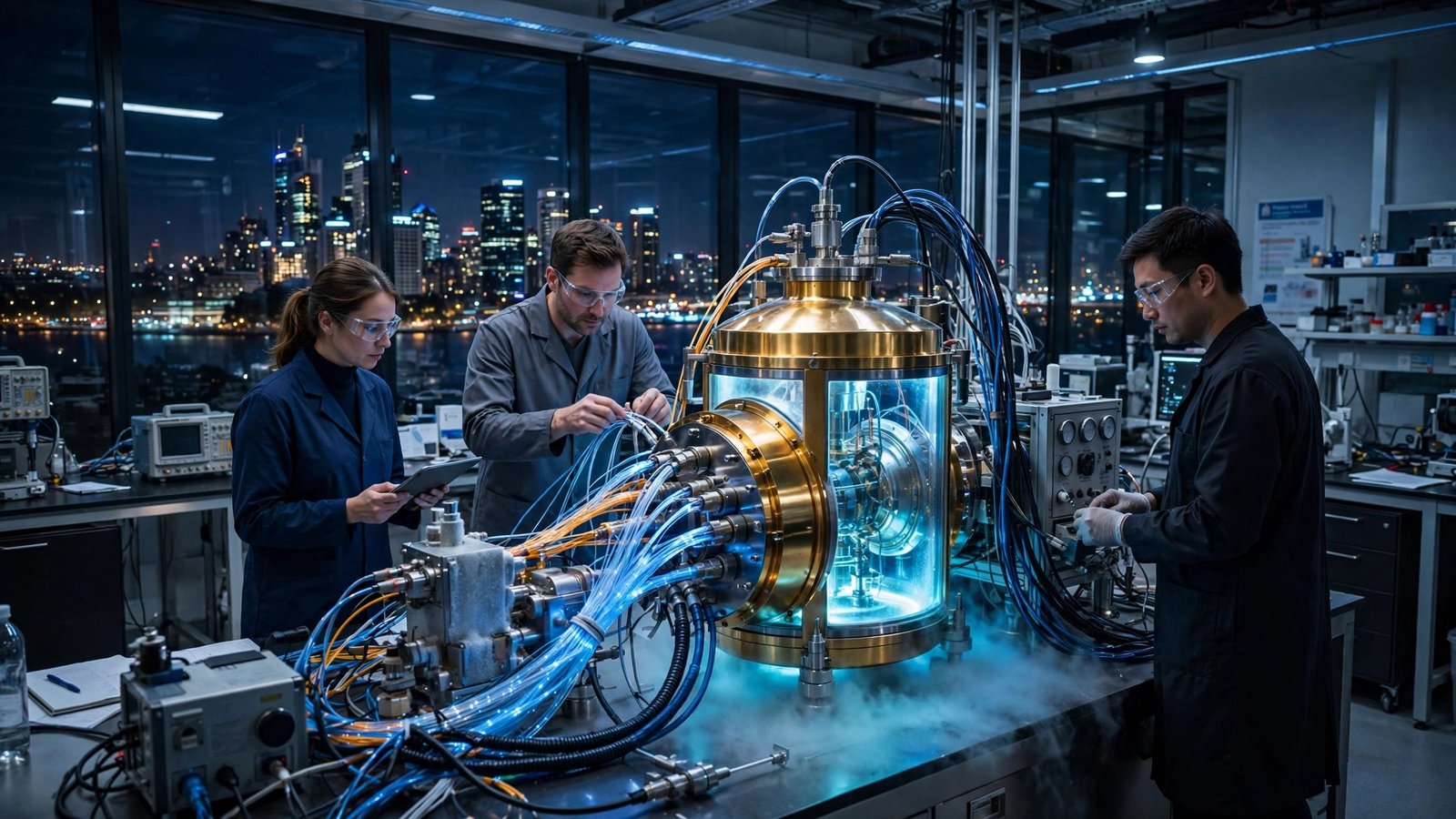
Quantinuum and the University of Western Australia Sign a Quantum Pact
Western Australia has quietly become one of the more interesting places to watch the global quantum race. Perth sits on top of the mines that feed the world's battery supply chains, it hosts a respected quantum research centre, and now it has a new deal with one of the biggest names in quantum computing. Quantinuum, the NASDAQ-listed quantum computing company, has signed a memorandum of understanding with the University of Western Australia (UWA) to bring cloud-based quantum access, hybrid quantum-AI workflows and structured workforce training to the university's researchers, students and startups. Reported in early October 2026, the deal does not involve building a machine on campus. Instead, UWA participants will get cloud access to Quantinuum's full-stack quantum platform, including Helios, the company's latest-generation trapped-ion system. Quantinuum describes Helios as the most accurate commercial quantum computer available when measured by two-qubit gate fidelity, which is the company's own characterization and worth keeping in mind when reading the press around this deal.
What the agreement actually covers
At its core, the MOU is about access. UWA participants will be able to run work on Quantinuum's cloud systems and, just as importantly, test hybrid workflows that combine quantum computing with artificial intelligence and high-performance computing (HPC). That combination reflects where the industry thinks the near-term value of quantum computing sits: not as a standalone replacement for classical computers, but as an accelerant layered on top of existing AI and HPC infrastructure.
Why Western Australia makes sense for this
The sectors named in the deal are telling: critical minerals, energy, agriculture and healthcare. The first of those is the giveaway. Western Australia's economy runs on minerals, and the state holds much of the resource base that feeds global battery and critical-minerals supply chains. Quantum computing's near-term pitch here rests on its potential to model molecular interactions in ore processing and battery chemistry with a fidelity that classical computing cannot match efficiently.
Energy and agriculture round out the picture. Both sectors involve complex optimization and simulation problems, from grid management to crop modeling, where quantum methods could eventually complement AI-driven approaches. Healthcare, the fourth sector, brings the familiar promise of quantum-assisted drug discovery and medical research into the frame.
The talent bet is the bigger story
If the hardware access is the headline, the workforce development side may be the part that matters most. Under the agreement, UWA participants will be able to engage with Quantinuum's Q-Net community and its Startup Partner Programme. That creates a pathway that runs from undergraduate training through to commercial venture development, linking students and researchers directly into Quantinuum's wider quantum ecosystem.
"Through co-design with potential end users and quantum computing hardware providers, this initiative will create new opportunities for UWA researchers, students and industry partners, while strengthening interdisciplinary collaboration across the University. We look forward to exploring all the opportunities this will bring for our researchers as well as student pathways, internships and workforce training initiatives," said Professor Jingbo Wang, founder and Director of UWA's Research Centre for Quantum Information, Simulation and Algorithm, according to reports.
Marvin Lee, Quantinuum's Singapore-based Country Leader, framed the deal as part of Australia's broader quantum push. "Australia has set an ambitious vision for quantum, and it is making meaningful progress toward turning that vision into reality thanks to leadership from institutions like UWA," Lee said. "Together, we are bringing our full suite of capabilities, from world-leading hardware and software to application expertise and ecosystem programs, to develop practical quantum applications and hybrid workflows that will prepare Australia for the quantum era and support the nation's future prosperity."
Petra Andrén, chief executive of Quantum Australia, added that access to strong capabilities both at home and abroad would help translate Australia's research strengths into economic and community benefit.
A playbook Quantinuum is running worldwide
Perth is not an isolated move. Quantinuum operates across multiple geographies, with facilities and partnerships spanning the United States, the United Kingdom, Germany, Japan, Qatar and Singapore. The university-anchor model it is using at UWA matches a pattern visible elsewhere in the company's expansion: each anchor partnership seeds a local talent pool and a government-adjacent network of collaborators, creating optionality for future enterprise and government business.
There is a reason for skepticism built into the structure, too. An MOU is explicitly non-binding, and the applications centre, the definitive agreements and any commercially viable outcomes all remain contingent on factors that have yet to be resolved. According to reports covering the announcement, Quantinuum's own forward-looking disclosures acknowledge this. That is normal for deals at this stage, but it means the MOU is best read as the start of a conversation rather than a finished project.
What to watch next
The harder question this partnership does not yet answer is when hybrid quantum-AI workflows cross from research demonstration to production-grade deployment in the sectors Australia is targeting. That threshold will decide whether the talent and infrastructure being seeded in Perth turns into durable competitive advantage or remains a hedge against a transition that arrives later than hoped.
For now, the concrete next steps are clear: watch for the cloud access to go live for UWA researchers, for the first hybrid quantum-AI-HPC workflows to be published or presented, and for movement on the proposed applications centre. If those milestones land, Western Australia's quiet quantum bet starts looking considerably less quiet.
Frequently Asked Questions
What did Quantinuum and the University of Western Australia agree to?
According to reports, the two signed a memorandum of understanding under which UWA-affiliated researchers, students and entrepreneurs get cloud-based access to Quantinuum's full-stack quantum platform, including its latest-generation Helios trapped-ion system. They will also explore creating a university-wide quantum computing applications centre focused on hybrid quantum, AI and HPC workflows, alongside workforce training through Quantinuum's Q-Net and Startup Partner Programme.
Which industries will the partnership target?
The collaboration names critical minerals, energy, agriculture and healthcare as strategically important sectors for the Australian economy. Critical minerals is the most natural fit for Western Australia given the state's mining and battery-materials industries, where quantum-assisted materials simulation could eventually improve extraction and processing efficiency, though that commercial potential is still being validated.
Is this a binding commercial contract?
No. The agreement is a memorandum of understanding, which is explicitly non-binding. According to reports, Quantinuum's own disclosures note that the applications centre, any definitive agreements and commercially viable outcomes all depend on factors that remain unresolved. It is a starting point for collaboration rather than a finalized commercial commitment.




Post Comment