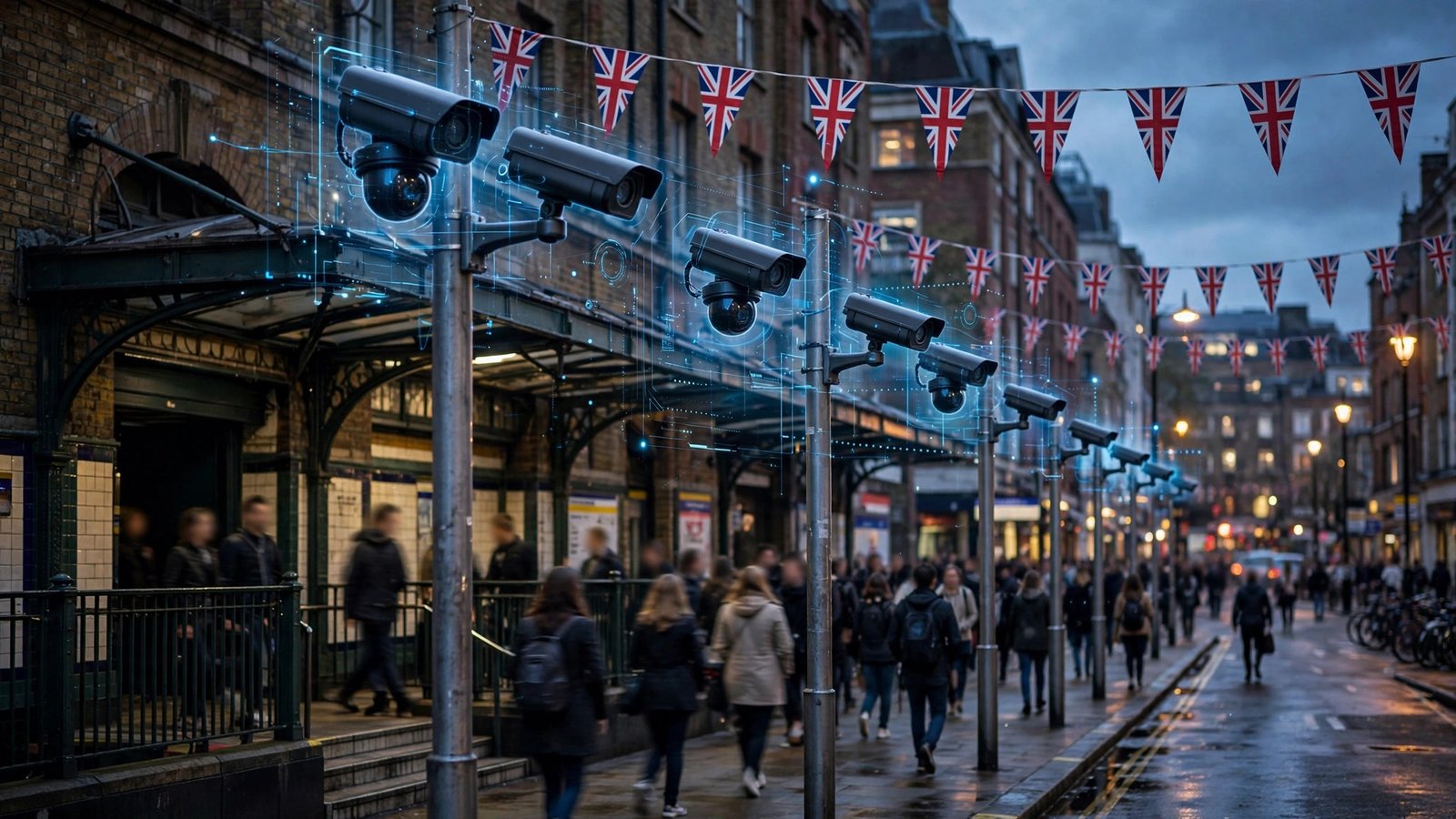
Britain Just Put State Money Behind an AI That Watches Its Cameras in Real Time
Britain’s GBP500 million Sovereign AI Fund has placed its latest bet, and it is not on a chatbot. The state-backed fund says it is investing in Augur, a British startup whose artificial intelligence reads live feeds from cameras and sensors and turns them into a real-time intelligence layer for national security and public safety. The announcement, made on 14 October 2026, shows what “AI sovereignty” looks like when the government stops talking about it and starts writing cheques.
What Augur Actually Does
Most of Britain’s surveillance infrastructure is dumb. A traditional CCTV camera records footage that sits on a hard drive until something goes wrong, and then a human scrolls backwards through hours of video looking for the relevant minute. Augur flips that model: instead of recording for later review, its software analyses what the cameras are seeing while it is happening.
The startup describes its technology as a way to transform fragmented sensor networks into a single real-time intelligence layer. In plain terms, it connects feeds across stations, streets and venues and uses AI to flag developing risks as they unfold, so security teams can respond before an incident rather than after it.
Why the Government Is Writing the Cheque
The Sovereign AI Fund was set up to back domestic AI startups in strategically important areas, and its portfolio reveals the pattern. Alongside Augur, it has invested in the AI infrastructure startup Callosum, the AI designer Olix, and the AI drug discovery company Isomorphic Labs. Its stated focus ranges from AI model development to drug discovery to agentic AI, with national security and economic resilience as the through line.
The fund’s own statement put the reasoning plainly: “We are partnering with Augur because Britain needs this capability and should own it. The infrastructure is already here. The technology that helps keep us safe should be built here too, by a team that has shown that better security and privacy can go together.”
The fund did not disclose the exact size of its investment. Its typical cheques run between GBP5 million and GBP10 million, usually leading or following Seed and Series A rounds. For context, Augur raised $15 million in a seed round led by Plural back in June, so the state money arrives on top of established private backing rather than carrying the company alone.
The Supercomputer Sweetener
Money is only half the deal. The fund also said it is giving Augur access to Isambard-AI, the UK’s most powerful AI supercomputer, which the startup will use to train on large, complex multi-camera datasets.
This reveals how the government thinks about competitive advantage. Compute is the scarcest resource in AI development, and by bundling supercomputer access with its investments, the fund offers something most private investors cannot: the raw processing power to train models that smaller labs could not otherwise afford to build. For video and sensor AI, which needs enormous amounts of training data and compute, that access can be worth as much as the cash.
It also fits the wider national picture. The GBP500 million Sovereign AI initiative was launched to back British AI companies in sectors tied to economic growth and national security, with supercomputer access extended to startups including Cosine and Doubleword. According to reports, Technology Secretary Liz Kendall has framed the strategy as an active effort to keep the benefits of AI inside Britain’s economy rather than watching them drift offshore.
The Privacy Question Nobody Can Dodge
A state fund backing an AI surveillance startup is going to raise eyebrows. Augur’s founders include two former Palantir executives, and live analysis of public space is a technology that privacy campaigners have long watched closely. The fund’s framing, echoed in its statement, is that better security and better privacy can go together: real-time monitoring could mean less indiscriminate recording and fewer hours of stored footage reviewed by humans.
Critics would answer that turning every camera into a decision-making instrument is more intrusive, not less. The timing sharpens the debate: days before this deal, the Law Commission launched a consultation proposing that software and AI systems be treated as products for liability purposes when they cause harm, a sign that Britain is rewriting the rules for who answers when AI fails. Whether Augur’s privacy promise holds will depend on how the technology is governed and audited once it scales beyond transport hubs.
What It Signals for British AI Startups
For founders, the Augur deal is a clear signal about where state capital is flowing. The fund is not chasing consumer apps or viral chatbots. It is targeting infrastructure, security, and sectors where government itself is the ultimate customer or regulator. That is a different risk appetite from the typical venture market, and it creates a second runway for startups whose technology serves public-interest missions but needs years of capital before revenue catches up.
The deeper story is a change in the state’s role. For years, British AI policy was mostly about creating conditions: tax reliefs, research grants, friendly regulation. The Sovereign AI Fund marks a shift toward direct participation, with the government taking equity, offering compute, and picking capabilities it believes the country must own. Augur is simply the latest, and most politically charged, example of that philosophy in action.
Frequently Asked Questions
How much money is the Sovereign AI Fund investing in Augur?
The exact figure was not disclosed. The fund’s typical investments run between GBP5 million and GBP10 million per company, usually at Seed or Series A stage, leading or following private rounds. Augur previously raised $15 million in a seed round led by Plural in June 2026, so the state investment adds to existing private backing.
Is Augur replacing CCTV in Britain?
No. According to the fund and the startup, Augur’s software works with existing cameras and sensors rather than replacing them. The difference is in the analysis: traditional CCTV records footage for later review, while Augur’s AI aims to interpret live feeds in real time so security teams can spot developing risks as they happen. Transport for London is already using the technology.
Which other startups has the Sovereign AI Fund backed?
The fund has invested in the AI infrastructure startup Callosum, the AI designer Olix, and the AI drug discovery company Isomorphic Labs. Its stated investment areas range from AI model development to AI drug discovery to agentic AI, with a focus on capabilities tied to national security and economic growth.




Post Comment