UK Puts £90 Million Into Atlantic Net: Drones, Sensors and AI to Hunt Russian Submarines
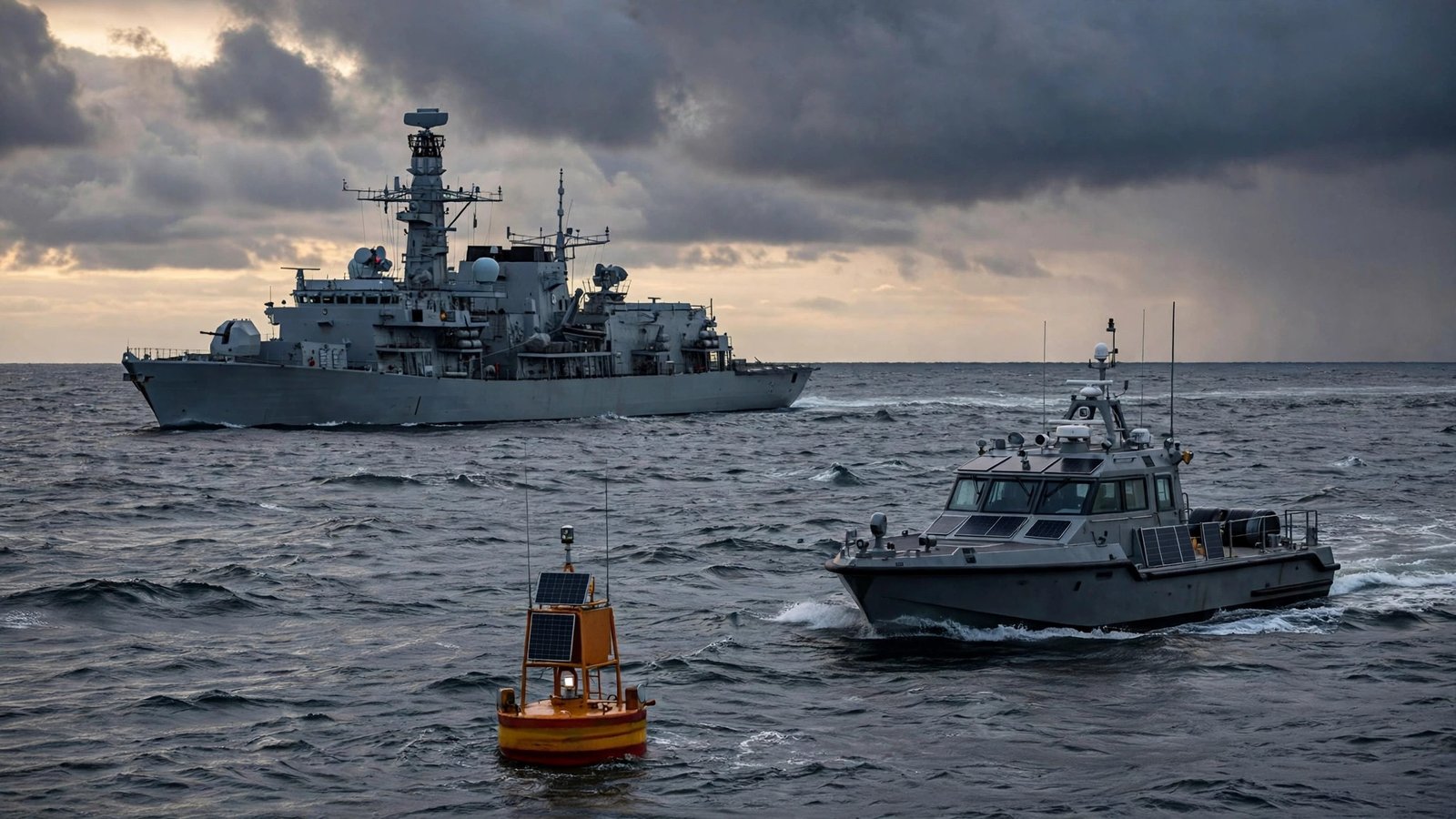
Britain is putting £90 million into a new undersea surveillance network that will use drones, sensors and artificial intelligence to track Russian submarines in the North Atlantic. The programme, called Atlantic Net, was announced on 10 November 2026 and marks the first phase of a wider Royal Navy plan to build a hybrid force of crewed and uncrewed vessels.
The money will pay for autonomous systems operating across one of the most strategically sensitive stretches of ocean in the world, giving the Navy earlier warning of submarine activity and protecting the cables and energy networks on the seabed below.
What is Atlantic Net?
Atlantic Net is a surveillance network designed to watch the North Atlantic around the clock. It will bring together underwater drones, advanced sensors, uncrewed vessels and AI-assisted analysis into a single capability, directed by the Royal Navy.
The framework behind it has been signed with Ocean Infinity Solutions, a British company based in Hampshire. The company will provide the network as a contractor-owned, contractor-operated service, which means it will run the vessels and sensors while the Navy directs the mission. The agreement paves the way for an initial investment of £90 million, worth around $121 million.
Defence Minister Luke Pollard announced the deal at the International Sea Power Conference in Oslo, Norway, aboard the aircraft carrier HMS Prince of Wales. He said the investment would make the UK more secure from Russian undersea threats in the North Atlantic.
Atlantic Net is the first element of Atlantic Bastion, the Royal Navy's wider programme to create a hybrid naval force that mixes crewed ships with uncrewed systems. The programme follows a key recommendation of the government's Strategic Defence Review, which called for the Navy to adopt autonomous technology at a much faster pace.
Why the North Atlantic matters now
The North Atlantic carries some of the most important undersea infrastructure in the world. The cables on its seabed carry most global internet traffic and support financial transactions between continents, while energy networks link the UK with its allies. Damage to any of them could disrupt communications, banking and power supplies.
Western officials have warned that Russia has increased its activity around subsea infrastructure in recent years. In April 2026, Britain said it had deployed military vessels to deter Russian submarines that it said had spent more than a month in and around British waters. At the time, the government warned Moscow that any attempt to damage cables or pipelines would have serious consequences. Russia denied the allegations.
NATO allies have responded by strengthening surveillance of cables and pipelines, and the UK announcement fits into that wider effort. The Greenland-Iceland-UK gap, the stretch of ocean between Greenland, Iceland and the north of Scotland, is an early focus for the new network. It has long been a key route for submarines moving between the Arctic and the Atlantic, and it is one of the hardest areas to watch with crewed ships alone.
How drones, sensors and AI will work together
Atlantic Net combines several types of technology so each covers gaps left by the others. Sonar and other sensors on the seabed and on uncrewed vessels will listen for submarine activity, while drones patrol the surface and the depths. AI-assisted analysis will then pull the sensor data together and flag anything unusual, giving conventional anti-submarine platforms earlier warning of activity beneath the surface.
That mix matters because the ocean is vast and crewed warships are expensive to keep at sea for long periods. Uncrewed systems can stay out longer, cover more water and work in rough conditions, while the AI layer helps a small team of operators make sense of a large flow of data. The result, according to the Ministry of Defence, should be a unified surveillance picture rather than a set of separate sensor feeds.
The announcement also included a separate contract for Saab, which will integrate its lightweight Giraffe 1X radar into the Navy's K3 Scout uncrewed vessels. The radar can detect and track small airborne targets, such as drones, and pass those tracks to another unit. The K3 Scout fleet is used to patrol the UK coastline, so the upgrade adds an air-defence layer to vessels that were built mainly for surface surveillance.
Jobs, industry and the wider programme
The £90 million framework is expected to support almost 200 new skilled jobs at Ocean Infinity Solutions and across its immediate supply chain. The Ministry of Defence said the work builds on the 38,700 jobs in South East England that are directly supported by defence spending with industry.
Most Atlantic Net systems will be delivered by British small and medium-sized firms, and the programme is being developed with industry, the Royal Navy and Commercial X, a unit set up to speed up maritime procurement.
Pollard said the aim was to have Atlantic Net operational from 2027, though the system still needs development, integration and testing, and the ministry has not published a detailed delivery schedule.
What happens next
Work on the first phase will now begin, and the Navy must connect the new autonomous systems with its existing command and surveillance arrangements before the full capability can be judged.
The announcement also signals a direction of travel for the Navy. Atlantic Bastion is a programme, not a single purchase, and Atlantic Net is only its first phase. If it works, more autonomous systems are likely to follow.
For now, the message from London is clear: the seabed has become a front line, and Britain is betting drones, sensors and AI can watch it more constantly than ships and sailors alone.
Frequently Asked Questions
When will Atlantic Net be operational?
Defence Minister Luke Pollard said the aim was to have Atlantic Net operational from 2027. The system still needs to be developed, integrated and tested, so that date is an aim rather than a confirmed entry-into-service date.
Who is building Atlantic Net?
The framework was signed with Ocean Infinity Solutions, a British company based in Hampshire. It will provide the network as a contractor-owned, contractor-operated service, with the Royal Navy directing the mission. Saab is separately supplying radar for the Navy's K3 Scout uncrewed vessels.
Why are undersea cables so important?
Undersea cables carry most global internet traffic and support financial transactions between continents. They also sit alongside energy networks that connect and power the UK and its allies, which is why governments treat damage to them as a serious security risk.





Post Comment