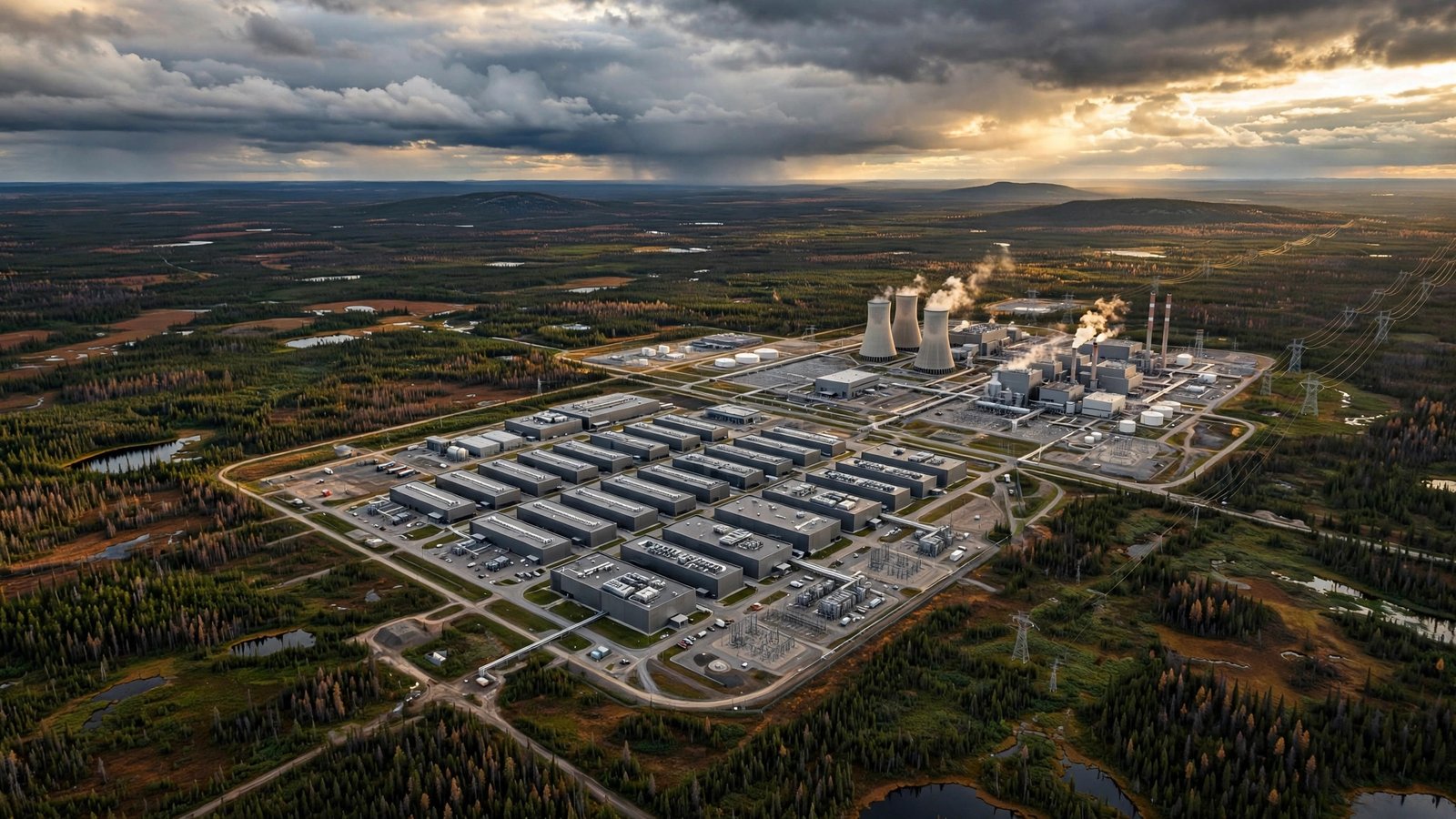
Kevin O’Leary’s $70-Billion Wonder Valley AI Data Centre Could Release Heat Equal to 23 Atomic Bombs a Day, Physicist Warns
A proposed artificial intelligence data centre in northern Alberta would release waste heat carrying roughly the same energy as 23 Hiroshima-sized atomic bombs every single day. That is the conclusion of a preliminary analysis by a Utah State University physicist, and it has turned a little-known infrastructure project into one of the most talked-about energy stories in Canada this month.
The project is called Wonder Valley: a $70-billion data centre park backed by investor Kevin O'Leary and his company, O'Leary Digital, planned for the Municipal District of Greenview, about 42 kilometres south of Grande Prairie. The analysis, reported by CBC News on November 1, 2026, says the site could become the largest single-site heat source on the planet, though the project's backers have not confirmed the claim.
What the analysis actually says
The physicist behind the numbers is Robert Davies of Utah State University. He prepared the analysis for the Sturgeon Lake Cree Nation, working from publicly available information about the project rather than from confidential engineering files. His calculations start with the project's power plan: roughly nine gigawatts of electricity generated on site, mostly from natural gas facilities built for the campus.
Generating that much electricity would require burning fuel at a continuous rate of about 16 to 18 gigawatts. Because the electricity would be used on site to run computing equipment, almost all of that energy would eventually leave the site as heat. Davies put the continuous heat output at roughly 18 gigawatts, day and night, all year. Spread over a full day, that adds up to about 1.5 petajoules of energy, which is where the atomic bomb comparison comes from.
The comparison describes a quantity of energy, not an explosion. A Hiroshima-sized bomb released its energy in a single instant. Wonder Valley would release a similar amount gradually, over 24 hours, as low-grade waste heat from servers and power plants. Davies also estimated the project would emit about 30 million tonnes of carbon dioxide a year, more than 4 per cent of Canada's total emissions. He told CBC the effect on the surrounding landscape "will almost certainly be large, if not extreme", while noting that further modelling would be needed to say how local temperatures, wildlife and ecosystems would be affected.
Why there was no full environmental review
The heat figures landed in the middle of a legal dispute. Alberta's environment department decided on March 31, 2026 that Wonder Valley did not require a provincial environmental impact assessment, on the grounds that the project used standard power and water systems that could be handled through ordinary permits. In September 2026, the Sturgeon Lake Cree Nation filed for a judicial review of that exemption, along with related water decisions, arguing that a project of this scale deserves a full assessment of its combined effects.
Davies made the same point in plainer language. Permits check the parts, he said, while an assessment checks the whole. A project this size is exactly what assessments are for, in his view. In an October 30 statement, Alberta's Ministry of Environment and Protected Areas said it had followed the established legal process in deciding that no assessment was required. The court process is ongoing.
The Nation has also called for a federal review, raising concerns about water, wildlife and consultation on its traditional territory. It commissioned Davies's analysis as part of that challenge, which is important context: a review paid for by one side of a dispute is advocacy research by definition, even from a credentialed scientist. No regulator has published a competing estimate, and O'Leary's side has not confirmed the figures.
The bigger picture: Alberta's data centre rush
Wonder Valley is not an isolated case. Alberta has become one of the hottest spots in North America for data centre development. It has abundant natural gas, low-cost land, the lowest corporate tax rate in Canada at 8 per cent, and the country's only deregulated electricity market, which lets developers contract power directly or build their own generation on site.
A CBRE report published in November 2026 said Alberta is attracting the world's largest hyperscalers for exactly those reasons, and that the province's data centre strategy has already drawn nearly $200 billion in potential private investment. The report pointed to Meta's $13-billion data centre north of Edmonton and Amazon's $4.3-billion campus near Calgary as examples of the scale involved. Federal Budget 2026, tabled on November 5, identified more than 200 data centre projects in the national pipeline and committed to helping Canadian AI companies access 500 megawatts of sovereign computing capacity.
That growth is why the Wonder Valley numbers matter beyond one site. If a single campus can release heat on the scale Davies describes, then the question of how to cool these facilities, and where their waste heat goes, becomes a planning question for the whole province.
What happens next
For now, the Wonder Valley story is a standoff between a striking set of numbers and a court calendar. The judicial review will test whether Alberta was right to skip a full assessment, Ottawa has not said whether it will step in, and the project's backers have not answered the heat estimates. The AI boom has reached a point where its energy footprint can no longer be treated as a footnote.
Frequently Asked Questions
How much heat would the Wonder Valley data centre release?
According to physicist Robert Davies, the project would release heat at a continuous rate of about 18 gigawatts, adding up to roughly 1.5 petajoules of energy per day. That daily total carries about the same energy as 23 Hiroshima-sized atomic bombs, though it would be released gradually as waste heat over 24 hours, not in an explosion.
Why did Alberta not require a full environmental assessment?
Alberta's environment department decided on March 31, 2026 that the project did not need a provincial environmental impact assessment, on the grounds that it used standard power and water systems covered by ordinary permits. The Sturgeon Lake Cree Nation filed for judicial review of that decision in September 2026, and the case is still before the courts.
Is the 23 atomic bombs figure reliable?
The figure comes from a preliminary analysis based on publicly available information, commissioned by the Sturgeon Lake Cree Nation, which is a party to the court case. CBC has clarified that 18 gigawatts is a continuous rate of power. The project's backers have not confirmed the numbers, and no regulator has published a competing estimate, so treat the figure as a serious opening argument rather than a settled finding.





Post Comment