Australia’s New Law Promises Phone Signal Almost Anywhere You Can See the Sky
Australia has passed a law that could change what it means to be out of range. Under the Universal Outdoor Mobile Obligation, Telstra, Optus and TPG Telecom will have to make voice calls and text messages reasonably available outdoors across almost the whole country. The obligation is due to start on 1 December 2027, and the government says it could add basic outdoor coverage across up to five million square kilometres that towers alone cannot reach.
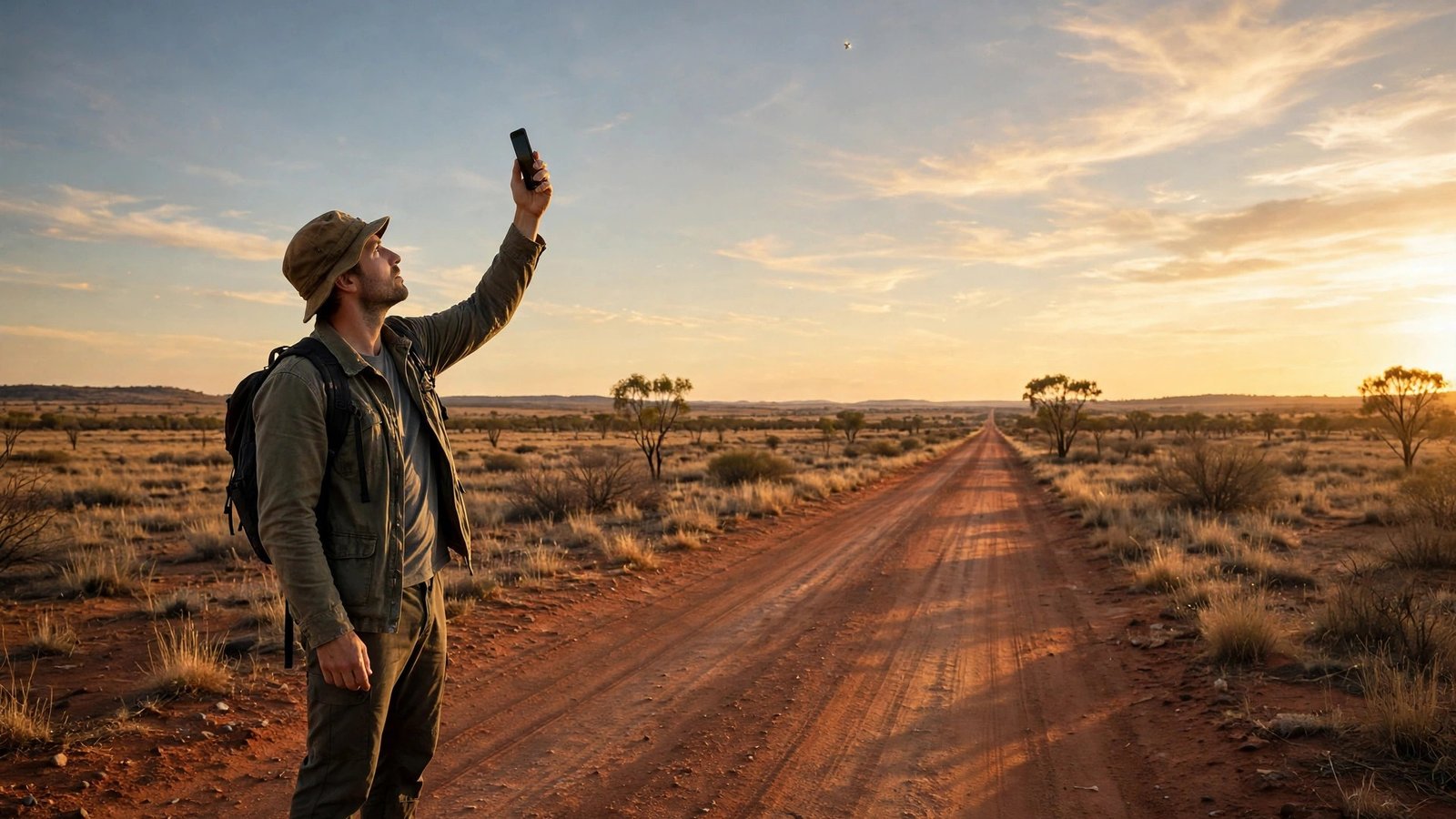
The law is the first of its kind anywhere in the world. It extends the old idea of a universal service, which once meant a landline in every home, into the mobile age. For people in the bush, on remote highways and on farms, it promises something city Australians take for granted: the ability to call for help, or to send a text, wherever they happen to be standing outside.
What the law actually requires
The Telecommunications Legislation Amendment (Universal Outdoor Mobile Obligation) Act 2026 came into force on 27 October 2026. It names Telstra, Optus and TPG Telecom as the three primary providers, since they are the only companies that run their own national mobile networks. From the default start day of 1 December 2027, each of them must ensure that voice calls and SMS are reasonably available outdoors throughout Australia.
The word outdoors matters. The obligation covers open-air locations, and it explicitly excludes the inside of buildings, vehicles, aircraft and vessels, along with underground and underwater areas. In practice, the promise is that if you are standing outside and can see the sky, your phone should be able to make a call or send a text.
The government expects the carriers to meet the obligation by combining their existing land-based towers with direct-to-device satellite technology. Low-Earth-orbit satellites can connect straight to an ordinary handset, without a dish or a special device. Telstra has already extended satellite access from texts to selected low-bandwidth apps, and TPG has demonstrated direct-to-phone SMS, according to industry reporting.
Why the government says it is needed
The case for the law is built on geography. Australia is a huge country with a small population spread across it, and building towers to cover every road, station and remote community was never commercially realistic. Large parts of the country have no mobile coverage at all, and people who live or travel there have learned to plan around dead zones.
That gap becomes a safety issue in an emergency. If a car breaks down on a remote road, or a bushfire changes direction, or someone is injured far from help, a phone with no signal is of little use.
The start date is not set in stone
The most important caveat is that the 1 December 2027 start date can move. The Minister for Communications can bring the date forward, or postpone it by 12 months at a time, up to three times. That means the full obligation could in theory be deferred until 2030 if the minister judges that the market or the technology is not ready.
The law also lets the minister set the detailed standards, benchmarks and rules that the carriers must meet, and gives the minister discretion over coverage areas, costs, funding, whether Triple Zero emergency calling is included, and how faults are fixed. The minister can start the voice and SMS obligations separately if one is ready before the other. A Senate committee that examined the bill took the view that the default date was not feasible for voice services, since the technology and commercial arrangements were outside the operators' control.
What Parliament changed on the way through
The bill passed with amendments secured by the Coalition. First, the law provides for temporary disaster roaming during eligible emergencies, so that customers of one network can use another network when disaster strikes. Second, it requires minimum network performance and reliability standards, informed by an inquiry by the Australian Competition and Consumer Commission. Third, it requires the minister to ask the ACCC to consider domestic mobile roaming more broadly, which could one day let customers roam onto a rival network where their own carrier has no coverage.
On disaster roaming, the Minister for Communications issued a statement on 29 October 2026 finding that the industry's existing arrangements were sufficient, and no disaster roaming determination had been made as at 3 November 2026. The Australian Communications and Media Authority welcomed the new laws on 15 October 2026, and it will be the regulator that enforces the obligation once it starts.
What it means for your phone
For most Australians, nothing will change on the day the obligation starts. People in cities and large towns already have coverage, and the new law does not promise faster speeds or cheaper plans. Its effect will be felt most by the minority of Australians who live, work or travel beyond the reach of the towers.
What to watch next
The next twelve months will decide whether the December 2027 date holds. The minister must set the standards and benchmarks, the ACCC must complete its work on reliability and roaming, and the three carriers must prove that satellite voice works reliably on ordinary handsets.
The government announced on 16 October 2026 that Parliament had passed the law, and the communications minister, Anika Wells, has described it as a world-first reform. The test of that claim will not be the passage of the law but the experience of the first traveller who finds a signal on a road where there was none before. If it slips, the postponement powers mean the delay will be visible and accountable, since each deferral will require a ministerial decision.
Frequently Asked Questions
When does the Universal Outdoor Mobile Obligation start?
The default start day is 1 December 2027. The minister can bring it forward or postpone it by 12 months at a time, up to three times, so the full obligation could start as late as 2030.
Which telcos does the obligation apply to?
It applies to Telstra, Optus and TPG Telecom, the three companies that run their own national mobile networks in Australia. They must ensure that voice calls and SMS are reasonably available outdoors across the country.
Will I get mobile data in remote areas under the new law?
Not as the law stands. The obligation covers voice calls and SMS only. The minister has the power to add new services later, but there is no promise of mobile data in areas beyond the reach of the towers.





Post Comment