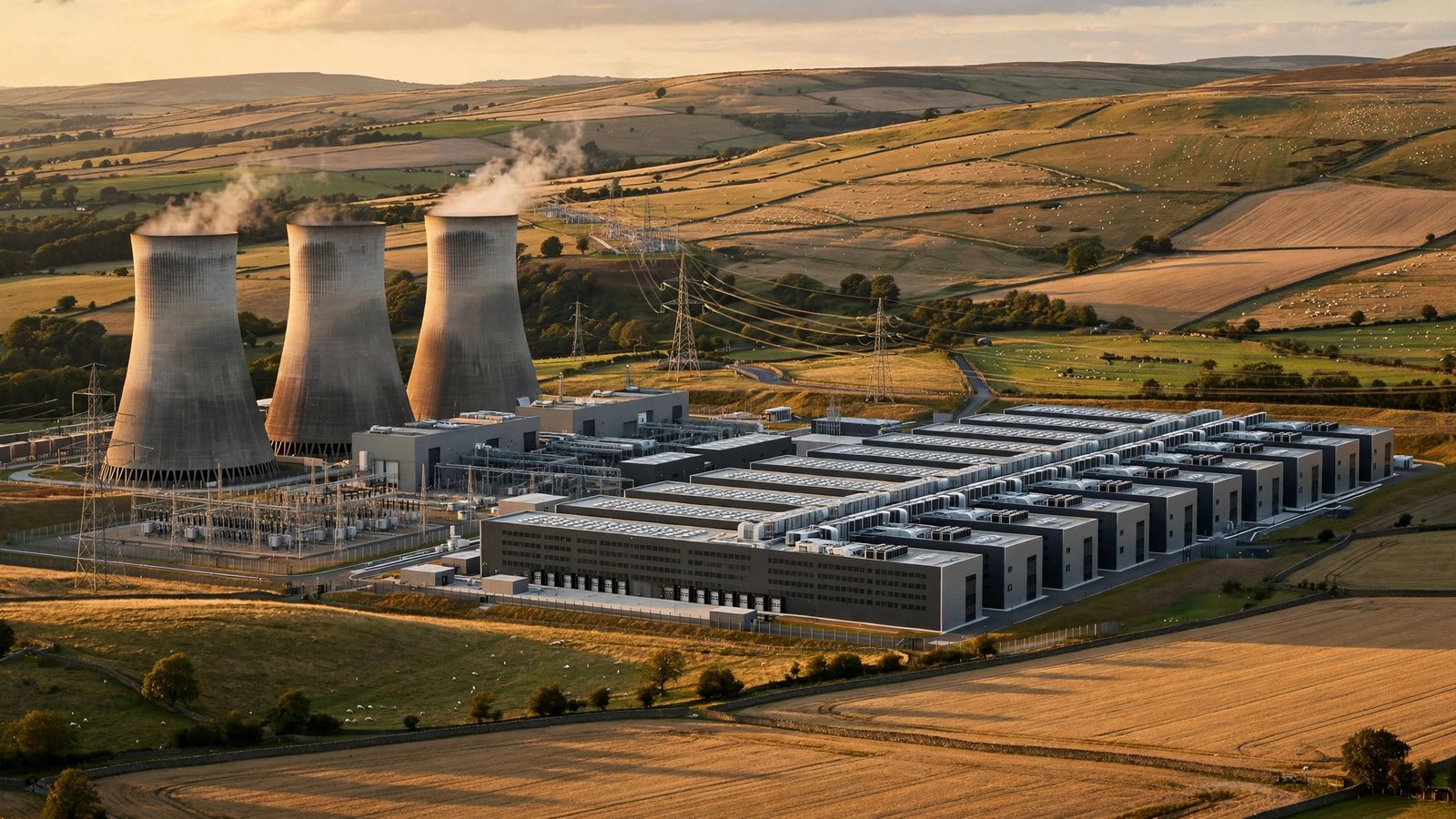
Drax, Brookfield and Radiant Plan a Gigawatt-Scale AI Data Centre in North Yorkshire
A power station in North Yorkshire could become one of the largest homes for artificial intelligence computing in the United Kingdom. Drax Group has signed an agreement to develop a strategic partnership with Brookfield and Radiant, Brookfield’s UK-headquartered AI infrastructure platform, to jointly develop, deliver and operate an AI data centre on the Drax Power Station estate. The announcement was made on 3 November 2026, and it immediately caught the attention of investors, local communities and the wider tech industry.
The headline numbers are large. If built in full, the project could exceed 1 gigawatt of capacity. Brookfield estimates that total potential investment, including semiconductor chips, could exceed £20 billion. The first phase alone is put at around £2.5 billion. Those figures explain why the story moved so quickly, but they need careful reading. The £20 billion figure is a potential total across the whole build, not money already spent. The first phase still needs planning approval, regulatory and network approvals, and a tenant before construction can properly begin.
What the partners have actually agreed
The deal is a strategic partnership, not a finished building. Drax brings the site, its power infrastructure and its experience in energy supply. Brookfield brings investment capital. Radiant, as Brookfield’s UK AI infrastructure platform, is set to lead the design, building and operation of the facility, along with customer engagement. In plain terms, each partner covers the part of the project it knows best.
The site itself is a big part of the story. Drax Power Station sits on an estate of more than 1,000 acres in the north of England, next to one of the country’s largest substations. Drax says the site offers 4 gigawatts of grid access, along with 2.6 gigawatts of dispatchable generation capacity and cooling systems. That combination matters because grid access has become one of the hardest parts of building a large data centre in the UK. Many developers face long waits for a connection. Drax starts from a position where much of the heavy electrical infrastructure is already in place.
A phased build, starting small by data centre standards
The project will be built in phases, with capacity added in line with customer demand. Phase 1 targets up to 100 megawatts of compute capacity, with commercial operations targeted for the first quarter of 2028. Drax says a data centre of that size would already rank among the largest current data centres in the UK, which gives a sense of how fast the scale of AI infrastructure has grown.
Phase 2 carries the ambition to ramp up to an additional 500 megawatts of capacity between 2028 and 2031. Beyond 2031, the partners aim for additional capacity that would take the site past 1 gigawatt in total. That staged approach lets the developers test demand and secure tenants phase by phase.
A planning application for Phase 1 is being prepared, and a public consultation process is expected to start in November 2026. Drax and Brookfield also expect to establish a voluntary community benefits fund, developed in consultation with local communities. Local reaction will matter here, and residents will want clear answers on noise, water use for cooling, and traffic.
Why the market reacted so fast
Shares in Drax reportedly rose by more than 8 percent to around 878p on 3 November 2026, making the company one of the top risers on the FTSE 250 that day. That kind of move shows how investors read the announcement: not just as a property deal, but as a possible new revenue stream for a power company looking for life beyond its traditional generation business.
The next date to watch is 23 November 2026, when Drax holds a Capital Markets Day. Investors expect the company to set out its growth plans through the end of the decade, and the data centre project is likely to feature heavily. Until then, much of the detail remains at the level of ambition rather than signed contracts. No anchor tenant has been named yet, and that tenant will be a key test.
What this means for Yorkshire and for UK AI
If the project goes ahead, Drax says it will preserve hundreds of jobs and create many direct and indirect jobs around the broader Yorkshire area. The partners also frame the project as support for reindustrialisation in Yorkshire and the North, and as a boost to the UK’s sovereign AI capability, meaning the ability to run advanced AI workloads on infrastructure based in this country.
There is a wider context as well. The UK government has talked for years about attracting AI investment, but developers keep running into the same bottleneck: power. A site that can offer gigawatt-scale capacity with an existing grid connection is rare, and that scarcity is part of why this announcement stands out. It also raises a fair question. AI data centres use large amounts of electricity and water for cooling, and critics will ask how that demand sits alongside climate goals and local resources. Drax will need to answer those questions during consultation, with specifics on efficiency and cooling, rather than general promises.
For now, the honest summary is this. Three serious partners have agreed to pursue a very large project on a site with unusual advantages. The first phase is modest compared with the full vision, and it is still subject to approvals and a tenant. The full £20 billion figure depends on chips, later phases and demand that has not yet materialised. But the direction is clear. The UK’s AI race is increasingly a race for power, land and grid connections, and Drax Power Station has just put itself near the front of that race.
Frequently Asked Questions
What have Drax, Brookfield and Radiant agreed to build?
They have signed an agreement to develop a strategic partnership to jointly develop, deliver and operate an AI data centre on the Drax Power Station estate in North Yorkshire. At full build, the project could exceed 1 gigawatt of capacity.
When could the first phase open, and how big would it be?
Phase 1 targets up to 100 megawatts, with commercial operations targeted for the first quarter of 2028. It remains subject to planning, regulatory and network approvals, and to securing a tenant.
How much investment is involved?
Brookfield estimates total potential investment, including semiconductor chips, could exceed £20 billion if the project is built in full. Around £2.5 billion is earmarked for Phase 1. The larger figure is a potential total, not a sum already committed.





Post Comment